




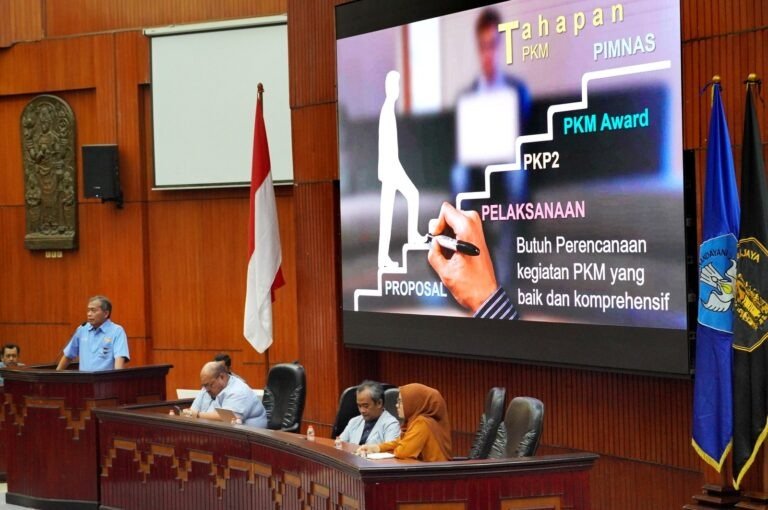
EduAsiaNews, Malang — Universitas Brawijaya (UB) continues to strengthen its strategic efforts in preparing students for the Student Creativity Program (PKM) and the National Student Scientific Week (PIMNAS) 2026. This initiative reflects UB’s long-term commitment to sustaining and enhancing its national achievements—an endeavor that, according to the university, cannot be achieved instantly but requires careful planning, sustainable program design, and structured mentoring from an early stage.
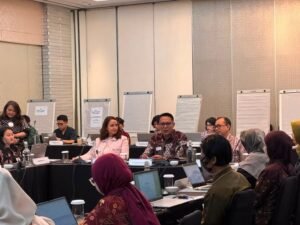
This commitment was manifested through the Workshop on Exploring Creative and Innovative Ideas for PKM Proposal Preparation, held on Tuesday (January 6, 2026) at the Widyaloka Building. The event brought together university leaders in student affairs, senior and junior lecturers from various faculties, as well as students with strong interest and potential in PKM development and PIMNAS preparation.
Vice Rector for Student Affairs, Alumni, and Student Entrepreneurship, Dr. Setiawan Noerdajasakti, S.H., M.H., emphasized that the workshop is part of UB’s broader strategic roadmap to ensure students are well-prepared for PIMNAS 2026. He stressed that national-level achievements cannot be pursued at the last minute but must be systematically programmed and designed from the outset, involving all elements of the university.
Structured Preparation Toward PIMNAS 2026
“Achievements at PIMNAS are not the result of instant work. They are the outcome of a long process that demands consistency, a clear program design, and continuous mentoring. This workshop serves as an initial step to ensure that both students and supervisors share the same vision from an early stage,” Dr. Setiawan explained.
He added that workshop participants were not limited to students with strong interest in PKM and PIMNAS, but also included senior lecturers with extensive experience in mentoring PIMNAS teams, as well as younger lecturers who are being prepared as future supervisors. According to him, cross-generational synergy among lecturers is a key factor in sustaining UB’s national achievements.
Dr. Setiawan further noted that all student-affairs units at UB—including the Research and Innovation Body, the Directorate of Student Affairs, the Talent Development Unit (UPT Pengembangan Talenta), the Subdirectorate of Interests and Talents, and faculty leadership—are fully committed to supporting UB’s targets for PIMNAS 2026.
Encouraging Early Student Engagement
On the same occasion, he highlighted the importance of encouraging students to actively engage in extracurricular and student development activities from the beginning of their academic journey. Through various introductory programs, such as student organization open houses, new students are introduced to platforms that nurture interests and talents, particularly those oriented toward national competitions.
The strong enthusiasm shown by students is considered a valuable asset for UB in generating PKM ideas that are innovative, applicable, and capable of delivering real impact to society.
“PKM is not merely a competition; it is a platform for character building, critical thinking, and innovation. This aligns with UB’s vision as a Research University, where student innovation is an integral part of the campus research ecosystem,” he added.
A Long-Term Roadmap for PKM Excellence
Meanwhile, Head of the Student Talent Development Unit, Prof. Dr. Eng. Abu Bakar Sambah, S.Pi., M.T., explained that the establishment of the unit marks an important milestone in accelerating student achievements at UB. The unit is specifically mandated to manage and develop student achievement programs, including PKM under the coordination of the National Achievement Center (Puspresnas).
According to Prof. Abu Bakar, PKM preparation toward PIMNAS is conducted continuously each year, beginning with post-PIMNAS evaluations and followed by planning for the next cycle. For PIMNAS 2026, preparations have been underway since late 2025 and are scheduled to continue through November 2026.
“The idea exploration workshop is the initial stage of a long series of PKM preparations. Previously, we conducted online sessions for students, followed by hybrid workshops involving around 300 prospective supervisors and student representatives from various faculties,” he explained.
He also highlighted key challenges commonly faced by students in preparing PKM proposals, particularly consistency and time management. Given the lengthy and multi-stage PKM-to-PIMNAS process, UB provides monthly mentoring programs through the PKM Center, supported by the Research and Scientific Writing Student Organization (RKIM).
Targeting a Strong Comeback at PIMNAS 2026
Regarding UB’s target for PIMNAS 2026, Prof. Abu Bakar expressed optimism that the university will rebound and rejoin the national elite. Under the spirit of a “1,000 High-Quality Proposals Initiative,” UB aims to significantly increase the number of funded PKM proposals while achieving top results at PIMNAS.
“With strong synergy among students, lecturers, and the institution, we are optimistic that UB can once again achieve outstanding success at PIMNAS 2026 and maintain its position as one of Indonesia’s leading universities,” he concluded.