




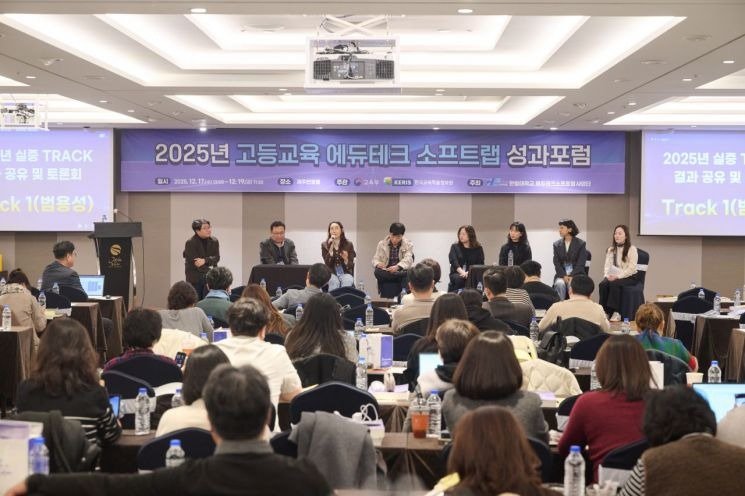
EduAsiaNews, Chuncheon — Hallym University, South Korea, hosted the “2025 Higher Education Edutech Soft Lab Performance Forum”, held over three days from December 17 to 19 at the Jeju Sun Hotel. The forum served as a platform to share achievements and reflect on the development of artificial intelligence (AI)–based educational technology (edutech) in higher education.
Organized by the Hallym University Edutech Soft Lab Project Group, the event was attended by 163 participants from 40 universities, 12 related institutions, and 11 edutech companies involved in demonstration projects across South Korea. Participants presented the results of edutech pilot implementations at their respective campuses and discussed strategies to expand and strengthen learning innovation in the future.
The forum opened with remarks by Ko Youngwoong, Director of the Hallym University Edutech Soft Lab Project Group, followed by a welcoming address from Choi Yanghee, President of Hallym University, and congratulatory remarks by Jeong Jeyoung, President of the Korea Education and Research Information Service (KERIS). The agenda continued with presentations and discussions on the results of the 2025 AI courseware demonstrations across three tracks, presentations on research outcomes of the Edutech Soft Lab project, and an outline of plans for the establishment and operation of the Edutech Soft Lab in 2026.
In his address, Choi Yanghee described the forum as an important opportunity to evaluate the achievements of the second year of the Edutech Soft Lab project while outlining directions for its future development. He also announced that the university consortium participating in the project would be launched under a new name, KELI (K-University AI Edutech & Learning Initiative).
“Through KELI, we aim to jointly build and share the K-University model while providing students with more personalized learning experiences,” Choi said. According to him, the structured adoption of AI is expected to drive innovation in higher education and help establish a sustainable learning ecosystem.
Meanwhile, Ko Youngwoong explained that from 2024 to 2025, AI courseware had been implemented in the curricula of 24 participating universities. The initiative involved 56 courses, 69 instructors, and 2,285 students, with results indicating improvements in academic performance and students’ AI literacy.
In the third year of the project, scheduled for 2026, the number of participating universities is targeted to increase to 50 institutions. Development efforts will focus on AI courseware that can be jointly utilized across universities, thereby promoting the standardization of innovative edutech models in higher education.
“These efforts are expected to lay the groundwork for the adoption of edutech not only domestically but also at the international level,” Ko said.
For reference, the Higher Education Edutech Soft Lab Establishment and Operation Project is a national program under the supervision of the Ministry of Education of South Korea, with support from KERIS. The program is designed to foster collaboration between higher education institutions and edutech companies in developing learning technologies relevant to public education. (**)