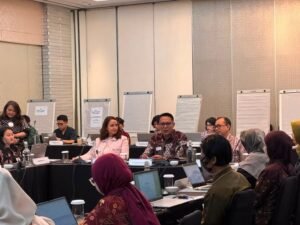





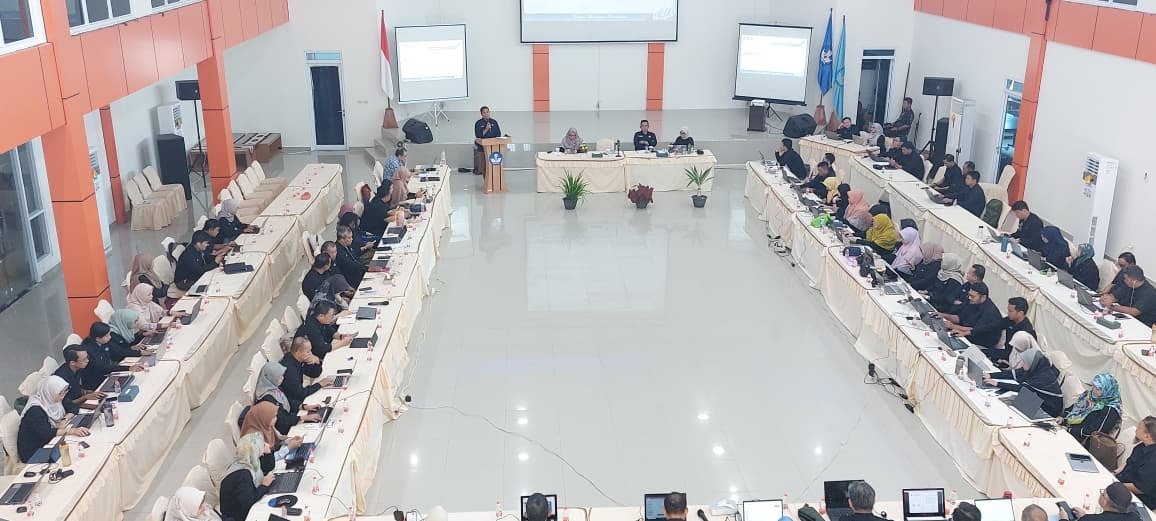
Edu Asia New,Bangka, UBB — As part of accountability and evaluation of the implementation of its work plan, Universitas Bangka Belitung (UBB) held a Coordination Meeting for the Evaluation of the 2025 Fiscal Year. The event took place at the Education Quality Assurance Hall (BPMP) of Bangka Belitung Province on Thursday, 18 December 2025.
This activity aimed to enhance the academic community’s understanding of the application of legal risk mitigation principles in managing state universities with Public Service Agency (BLU) status.
The event was officially opened by the Rector of Universitas Siliwangi, Prof. Dr. Ir. Nundang Busaeri, M.T., IPU., ASEAN Eng., and attended by the Chair of the Senate, Vice Rectors, Head of SPI, Deans, Director of the Postgraduate Program, Heads of Institutes and Bureaus, and Heads of Academic Implementation Units (UPA).
In his remarks, the Rector emphasized that awareness of potential legal risks is a key component of strengthening transparent and accountable university governance.
“As a university with BLU status, Universitas Siliwangi must adopt strategic measures to map and anticipate legal risks, ensuring that all activities and policies comply with regulations,” he stated.
The Head of SPI Universitas Siliwangi, Dr. H. Acep Zoni Saeful Mubarok, M.Ag., CRA., CRP., CLA., CIAP., reported that this activity is part of SPI’s work program to strengthen internal oversight, particularly in legal compliance and risk management within the university.
The workshop featured a speaker from the Financial and Development Supervisory Agency (BPKP) of West Java Province, Mr. Syarwan, Ak., who delivered a comprehensive presentation on Legal Risk Mitigation in BLU management and the concepts and processes of risk management in higher education institutions.
He explained that legal risk refers to the potential for juridical loss arising from an organization’s inability to manage policies or respond to claims from third parties. Such risks may take the form of civil lawsuits, administrative litigation, criminal violations, or misuse of assets and budgets.
Furthermore, the speaker emphasized the importance of applying ISO 31000 Risk Management principles, in which legal considerations are integrated into the organization’s risk management framework. Legal risks in BLU operations may arise from non-compliance with laws and regulations, procurement processes, budget management, and the execution of education, research, and community service programs.
The workshop also introduced risk management concepts based on the Government Internal Control System (SPIP) and Universitas Siliwangi Rector Regulation No. 2 of 2024, highlighting that risk management involves planned and measured activities to identify, manage, and control risks that could threaten the achievement of organizational objectives.
In addition, strategies for preventing fraud were discussed using the KPK’s Trisula Prevention approach—prevention, education, and enforcement—alongside BPKP’s risk control strategies: prevent, detect, and respond.
The session concluded with an overview of eight high-risk areas for corruption in local government and higher education institutions, including planning, budgeting, procurement, public services, internal supervision (APIP), civil servant management, asset management, and revenue optimization. These areas are considered primary targets for legal risk mitigation and strengthening university governance.
Through this activity, SPI Universitas Siliwangi aims to provide participants with a comprehensive understanding of the importance of continuously applying legal risk management as part of good university governance.