




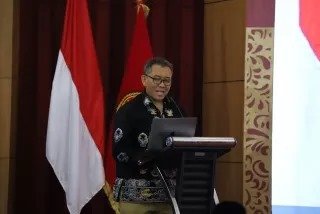
Edu Asia New,Humas UPNVJ – Prof. Dr. Cecep Darmawan, Professor of Political Science at Universitas Pendidikan Indonesia, who also serves as the Principal Maheswara of the Agency for Pancasila Ideology Development of the Republic of Indonesia (BPIP RI) and the Senior Advisor for National Defense at the National Resilience Council of the Republic of Indonesia, delivered a presentation on the transformation of non-military–based national defense to realize Indonesia Emas 2045.
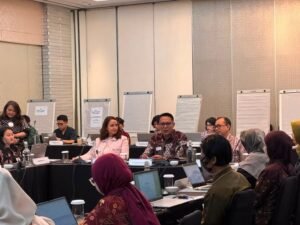
The presentation was delivered at a National Symposium organized by Universitas Pembangunan Nasional “Veteran” Jakarta (UPNVJ) in collaboration with the Indonesian National Defense Movement, held on 20 December 2025.
On this occasion, Prof. Cecep emphasized a paradigm shift in national defense from a conventional military approach toward active public participation in addressing multidimensional threats. The objective is to strengthen national resilience through education, public ethics, and cross-sectoral collaboration.
Prof. Cecep highlighted the urgency of national defense as the determination of citizens to safeguard sovereignty, territorial integrity, and national security. He cited Article 27 paragraph (3) and Article 30 paragraph (1) of the 1945 Constitution of the Republic of Indonesia, which mandate public participation in national defense. According to him, the new paradigm of national defense focuses on non-military threats—such as ideological, economic, socio-cultural, and cyber threats—rather than solely on military challenges.
In his presentation, Prof. Cecep outlined forms of national defense as stipulated in Law Number 23 of 2019 on the Management of National Resources for State Defense. These include civic education, compulsory basic military training, voluntary or compulsory service as Indonesian National Armed Forces (TNI) personnel, and service in accordance with one’s profession. The core values of national defense encompass love for the homeland, awareness of nationhood and statehood, loyalty to Pancasila, willingness to sacrifice, and basic national defense capabilities.
He also discussed hybrid threats that combine military and non-military elements, such as terrorism, separatism, natural disasters, drug abuse, and nuclear or biological threats. Citing Jerry Indrawan (2016), he explained that non-military threats span ideological, political, economic, socio-cultural, technological, and public safety dimensions. He further emphasized the concepts of soft power, hard power, and smart power introduced by Joseph S. Nye as strategic approaches to addressing such threats.
Efforts to strengthen the transformation of national defense include the reorientation of education toward active citizenship, the mainstreaming of national defense in national development, the reinforcement of Pancasila ideological resilience, digital literacy, the revitalization of public ethics, and the development of a collaborative pentahelix ecosystem involving government, academia, business, communities, and the media. These elements are expected to support the vision of Indonesia Emas 2045 as a unified, sovereign, advanced, and sustainable nation.
Meanwhile, Prof. Dr. Anter Venus, M.A., Comm., Rector of Universitas Pembangunan Nasional “Veteran” Jakarta, affirmed UPNVJ’s commitment to producing leaders with integrity. “This symposium aligns with UPNVJ’s vision as a National Defense Campus. We will integrate the transformation of national defense into the curriculum, research, and community service to strengthen national resilience, in line with Pancasila-based education policies and our record of excellence,” he stated.(www.upnvj.ac.id)