




EduAsiaNews, Jember – The protection of indigenous peoples’ living spaces in Indonesia continues to face significant challenges.
In many cases, indigenous communities’ right to participate in safeguarding their environmental management areas is perceived as opposition to development initiatives. This critical issue has prompted concern and a thoughtful response from the academic community at the University of Jember (UNEJ).
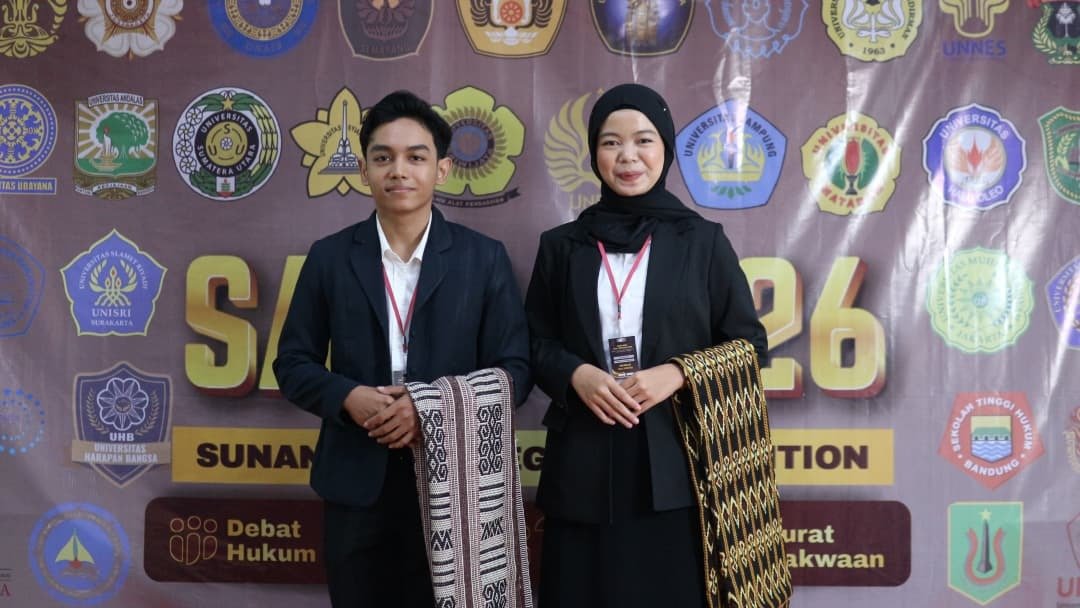
Pradipta Noor Adiningsih and Renhaddwi Mahadana Satya, two students from the Faculty of Law (FH) at UNEJ, have demonstrated a deep commitment to addressing this issue. Through comprehensive legal research, they advocate for a proactive legal framework that goes beyond passive law enforcement by providing preventive protection for indigenous peoples who frequently face intimidation while defending their environmental rights.
In response to these challenges, Pradipta and Renhaddwi propose integrating the concepts of Eco-Consent and Anti-SLAPP as complementary legal instruments that offer both preventive and repressive protection.
Eco-Consent functions as a preventive mechanism to ensure that indigenous peoples have the full right to be informed, carefully consider, and freely grant or withhold their consent before any project or policy with potential environmental impacts is implemented. Meanwhile, Anti-SLAPP (Strategic Lawsuit Against Public Participation) serves as a repressive legal safeguard, protecting communities and environmental advocates from intimidation or retaliatory lawsuits initiated by corporations or authorities solely because they exercise their right to defend a healthy environment.
“We want to demonstrate that protection for indigenous peoples should not begin only after conflicts have emerged. It must start from the decision-making process through meaningful participation and be reinforced by legal protection mechanisms whenever the rights of indigenous communities are threatened,” Pradipta explained.
For the two students, social awareness must ultimately lead to tangible solutions. Their objective extends beyond academic writing to promoting a legal system that genuinely responds to the realities faced by society.
“We understood that SALC is one of the most competitive national legal competitions. Therefore, our primary goal was not simply to achieve a high ranking but to produce our best work by offering practical solutions to real-world legal issues. Being recognized as the recipient of the Best Paper Award was truly beyond our expectations, and we are deeply grateful for the achievement,” he added.
Their progressive proposal on strengthening legal protection for indigenous peoples ultimately earned them national recognition. Through their legal essay, the UNEJ Faculty of Law team secured a place among the Top Three National Winners while also receiving the Best Paper Award at the Sunan Ampel Legal Competition (SALC) 2026. Organized by the Faculty of Sharia and Law at UIN Sunan Ampel Surabaya, the prestigious competition brought together 64 of the country’s best law student teams from universities across Indonesia.
This accomplishment reflects the quality of UNEJ Faculty of Law students, who remain highly responsive to humanitarian and agrarian issues. Notably, the achievement was also the result of perseverance, as the team had previously fallen short in the Legal Opinion category during the previous edition of SALC.
“When registration for SALC 2026 opened, we saw an opportunity to adopt a different approach. We were particularly interested in the subtheme concerning the protection of indigenous peoples in environmental governance, which allowed us to further develop an idea we had previously discussed together under the guidance of our academic supervisor,” Pradipta said.
Reflecting on the experience, Pradipta emphasized the essential role of law students in society.
“This competition taught us that the law must genuinely serve to protect the people. It should not merely function as an instrument to provide legal certainty for development but must also ensure protection for communities affected by that development,” he stated.
In closing, he encouraged all UNEJ students to confidently express their ideas through writing and to embrace failure as part of the learning process.
“Don’t wait until you feel completely ready before you start writing. By taking the first step, we learn and grow. Choose issues you genuinely understand, read extensively, sharpen your critical thinking skills, and never be afraid of failure. We also experienced numerous setbacks before reaching this point. The most important thing is to keep trying and never stop learning,” he concluded.