




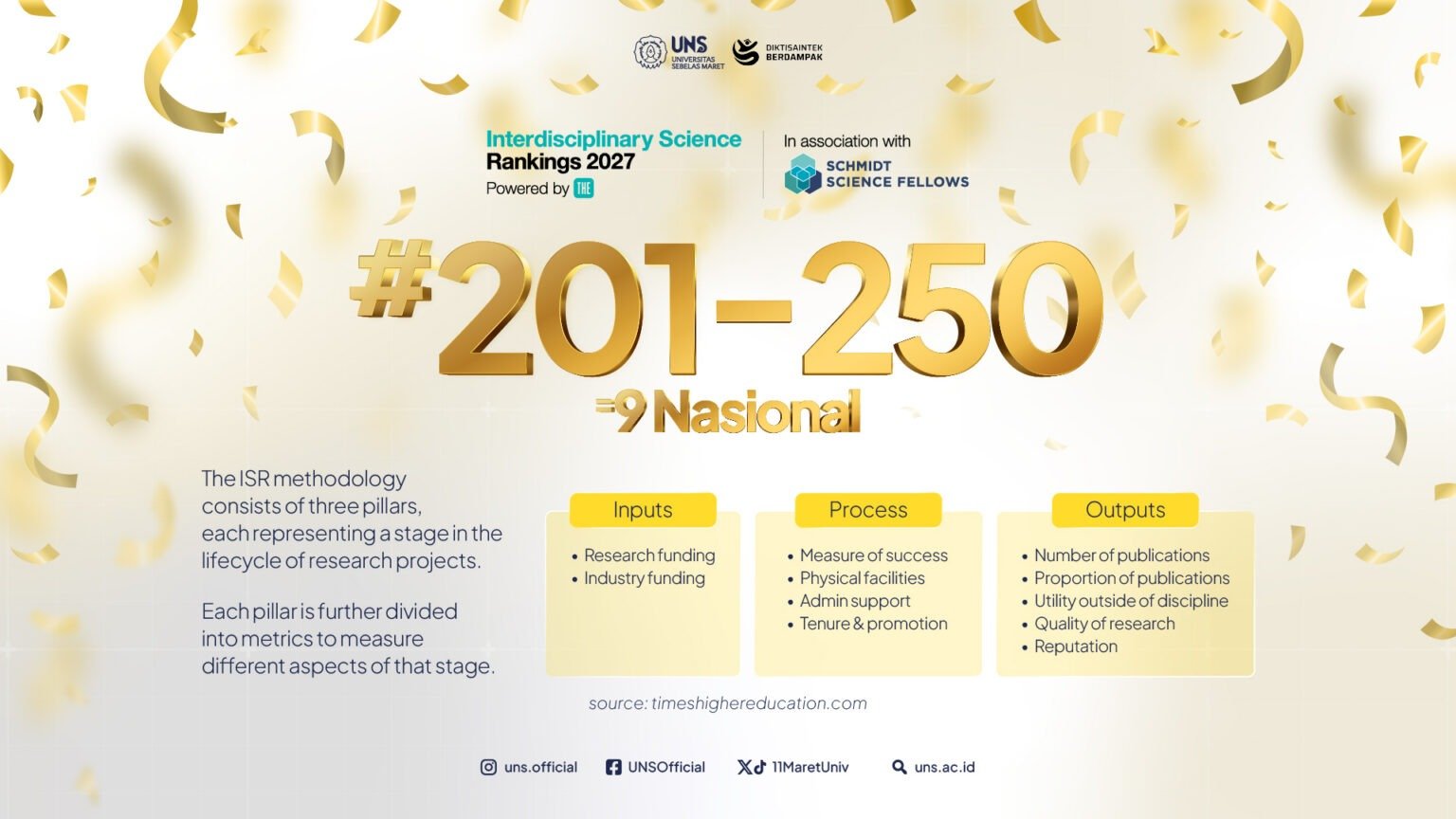
EduAsiaNews, Surakarta Central Java – Sebelas Maret University (UNS) in Surakarta has been ranked in the 201-250 band globally in the Times Higher Education (THE) Interdisciplinary Science Rankings (ISR) 2027. THE announced the results on Wednesday.
UNS rector Hartono expressed appreciation and thanks to the entire academic community for its support, hard work and contributions to developing interdisciplinary research. He said the achievement motivates the university to keep improving the quality and impact of its research through cross-disciplinary collaboration.
“This achievement is the result of the joint work of the entire UNS academic community. We thank everyone for their commitment and contributions in driving research that is innovative, collaborative and brings real benefits to society. Going forward, UNS will keep strengthening its interdisciplinary research ecosystem so that it can produce solutions to various challenges at national and global levels,” Hartono said on Thursday.
The THE Interdisciplinary Science Rankings were developed by THE to assess the commitment, institutional support, processes and achievements of universities in interdisciplinary research. The rankings highlight the importance of collaboration among disciplines in producing research that can address complex problems and offer solutions to society.
In the 2027 edition, interdisciplinary science covers research that integrates at least two science disciplines, two different topics within one science field drawn from different subjects under THE’s classification, or a combination of a science discipline with certain social science disciplines or the clinical and health field (excluding translational medicine). Research that combines only social science disciplines or health fields without involving a science discipline falls outside the scope of the rankings.
This year’s edition covers 1,058 institutions from 102 countries and territories, up from 911 institutions from 94 countries and territories in the 2026 edition. The expanded coverage shows growing participation by universities worldwide in developing and strengthening interdisciplinary research.
The rankings use 11 indicators grouped into three pillars: inputs, process and outputs, weighted at 19 percent, 16 percent and 65 percent respectively.
The inputs pillar assesses funding support for interdisciplinary science research. It has two indicators: the share of interdisciplinary science research funding in total science research funding (8 percent) and industry funding in science, normalized by the number of academic and research staff in the sciences (11 percent).
The process pillar, worth 16 percent overall, assesses institutional support for developing interdisciplinary research. It covers four indicators, each weighted at 4 percent: institutional success, physical facilities, administrative support, and promotion and career-track systems. The assessment considers the availability of evidence, how specific policies are and whether information is publicly accessible.
The outputs pillar carries the largest weight, at 65 percent, and has five indicators: the number of interdisciplinary science publications (10 percent), the proportion of such publications (5 percent), the utility of research beyond its home discipline (5 percent), the quality of interdisciplinary science research (20 percent) and university reputation (25 percent).
For the publication count, the assessment uses the number of interdisciplinary science publications normalized by the square root of the total academic and research staff in the sciences. The proportion indicator measures interdisciplinary science publications against total science publications. The utility of research indicator gauges the influence of interdisciplinary science research on other disciplines through analysis of cross-disciplinary citation links, using the 75th percentile of the C-score, which shows how interdisciplinary the citation links between publications are.
Research quality is assessed using the 75th percentile of the field-weighted citation impact (FWCI), a citation impact measure adjusted for field of study. Reputation is measured through a survey of active researchers, who are asked to name up to five of the world’s best institutions supporting interdisciplinary science research.
The methodology therefore measures not only the productivity and quality of scientific publications but also funding support, institutional readiness, the cross-disciplinary impact of research and universities’ reputation in developing interdisciplinary research.