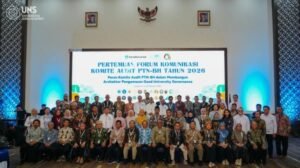




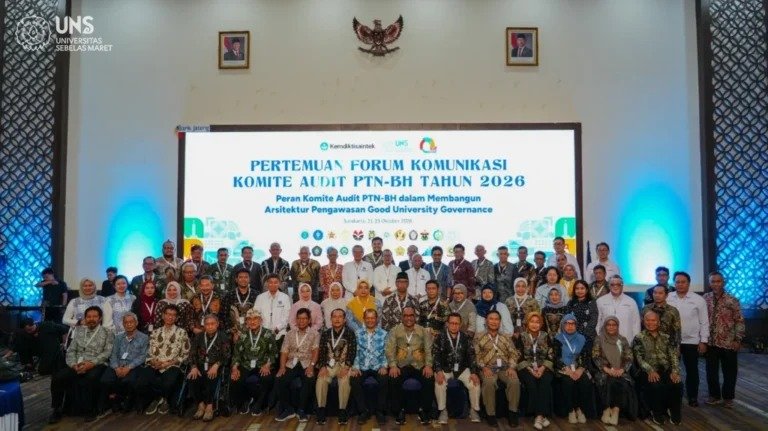
EduAsiaNews, Surakarta — Universitas Sebelas Maret (UNS) Surakarta hosted the Communication Forum of Audit Committees of State Universities with Legal Entity Status (FKKA PTNBH) at the Ki Hadjar Dewantara Building, UNS Tower, in Surakarta on Thursday, Oct. 22, 2026. The forum provided a platform for audit committee members from state universities with legal entity status across Indonesia to exchange experiences, share best practices and formulate strategies to strengthen professional, ethical, transparent and accountable university governance.
In his opening remarks, UNS Rector Prof. Dr. Hartono, dr., M.Si., said the growing number of institutions with PTNBH status reflected the strengthening of autonomy and independence among Indonesian universities. Autonomy gives universities greater flexibility to develop their potential, manage resources, encourage innovation and respond adaptively to changes in higher education.
However, the rector emphasized that autonomy was not an end in itself, but rather a means of improving university performance, quality and impact on society. The broader the authority granted to an institution, the greater its responsibility. Therefore, flexibility in decision-making must be balanced with integrity, transparency, prudence and accountability through the implementation of Good University Governance (GUG).
“Universities are not only expected to make decisions quickly but also to ensure that the process is appropriate, based on adequate data, supported by proportionate risk mitigation, and accountable to all stakeholders,” Prof. Hartono stressed.
He added that audit committees played a strategic role in strengthening internal control systems, optimizing risk management and ensuring that resource allocation aligned with institutional visions. This oversight function has become increasingly crucial amid the complexity of modern university governance, from asset management and funding diversification to accelerated digital transformation.
Forum Communication Committee Chair Prof. Dr. Bahrullah Akbar, M.B.A., CIPM, CA, CPA, CSFA, CFrA, CGCAE, QGIA, CertDA, explained that the FKKA PTNBH meeting series ran for three days, from Oct. 21 to 23, 2026. The forum provided an important opportunity to reflect on and strengthen audit committees’ oversight functions in supporting the supervisory responsibilities of university boards of trustees, known as Majelis Wali Amanat (MWA).
According to Prof. Bahrullah, the forum had held six meetings and now encompassed 23 PTNBH institutions across Indonesia. Differences in legal frameworks and institutional characteristics presented a challenge in developing oversight standards that were both adaptable and applicable across universities.
The discussions focused on nonacademic oversight, performance audits, accountability for various university funding sources and remuneration policies.
“We hope the plenary session following the commission discussions will produce concrete work programs, including regular online meetings and the development of strategic guidelines to support oversight at each university,” Prof. Bahrullah said.
On the same occasion, UNS Board of Trustees Chair Prof. Muliaman Darmansyah Hadad, Ph.D., reminded participants that PTNBH status offered more than the freedom to manage budgets independently. It also entailed a social responsibility to educate the nation. Financial independence and institutional governance, he stressed, must remain aligned with the fundamental mission of education.
Prof. Muliaman identified four major governance challenges facing PTNBH institutions: maintaining integrity amid extensive autonomy; balancing academic missions with demands for financial independence; mitigating data security risks and ethical concerns surrounding the use of artificial intelligence (AI); and meeting internationally recognized standards of world-class governance.
“World-class reputation cannot be measured solely by international rankings or publication productivity. A foundation of clean, transparent and integrity-driven governance is essential to maintaining legitimacy and public trust,” Prof. Muliaman emphasized.
The event continued with a keynote address by Drs. Fathan Subkhi, M.A.P., CIISA, CSFA, a member of Audit Board of Indonesia (BPK RI) Commission VI and head of State Financial Audit VI.
The national seminar featured several experts: Prof. Dr. Cris Kuntadi, S.E., M.M., from the Audit Committee and Risk Management functions at Bandung Institute of Technology (ITB); Prof. Dr. Hartono, dr., M.Si., UNS rector; and Prof. Dr. Mardiasmo, Akt., M.B.A., chair of the Indonesian Governance Committee.
The meeting concluded with commission sessions divided into three working groups: PTNBH leadership models and innovation; financial governance and quality assurance; and the development of an audit committee oversight framework.
The outcomes of each commission were subsequently consolidated in a plenary session to formulate joint recommendations for strengthening the governance of state universities with legal entity status across Indonesia.
UNS Public Relations