




EduAsiaNews, Depok – As the adoption of electric vehicles (EVs) continues to increase across Indonesia, the demand for Public Electric Vehicle Charging Stations (SPKLU) has grown accordingly. Determining optimal locations for these charging stations has become a critical challenge to ensure that charging infrastructure keeps pace with the rapid growth of electric vehicles while meeting the needs of the public.
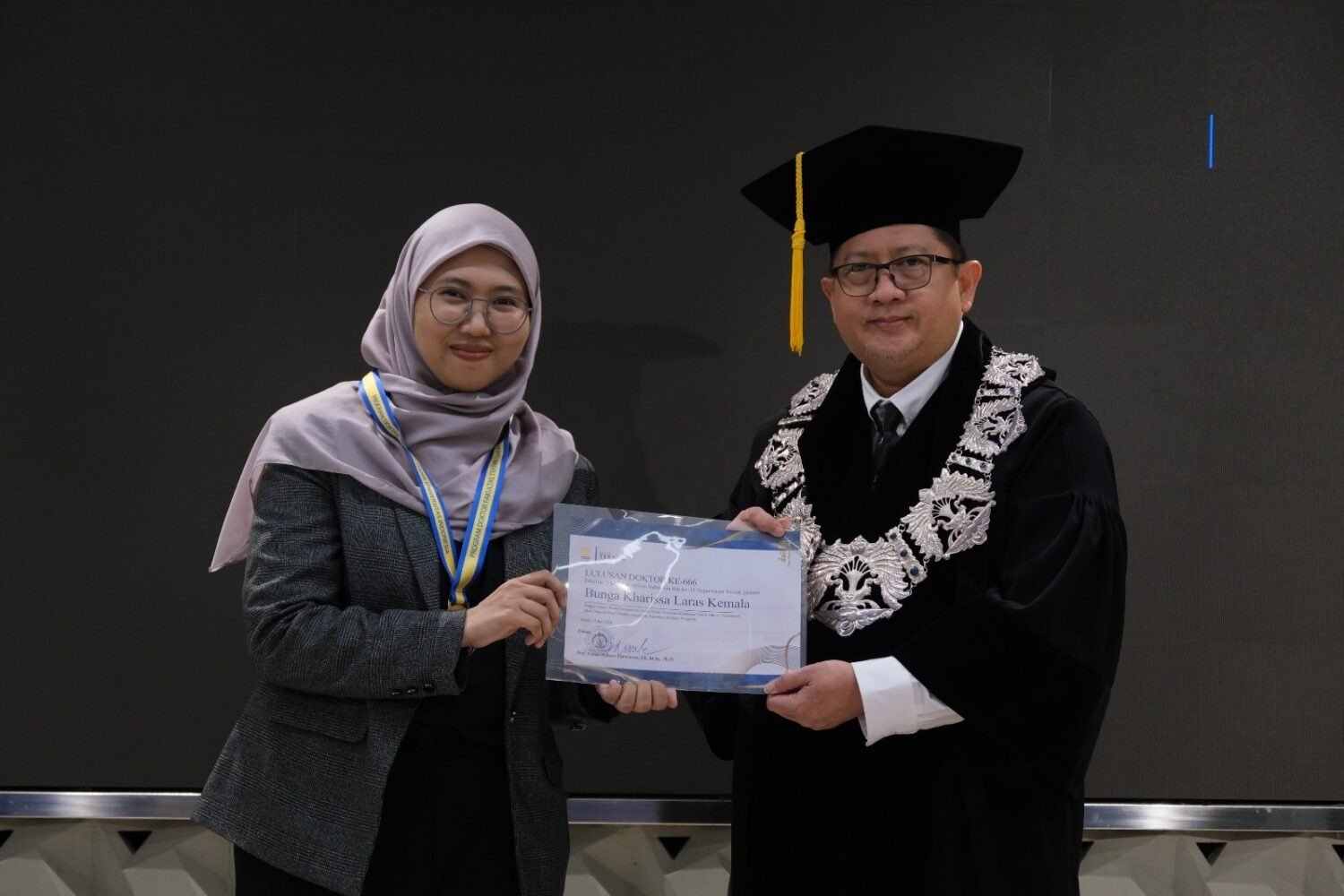
Addressing this challenge, Bunga Kharissa Laras Kemala, a doctoral candidate at the Department of Industrial Engineering, Faculty of Engineering, Universitas Indonesia (FTUI), has developed a planning model for SPKLU locations that integrates electric vehicle adoption forecasting with user behavior analysis. The model was presented during her Doctoral Dissertation Defense, held on Sunday (June 15) at the Smart Meeting Room, FTUI Dean’s Building.
Through her dissertation entitled “Development of a Planning Model for Public Electric Vehicle Charging Station Locations: A Multi-Stage Approach Based on Adoption Forecasting and User Behavior Modeling,” Bunga introduced a four-stage framework to support strategic planning for SPKLU deployment. The framework integrates forecasts of Battery Electric Vehicle (BEV) adoption, travel behavior analysis, charging demand simulation, and long-term optimization of charging station locations.
“Unlike conventional approaches that primarily consider current conditions, this research incorporates both the spatial and temporal evolution of electric vehicle adoption, as well as patterns of vehicle usage by the public. This enables charging infrastructure planning to adapt more effectively to future changes in demand,” Bunga explained.
Using the Greater Jakarta metropolitan area—Jakarta, Depok, Tangerang, and Bekasi (Jadetabek)—as the study area, Bunga employed a neural network approach to predict electric vehicle adoption rates. The forecast results were then integrated with travel behavior surveys and further developed using agent-based simulation to estimate charging demand based on users’ locations, travel times, and travel characteristics. Subsequently, an optimization model was applied to determine charging station locations capable of maximizing service coverage while minimizing users’ travel distance to charging facilities.
The proposed model demonstrates that SPKLU planning should not rely solely on current conditions. Instead, forecasts of electric vehicle adoption and user behavior should be considered simultaneously to ensure that charging infrastructure development is both efficient and future-oriented. The model can be utilized to identify present charging infrastructure requirements while also projecting future demand, providing valuable input for formulating Indonesia’s long-term electric vehicle ecosystem development strategy.
According to Bunga, the research was motivated by the need to ensure that charging infrastructure development can effectively keep pace with the rapid growth of electric vehicles.
“The availability of charging infrastructure is one of the key factors influencing public confidence and convenience in adopting electric vehicles. Through this model, I hope SPKLU planning can become more accurate and serve as a valuable reference for stakeholders involved in developing Indonesia’s electric vehicle infrastructure,” she said.
The doctoral defense was chaired by Prof. Kemas Ridwan Kurniawan, S.T., M.Sc., Ph.D., Dean of the Faculty of Engineering, Universitas Indonesia. Her dissertation was supervised by Prof. Dr. Ir. Isti Surjandari, M.T., M.A., Ph.D., CQE., IPU., with Dr. Ir. Zulkarnain, S.T., M.T. serving as co-supervisor.
The examining committee consisted of Prof. Dr. Ir. Kadarsah Suryadi, DEA.; Dr. Ir. Setia N. Milatia Moemin, MBA.; Prof. Dr. Ir. T. Yuri M. Zagloel, M.Eng.Sc.; Dr. Arian Dhini, S.T., M.T.; and Annisa Marlin Masbar Rus, S.T., M.Sc., Ph.D.
On the occasion, Prof. Kemas expressed his appreciation for Bunga’s academic achievement and the significance of her research in advancing sustainable transportation.
“The development of an electric vehicle ecosystem requires well-planned, data-driven infrastructure. Bunga’s research demonstrates how industrial engineering approaches can contribute to more effective planning of public charging stations, ultimately supporting the realization of a sustainable transportation system,” he stated.
With this academic accomplishment and her research contribution, Bunga Kharissa Laras Kemala joins the growing number of FTUI doctoral graduates contributing to the advancement of science and technology. Her research underscores the importance of data-driven approaches in developing adaptive electric vehicle infrastructure while supporting Indonesia’s broader transition toward a sustainable transportation ecosystem.