




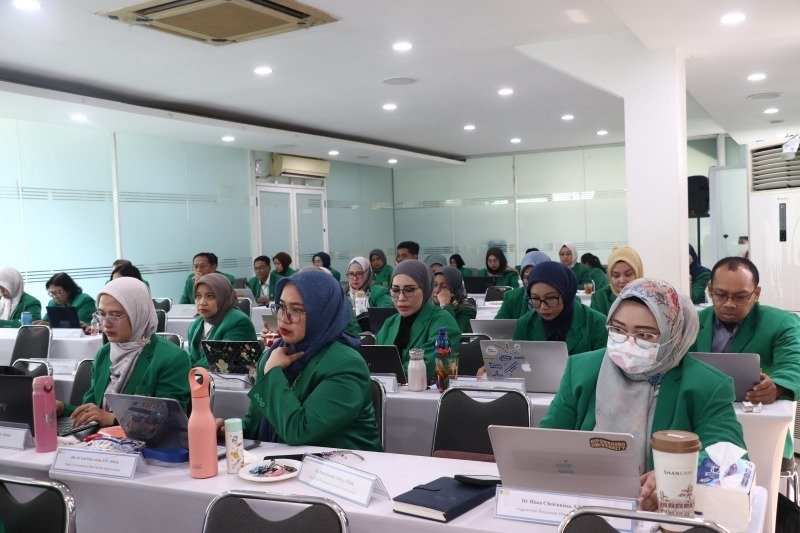
EduAsiaNews, Jakarta — Universitas Nasional (UNAS) continues to strengthen its higher education quality culture through the ongoing evaluation and development of its quality assurance system. One such initiative was a Quality Assurance Sharing Session organized by the UNAS Quality Assurance Agency (BPM) in collaboration with the Midwifery Study Program and the leadership team of the Faculty of Health Sciences (FIKES). The session was held in the Seminar Room, Third Floor, Block A, at the UNAS Pejaten Campus in Jakarta, on Wednesday (Oct. 28, 2026).
The session aimed to evaluate the implementation of the quality assurance system, review the completeness of study program documentation, and identify areas requiring improvement in preparation for accreditation. Through this forum, BPM, faculty leaders, and the Midwifery Study Program management team sought to align academic management with higher education quality standards.
In her presentation, FIKES Dean Prof. Dr. Dra. Retno Widowati, M.Si., explained that the Midwifery Study Program specializes in evidence-based complementary maternal and child care that incorporates local wisdom. This specialization is a defining feature of the program and is developed through education, research, community service, and partnerships with various stakeholders.
She emphasized that improving the study program’s quality requires a curriculum aligned with scientific developments, community needs, and the demands of the midwifery profession. Accordingly, the Midwifery Study Program has adopted an Outcome-Based Education (OBE) curriculum.
The curriculum draws on the National Standards for Higher Education, the Indonesian National Qualifications Framework (KKNI), Indonesian Midwifery Competency Standards, the curriculum of the Indonesian Association of Midwifery Education Institutions (AIPKIND), and the standards of the International Confederation of Midwives (ICM).
The curriculum is evaluated regularly with input from various stakeholders. This process is intended to ensure that learning activities produce competent and professional graduates equipped with the skills required to meet the needs of maternal and child health services.
“The Midwifery Study Program’s strength in evidence-based complementary maternal and child care rooted in local wisdom must continue to be developed through education, research, community service, and collaboration. The curriculum must also undergo continuous evaluation to remain relevant to scientific developments and the needs of the profession,” was the key message in the presentation on the development direction of the FIKES UNAS Midwifery Study Program.
In addition to curriculum development, internationalization is another priority for the study program. Efforts include expanding international partnerships, promoting faculty and student mobility, and fostering collaboration in education and research. These initiatives are expected to broaden academic perspectives, improve learning quality, and strengthen graduates’ competitiveness.
The event continued with a discussion and review of the Midwifery Study Program’s documents involving the dean and the FIKES UNAS leadership team. The session formed part of an assessment of the program’s readiness to meet the quality assurance requirements for accreditation.
Through the document review, the study program is expected to identify areas requiring improvement in academic management, curriculum implementation, and documentation of education, research, and community service activities.
Quality assurance is not merely about completing administrative documents; it also concerns the consistent application of standards in academic activities. The documents prepared must therefore reflect program implementation, evaluation results, and follow-up measures undertaken for continuous improvement.
Collaboration between BPM and FIKES UNAS is essential to this process. BPM supports the strengthening of the quality assurance system, while the faculty and study program are responsible for ensuring that established standards are consistently implemented in accordance with the program’s characteristics and needs.
The session concluded with remarks from UNAS Vice Rector for General Administration, Finance, and Human Resources Prof. Dr. Suryono Efendi, S.E., M.B.A., M.M. He emphasized the importance of cooperation, coordination, and support across the university in improving study program quality and preparing for accreditation.
He said that quality improvement requires a shared commitment from study program managers, faculty leaders, BPM, and all other university stakeholders. Such synergy is necessary to ensure that shortcomings are evaluated and addressed through targeted improvement measures.
“We must work together effectively and support one another so that our already strong quality can continue to improve toward an Excellent accreditation rating. All parties must therefore share the same commitment to accreditation preparation. UNAS supports this effort as part of its commitment to continuous improvement in education quality,” Prof. Suryono said.
He also stressed that accreditation preparation must be carried out systematically through stronger documentation, evaluations of standards implementation, and follow-up improvements involving all relevant stakeholders.
Through the Quality Assurance Sharing Session, BPM and FIKES UNAS are expected to strengthen coordination in improving the quality of the Midwifery Study Program, from curriculum development and quality documentation to broader academic partnerships. These efforts reflect UNAS’s commitment to fostering a consistent, measurable, and sustainable quality culture to improve higher education standards and strengthen graduates’ competitiveness. (SAF)