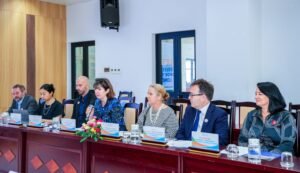




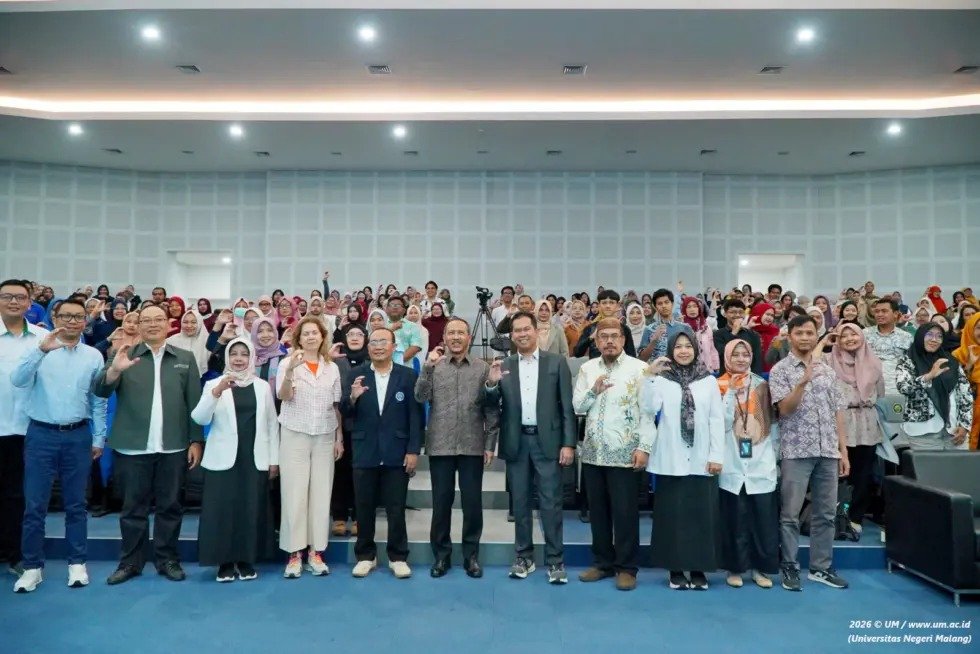
EduAsiaNews, Malang – Universitas Negeri Malang (UM) has introduced Collaborative Activation for Nurturing Awareness (CANA) as a learning paradigm that integrates neuroscience, interpersonal relationships, and inclusive education to address the challenges of contemporary education. The initiative was officially unveiled during the CANA Academic Series 2026, organized by the Faculty of Education (FIP) at the 9th Floor Auditorium of GKB A20 on Monday (July 6).
Carrying the theme “A Reflective Interdisciplinary Academic Movement,” the event brought together national and international academics to discuss the development of a more reflective, human-centered, collaborative, and awareness-based educational ecosystem.
CANA, an acronym for Collaborative Activation for Nurturing Awareness, is an educational approach that positions awareness as the fundamental principle underpinning every stage of the learning process. The paradigm is expected to transform education by enabling students not only to acquire academic knowledge but also to develop emotional intelligence, collaborative competencies, and the adaptability required in the workplace and society.
The Dean of UM’s Faculty of Education, Dr. Ahmad Yusuf Sobri, S.Sos., M.Pd., stated that today’s educational challenges have become increasingly complex, making academic achievement alone an insufficient measure of graduate success.
“Today, many graduates possess outstanding grade point averages. However, the world of work increasingly demands practical skills, the ability to build relationships, empathy, strong character, and readiness to adapt to change. Therefore, education must not only produce academically accomplished graduates but also individuals who are capable of adapting and making meaningful contributions to society,” he said.
According to Ahmad Yusuf Sobri, UM continues to encourage students to develop competencies beyond the classroom through various student development activities integrated with the implementation of SKEMA. This approach provides opportunities for students to strengthen their non-academic experience, leadership, collaboration, and skills that are relevant to future workforce demands.
“In addition to academic excellence, students must also develop non-academic experiences and competencies. Education should cultivate character, collaborative abilities, and skills that are relevant to future needs,” he added.
Meanwhile, CANA Advisor Prof. Dr. Syihabuddin, M.Pd., emphasized that CANA is not merely a teaching method but a comprehensive educational ecosystem designed to foster awareness throughout every stage of the educational process, from planning to evaluation.
“CANA is like salt in cooking. It is present throughout the entire learning process, adding meaning from planning to evaluation. Its purpose is to ensure that every educator remains fully aware of what they are doing, making learning more meaningful,” he explained.
He further noted that the CANA paradigm was developed through an interdisciplinary approach that combines neuroscience, psychology, and humanistic education. Its implementation is structured around five key stages: activate awareness, release emotion, retrain mindset, stabilize mental state, and nurturing awareness. These stages are designed to help educators cultivate self-awareness, regulate emotions, shift their mindset toward becoming effective learning facilitators, maintain mental well-being, and foster a sustainable learning culture.
Through CANA, UM seeks to strengthen its commitment to enhancing learning models that are more reflective, human-centered, and collaborative.
In addition to the official launch, the event featured a series of workshops highlighting four key pillars for developing the CANA ecosystem: academic dialogue, strategic collaboration, capacity building through training based on the CANA framework, and the creation of sustainable educational impact that promotes inclusive education and learner well-being. Looking ahead, the development of CANA will also be supported by a digital platform, enabling training programs to reach a broader community of educators across Indonesia.
The introduction of CANA offers tangible benefits to the education sector by promoting a more human-centered learning approach, strengthening educators’ mental well-being and self-awareness, improving the quality of classroom interactions, and fostering learning experiences that are more meaningful, adaptive, and responsive to the needs of future society.
This initiative also reinforces UM’s commitment to supporting the United Nations Sustainable Development Goals (SDGs), particularly SDG 4 (Quality Education) through inclusive and transformative educational innovation, and SDG 17 (Partnerships for the Goals) by fostering interdisciplinary and inter-institutional collaboration to build a sustainable educational ecosystem.