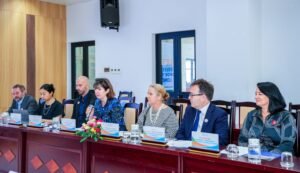




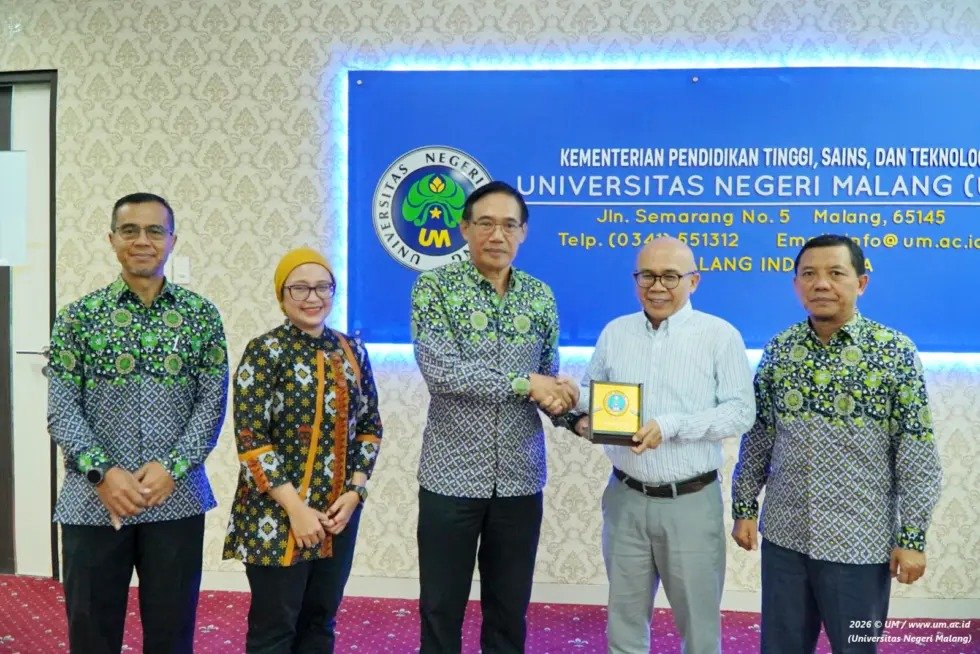
EduAsiaNews, Malang – Universitas Negeri Malang (UM) hosted The Netherlands Knowledge House (NLKH) Meeting at the Senate Meeting Room on the 9th Floor of the Rectorate Building on Wednesday (July 15). The meeting brought together members of the Netherlands Knowledge House (NLKH) from universities across Indonesia to strengthen academic collaboration with higher education institutions in the Netherlands and formulate a joint work agenda for 2026.
The event was attended by UM Rector Prof. Dr. Hariyono, M.Pd., members of the university’s leadership, Director of Education Prof. Evi Eliyanah, representatives from the Office of International Affairs (KUI), and delegates from Nuffic Southeast Asia, the organization that facilitates higher education cooperation between Indonesia and the Netherlands.
In her presentation, Astrid Rehulina Peranginangin, Events Officer and NL Knowledge House Support Officer at Nuffic Southeast Asia, explained that the Netherlands Knowledge House (NLKH) serves as a collaborative platform designed to connect higher education institutions in Indonesia and the Netherlands through knowledge exchange, research collaboration, and academic capacity development.
The NLKH currently comprises 25 member institutions, including universities and knowledge organizations from both countries. The network includes 14 Dutch Knowledge Institutions, supported by strategic organizations such as the Dutch Research Council (NWO), Universities of the Netherlands, and the Royal Netherlands Academy of Arts and Sciences (KNAW).
“All NL Knowledge House activities are designed by its members. We strive to serve as a bridge that connects the shared vision of Indonesia and the Netherlands through a variety of collaborative programs,” Astrid said.
She further explained that the organization’s governance is managed collaboratively through its secretariat, chairs, and working groups, enabling members to jointly develop initiatives and make strategic decisions. This collective governance model ensures that every member institution has an equal opportunity to contribute to the network’s development.
During the meeting, Astrid also highlighted several initiatives previously organized by NLKH, including Collaboration Dialogues, the Energy Efficiency Workshop, Economic Missions, Institutional Visits, and participation in the World Conference. These programs provide platforms for Indonesian and Dutch academics to exchange knowledge and address strategic issues ranging from energy and research to higher education development.
In addition to reviewing ongoing initiatives, this year’s meeting focused on developing the organization’s future agenda, including preparations for the 2026 World Conference. The forum also provided members with the opportunity to propose new ideas and collectively determine the strategic direction of future programs.
Astrid noted that the NL Knowledge House has continued to expand since welcoming Indonesian member institutions in 2025. The growing membership is expected to create broader opportunities for international collaboration that deliver tangible benefits to higher education institutions in both countries.
As host of the Netherlands Knowledge House (NLKH) Meeting, UM reaffirmed its commitment to strengthening its international network while expanding collaboration in education, research, and innovation. Strategic partnerships with higher education institutions in the Netherlands are expected to create greater opportunities for collaborative research, faculty and student exchanges, and the development of innovative solutions to address global challenges.
These initiatives also contribute to the achievement of the Sustainable Development Goals (SDGs), particularly SDG 4 (Quality Education), SDG 9 (Industry, Innovation and Infrastructure), and SDG 17 (Partnerships for the Goals), by enhancing the quality of higher education, advancing research and innovation, and fostering sustainable international collaboration.