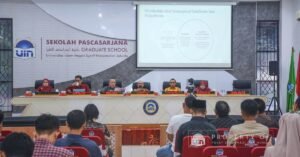





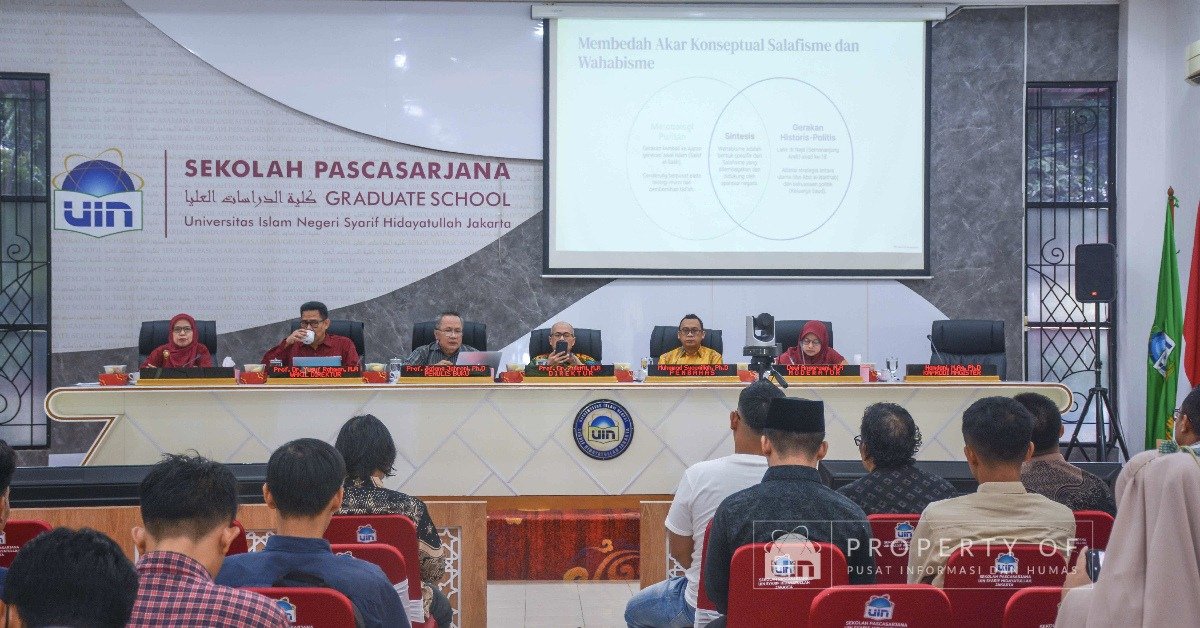
EduAsiaNews, Jakarta – Syarif Hidayatullah State Islamic University (UIN) Jakarta, through its Graduate School (SPs), held a public lecture (Studium Generale) and book discussion titled “Salafism-Wahhabism in Indonesia: An Introduction.” The event provided an academic forum to deepen understanding of the dynamics of Salafism-Wahhabism and strengthen religious moderation in Indonesia. It took place at the Prof. Dr. Suwito, M.A. Auditorium on Thursday (Nov. 12, 2026).
The event was attended by UIN Jakarta Graduate School Director Prof. Zulkifli, M.A., and UIN Jakarta professor and lecturer Jajang Jahroni, M.A., Ph.D., who is also the author of the book. The discussion featured Muhamad Syauqillah, S.H.I., M.Si., Ph.D., a lecturer at the University of Indonesia (UI) and an expert on the National Counterterrorism Agency (BNPT) team. Dewi Anggraeni, M.A., a lecturer at K.H. Abdurrahman Wahid State Islamic University in Pekalongan, served as moderator. Master’s and doctoral students also attended the event.
In his opening remarks, UIN Jakarta Graduate School Director Zulkifli expressed his appreciation to the speakers for participating in the academic forum. He said the event was intended to equip the academic community and the wider public with a more comprehensive understanding of the development and dynamics of Salafism-Wahhabism in Indonesia.
“Through academic forums such as this, we hope participants will be able to examine religious phenomena comprehensively, critically and objectively, enabling them to respond wisely to emerging developments,” he said.
In his presentation, Jajang Jahroni examined the growing influence of radicalism in Indonesia, arguing that it was neither an instantaneous nor an organically emerging religious phenomenon. Rather, he said, it was the product of an integrated system bringing together puritanical ideology, state political agendas and international financial support.
“This movement evolved from a theological purification movement on the Arabian Peninsula into an instrument of geopolitical diplomacy, backed by petrodollar wealth. Transnational funding began flowing systematically during the New Order era through campus-based religious outreach networks, continuing into the Reform Era, which provided legal opportunities for the establishment of foundations and media outlets,” the UIN Jakarta professor explained.
He added that the transmission of the ideology took root in Indonesia through strategic alliances with local networks, including the Indonesian Islamic Da’wah Council (DDII). Foreign donor funding was used to establish exclusive mosques, Islamic boarding schools (pesantren) and media outlets, creating closed ecosystems that differed from the more culturally accommodating traditions of Nahdlatul Ulama (NU) and Muhammadiyah.
However, Jajang noted that the geopolitical landscape had undergone significant changes following the introduction of Saudi Arabia’s Vision 2030 under the leadership of Crown Prince Mohammed bin Salman (MBS). The shift in focus from religious hegemony toward economic modernization had led to the cessation of funding for extremist networks, forcing local foundations to operate independently.
“Although centralized financial support has declined, the threat has not necessarily disappeared. The loss of centralized control has instead triggered fragmentation, with smaller groups splitting off and potentially evolving into independent radical cells operating sporadically,” he said.
In the following session, UI lecturer and BNPT expert team member Muhamad Syauqillah emphasized the importance of historical and sociological approaches to understanding puritanical movements in Indonesia.
“This transmission of religious knowledge actually has roots dating back to well before the Padri War, before becoming institutionalized through modern institutions and networks of prominent figures such as Mohammad Natsir,” he explained.
He subsequently classified Indonesia’s Salafi movement into two political typologies: quietism, which focuses on the purification of religious beliefs without engaging in practical politics, and assertive politics, which actively mobilizes public support to push for the formalization of Islamic law.
The movement’s textual approach, he said, has often attracted educated segments of society, while the political dynamics of the Reform Era at one point gave rise to Laskar Jihad under the leadership of Ja’far Umar Thalib.
Furthermore, the BNPT expert mapped the escalation toward terrorism, beginning with religious purification, intolerance toward local traditions and the delegitimization of Pancasila, eventually progressing to the use of violence. He also commended Jajang’s book for its incisive analysis of the networks involved.
“The book provides a particularly insightful mapping of these networks. As a critical observation, however, future studies should further explore the historical context following the collapse of the Ottoman Caliphate. A thorough historical and sociological analysis is crucial to identifying patterns of escalation at an early stage, before they develop into violent extremism,” he said.
Through the event, UIN Jakarta’s Graduate School hopes to provide the public and policymakers with a solid academic reference for preserving social harmony, strengthening religious moderation and safeguarding Indonesia’s national unity and integrity.