




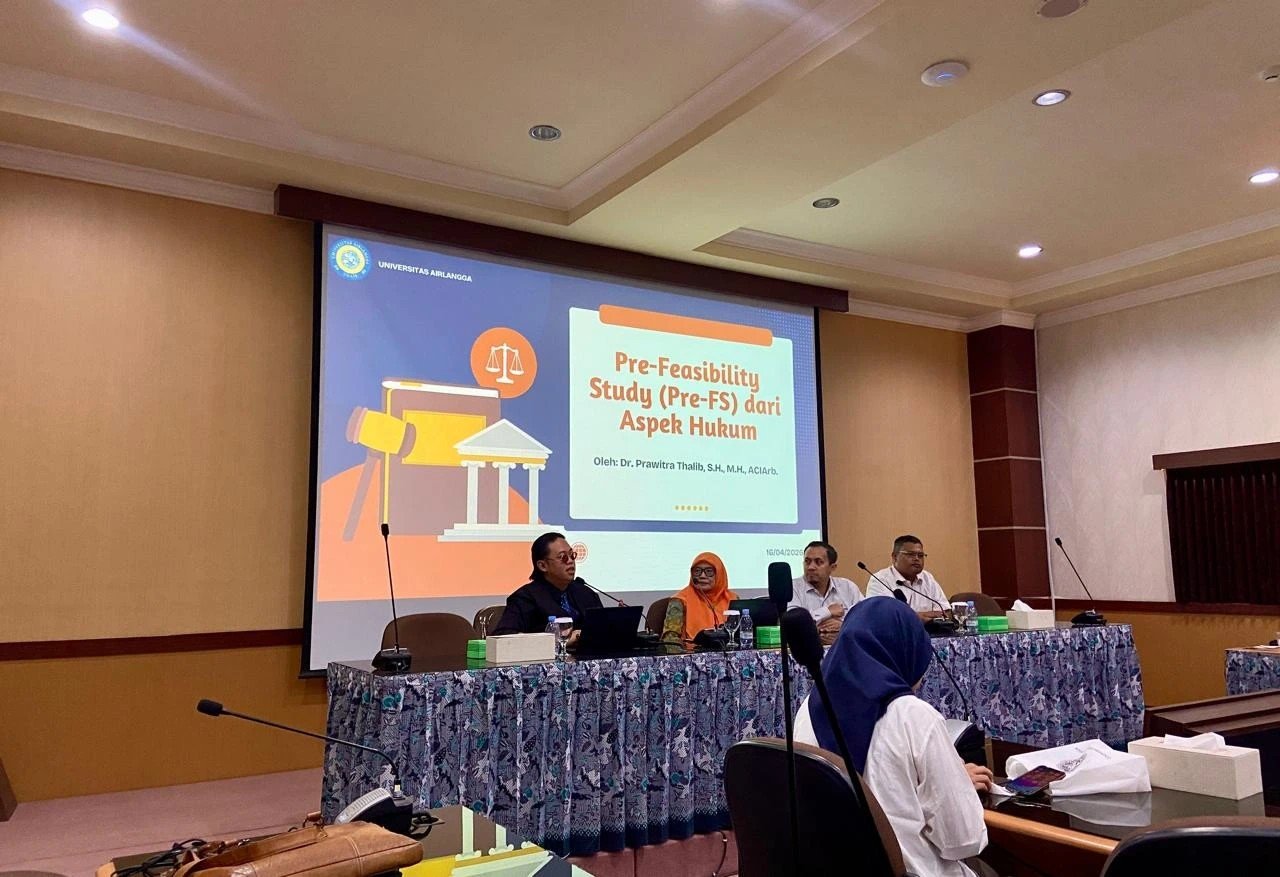
EduAsiaNews, Surabaya – The success of commercializing research-based products does not rely solely on technological sophistication, but also on compliance with regulations. Highlighting this issue, Universitas Airlangga (UNAIR) held an Expertise Capacity Building session for the Pre-Feasibility Study (Pre-FS) Expert Team. This activity was part of the fourth day of the Innovation Forum DRI WEEK 2026, which took place on Friday (April 17, 2026) at the Kahuripan Building, Management Office, MERR-C Campus.
A legal expert from UNAIR, Dr. Prawitra Thalib, S.H., M.H., ACIArb., presented the phenomenon of ordinary products that are able to sustain a long presence in the market due to strong legal compliance, licensing, and Intellectual Property Rights (IPR). According to him, many large-scale projects ultimately fail midway due to disputes.
Preventive Measures and Legal Certainty Synergy
Prawitra explained that Pre-FS is an initial feasibility assessment stage before a research project advances further. “Many innovation projects fail not due to financial or technical issues, but because legal aspects are neglected, such as land disputes or licensing issues. This is where Pre-FS plays a crucial preventive role,” he stated.
There are four main outcomes of Pre-FS from a legal perspective: legal certainty, innovation protection, early risk mitigation, and cost efficiency. Without these aspects, innovations risk being prohibited from distribution and investments may be stalled. “The downstreaming of research requires strong legal certainty to ensure secure investment. Therefore, identifying risk clauses and contractual needs must be mapped from the outset,” emphasized the Faculty of Law lecturer.
In addition to contract analysis, stakeholder synergy is also key. “It is important to conduct a triple helix assessment that bridges government, business (industry), and universities. In this way, the interests of all parties are accommodated, and the intellectual property rights of inventors are protected,” Prawitra explained.
Risks of Neglecting Sectoral Licensing
Furthermore, Prawitra stressed that obtaining a Business Identification Number (NIB) from the OSS system is only the initial step. Each technological innovation has a specific regulatory landscape and standards that must be complied with. Errors in identifying sectoral permits can have serious consequences.
In closing, Prawitra highlighted the high risks of legal negligence by citing a real case in which millions of unlicensed products were withdrawn in 2025, causing state losses amounting to tens of billions of rupiah. “This fact underscores that Pre-FS reports must clearly establish legal risk mitigation. Do not let brilliant innovations come to a halt simply because of negligence in legal compliance and licensing,” he concluded.
Author: Muhammad Yasir Dharmawan D.