





EduAsiaNews, Riau – A glass of yogurt may appear to be a simple food product. However, beneath its smooth texture lies millions of beneficial bacteria that play a vital role in maintaining digestive health. The challenge is that these probiotic bacteria are highly susceptible to environmental changes, from storage conditions to their journey through the human stomach.
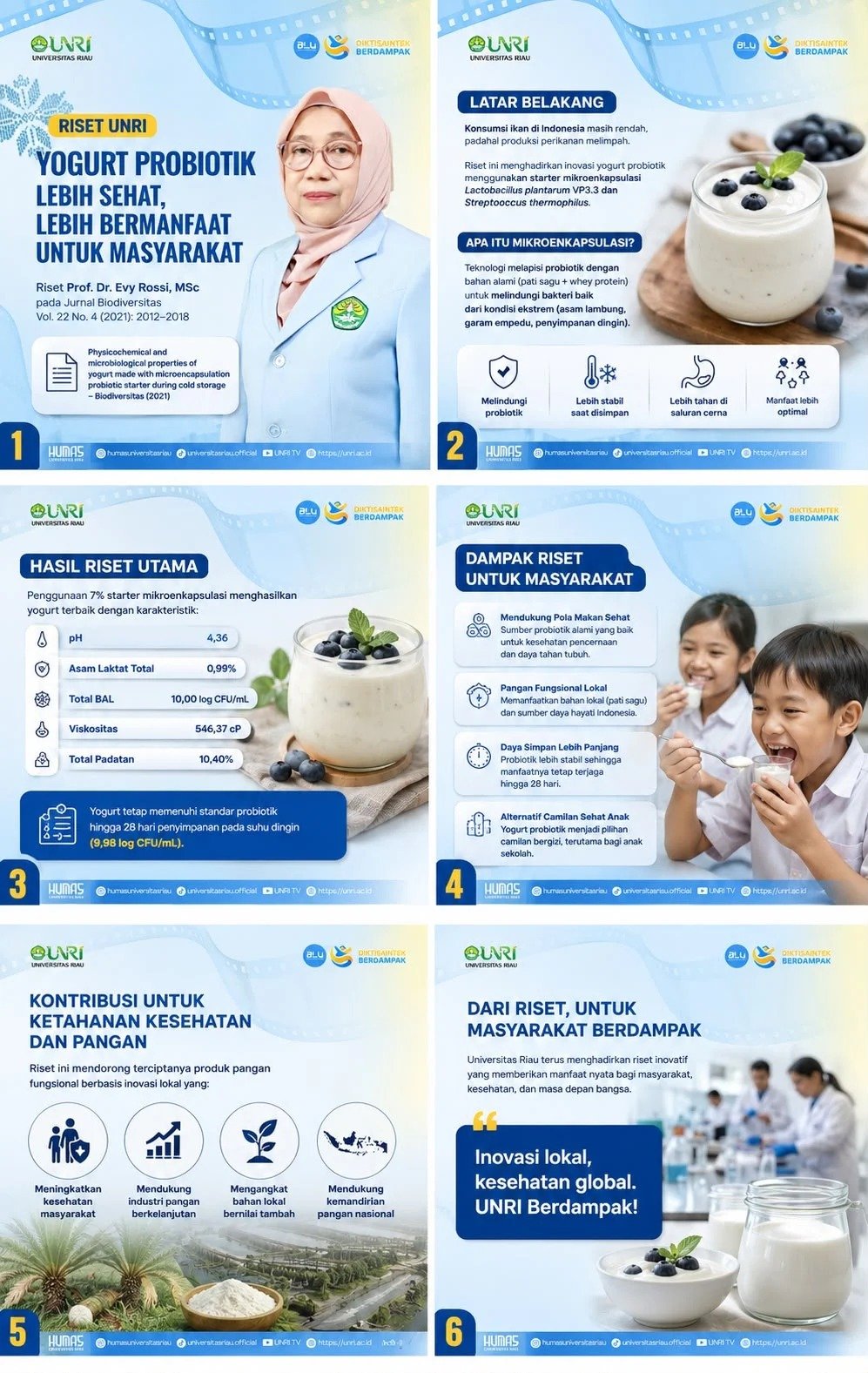
Addressing this challenge, Universitas Riau (Unri) researcher Prof. Dr. Evy Rossi, M.Sc., together with her research team, has developed an innovative probiotic yogurt utilizing microencapsulation technology—a technique that coats probiotic bacteria with natural materials derived from sago starch and whey protein. This innovation provides greater protection for the probiotic bacteria, enhances their stability during storage, and improves their ability to survive until they reach the digestive tract.
Microencapsulation technology functions as a protective “shield” for beneficial bacteria. With this protective layer, the probiotics are less vulnerable to damage caused by stomach acid, bile salts, and temperature fluctuations during storage. This represents an important step in ensuring that the health benefits of probiotics can be fully delivered to the body after consumption.
The research employed Lactobacillus plantarum VP3.3 and Streptococcus thermophilus as the yogurt starter cultures. Following a series of laboratory evaluations, yogurt formulated with 7 percent microencapsulated starter culture demonstrated the best overall quality. The product achieved a pH of 4.36, 0.99 percent lactic acid content, a total lactic acid bacteria count of 10.00 log CFU/mL, viscosity of 546.37 cP, and 10.40 percent total solids.
Even more significantly, the probiotic bacteria remained above the required standard after 28 days of refrigerated storage, demonstrating that the microencapsulation technology effectively preserves product quality and extends shelf life compared with conventional probiotic yogurt.
Prof. Evy explained that, amid growing public awareness of functional foods, probiotic yogurt with an extended shelf life presents greater opportunities for development as a healthy food product that is more accessible to consumers.
“This innovation also holds strategic value because it utilizes sago starch, one of Indonesia’s indigenous natural resources, as the primary material for the microencapsulation process. The use of local raw materials not only increases the added value of regional commodities but also reduces dependence on imported ingredients in the food industry,” she said.
For consumers, the research offers broad potential benefits. Regular consumption of probiotic yogurt may help maintain digestive health, strengthen the immune system, and provide a nutritious snack option for both children and adults. Its longer shelf life also makes the product more practical for distribution, enabling it to reach a wider market.
Beyond its public health benefits, the research contributes to the advancement of Indonesia’s food industry. The integration of microencapsulation technology with locally sourced raw materials has the potential to stimulate the development of high-value functional food products, strengthen innovation-driven food industries, and support Indonesia’s long-term food self-sufficiency.