





EduAsiaNews, Korea Selatan – With the success of the 2026 film The Odyssey, the homecoming journey of the ancient Greek hero Odysseus has once again captured public attention. Homer’s epic poem The Odyssey tells the story of Odysseus, king of Ithaca, as he struggles to return home after the Trojan War. His journey takes him across dangerous seas, where he encounters monsters, temptations, and the wrath of the gods. Along the way, he loses his companions, escapes danger through his ingenuity, and sometimes creates trouble through his own curiosity and poor judgment.
Yet The Odyssey is more than an adventure about a hero returning home after 20 years. It is also a story about reclaiming one’s family, place in the world, and sense of identity. Above all, it asks what makes life worth pursuing, even in the face of suffering and temptation.
Professor Kim Heon of Seoul National University’s Institute of Humanities spent 22 years translating The Odyssey into Korean. Having long introduced Greek and Roman mythology and classical literature through university courses and public lectures, Kim sees the epic not only as a work of literature but also as a source of profound questions about life. Together with Professor Kim, we retraced Odysseus’s journey home and explored the questions this ancient epic still raises about our lives today.
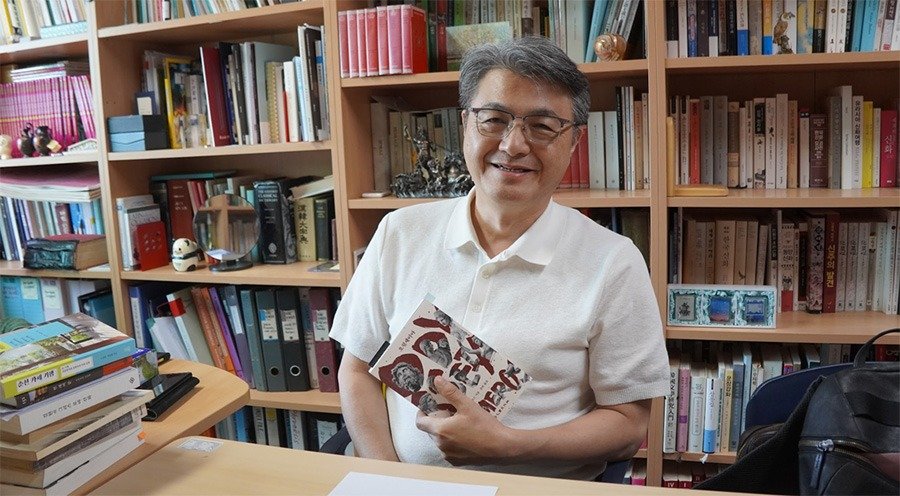
Professor Kim Heon of the Institute of Humanities with his Korean translation of <i>The Odyssey</i>, completed after 22 years.
Professor Kim Heon of the Institute of Humanities with his Korean translation of The Odyssey, completed after 22 years.
Bringing an Ancient Rhythm into Korean
Q. It took you 22 years to translate The Odyssey. What was the greatest challenge?
It’s difficult to single out one particular passage. The original Greek is written in dactylic hexameter*, a poetic form in which each line flows almost like a song. My greatest challenge was finding a way to preserve that musical quality in Korean. Conveying the meaning accurately was important, of course, but I also wanted readers to experience the poetic rhythm of the original. That’s why I tried to preserve the original word order and sequence of lines as much as possible. When a poet recites a story, listeners form images in their minds as each word unfolds. The full picture only becomes clear at the end of a sentence. This oral tradition raises an interesting question: Was Homer a single author, or did the epic emerge from songs passed down through generations of poets? Rather than rushing to settle the question of authorship, I think we first need to understand how the work was transmitted orally. That was also why I wanted to retain the original word order. Rewriting everything in familiar Korean expressions might make the text easier to read, but it could also erase its distinctive voice. Even if the language feels unfamiliar at times, I wanted readers to experience how the words unfold and gradually create a scene.
One example is my decision to translate the Greek word phrenes (φρένες) as “diaphragm.” In Homer’s world, the diaphragm was understood not simply as a part of the body but also as the seat of emotions, thoughts, and judgment. Rather than saying someone engraved important words in their heart or mind, the ancient Greeks might describe them as being engraved in the diaphragm. I could have translated the word as “heart” or “mind” to make it more accessible. But doing so would have concealed something important about how the ancient Greeks understood human beings. By preserving the unfamiliar expression, I hoped to remind readers that even the ideas we take for granted today may one day seem strange.
* Dactylic hexameter is a poetic form commonly used in ancient Greek epic poetry, consisting of six metrical units per line.
The Homecoming of an Imperfect Hero
Q. You’ve described Odysseus as a deeply human character, someone who makes mistakes and even risks his life to hear the Sirens’ song. How does this portrayal differ from the film?
Odysseus is an incredibly human character. He wanted to hear the Sirens’ song simply because he was curious. He knew their singing could lure sailors to their deaths, but he still wanted to experience it for himself. What could make a song so irresistible that people would throw themselves into the sea? So he had his companions plug their ears with wax and tie him to the mast to prevent him from jumping overboard. I think this willingness to experience something new and unknown, rather than simply avoiding danger, can enrich our lives.
But there’s also something troubling about that episode. His companions had to keep rowing without hearing the song, while Odysseus alone enjoyed the experience. He satisfied his own curiosity without sharing the opportunity with others. You could argue that he was taking advantage of his position and privileges as king. We see something similar when Aeolus, the god of winds, gives Odysseus a bag containing the dangerous winds, leaving only a favorable breeze to carry him home. Odysseus keeps the bag to himself without explaining its contents to his companions. When he falls asleep just as they are approaching Ithaca, they open it, releasing the winds and sending their ship far out to sea again. Odysseus is clever and resourceful, but he is far from perfect. His curiosity and self-centeredness sometimes lead him to make serious mistakes.
The film presents him rather differently. He appears as a devoted husband who remains faithful to Penelope and reflects on his actions. In the original epic, however, he spends a year with Circe and seven years with Calypso, revealing his vulnerability to desire. The film connects his time on Calypso’s island to memory loss, making him seem less responsible for his actions. There is also a difference in how he treats the suitors who have occupied his home. In the epic, he ambushes and kills them all after returning to Ithaca. In the film, he shows mercy to those who ask for forgiveness. Some of these changes may reflect the need to tell the story within a three-hour film. But the adaptation also seems to reshape Odysseus into a more idealized, self-reflective hero who better fits modern moral expectations.
Q. How can we connect these mythological stories to our own lives?
We might say that mythology is a product of imagination, while history is based on empirical investigation. But that doesn’t mean myths are simply lies. Mythological imagination is rooted in real life. Although myths use symbols and metaphors, they reflect people’s experiences, their observations of nature, and their understanding of the world.
Take the story of Odysseus receiving help from Athena and other gods on his journey home. We can also interpret it in human terms. Perhaps he survived because he was exceptionally good at gathering information and making judgments. Divine intervention may have been a mythological way of expressing human abilities at their highest level. The value of mythology goes beyond distinguishing fact from fiction. It helps us understand how people made sense of the world.
What Does It Mean to Return Home?
Q. Odysseus chooses to return home even though Calypso offers him immortality and a life of comfort. What does that choice mean to you?
Calypso offers him a life without pain, aging, or suffering. He could live forever in comfort, enjoying almost everything a human being might desire. Yet Odysseus ultimately chooses to leave. Why would someone return to a home where suffering awaits? That’s a question that has stayed with me for a long time.
I began to wonder whether each moment of human life is precious precisely because our lives are limited by birth and death. If we could live forever, perhaps no moment would feel particularly special. Life itself might lose its meaning. Knowing that our time is finite is what makes us value it. This question also applies to everyday life. Calypso’s island can be seen as a symbol of comfort and ease. We all know the feeling of waking up tired and wanting to stay in bed for another day. But if we remain in that comfortable place, we cannot accomplish what we need to do. Sometimes we have to leave our comfort behind and face the demands of everyday life, even when it’s difficult.
Returning home also means more than going back to a familiar place. Odysseus is someone who loses his name and becomes simply “a man,” only to reclaim his identity. After years of war and wandering, he returns to his place in the world and rediscovers who he is. In that sense, his homecoming is also a journey toward answering two questions: “Who am I?” and “What makes me who I am?”
Q. What gives Odysseus the strength to complete his journey home?
We shouldn’t underestimate Penelope’s role in the story. While her husband is away, she endures 20 years of loneliness, anxiety, and fear as suitors gather around her and pressure her to remarry. She tells them that she will choose a husband once she finishes weaving a burial shroud for her father-in-law. She weaves during the day and secretly unravels her work at night, buying herself more time. Despite the uncertainty and emotional strain, she does everything she can to endure the situation.
I sometimes think Penelope may be the true central figure of The Odyssey. She is the one who continues to call Odysseus home, giving him a reason to return. When we’re exhausted or struggling, having someone who believes in us and waits for us can give us the strength to carry on. Reading this epic invites us to ask not only, “Could I be Odysseus?” but also, “Could I be someone’s Penelope?”
When I first began translating The Odyssey, the project became my own Ithaca. Just as Ithaca was the home Odysseus longed to reach, it represented a goal I had set for myself and a responsibility I wanted to fulfill. Once we reach one goal, we often set another. Like Sisyphus*, who must repeatedly push a boulder uphill, we sometimes find ourselves doing the same things over and over. Yet there is meaning in the process of continuing toward new goals.
When I think of Penelope, I naturally think of my family. My wife, in particular, quietly believed in me and comforted me whenever I felt like giving up. My friends and academic colleagues have also supported me. Their encouragement has given me the strength to keep going.
* Sisyphus is a figure in Greek mythology who was condemned to push a massive boulder up a hill for eternity. Each time the boulder neared the summit, it rolled back down, forcing him to begin again.
Finding a Way Forward After Failure
Q. What can students who are still searching for their own path learn from Odysseus?
None of us chose to enter this world, did we? In that sense, we may sometimes feel that we’ve been placed in circumstances we never asked for. Odysseus devised many strategies to achieve victory, but things often didn’t go according to plan. Looking back, some of his efforts might seem pointless. Yet whenever he saw a possibility, he kept trying. That persistence may ultimately have led him to devise the strategy of the Trojan Horse*.
We can also learn from his mistakes and self-centered behavior by treating them as cautionary examples. But I hope students won’t give up because of a single failure. Even when things don’t go as planned, or when we have to take a longer route, those experiences aren’t necessarily meaningless. I think it’s important to remain curious and be willing to try new things.
* The Trojan Horse was a strategy devised by Odysseus during the Trojan War. Greek soldiers hid inside a large wooden horse while the rest of the army pretended to retreat. After the Trojans brought the horse into their city, the hidden soldiers emerged at night and opened the gates, allowing the Greek army to capture Troy.
Q. For readers who have never read The Odyssey, is there a particular passage you would recommend as a starting point?
My favorite is the very first line: “Sing to me of the man, Muse, the man of twists and turns …” The entire work is contained in that opening. From there, we gradually discover who Odysseus is, what he has experienced, and where he is trying to go. I would encourage readers not to feel intimidated. Try reading the first 50 lines several times. Once you begin to appreciate their beauty, you may naturally want to continue.
Another passage I particularly like appears in Book 20, when Odysseus speaks to his own heart to restrain his anger: “Endure, my heart. You have endured worse than this.” At that moment, he is furious with the suitors occupying his home, but he reminds himself that he has survived even greater suffering and must wait for the right moment. He recalls how he endured the terrible experience of watching his companions being devoured by the Cyclops.
We all encounter situations that leave us feeling hurt, frustrated, or unfairly treated. Sometimes expressing our anger only makes us feel worse. When you read this passage, you might begin to wonder what makes Odysseus so angry and why he chooses to hold back rather than immediately act on his emotions. In fact, this passage may resonate most strongly when you’re feeling frustrated or wronged yourself. And perhaps that curiosity will lead you to discover what happens next.
Why do we continue to read stories about people who lived in such different times and circumstances? Perhaps it is because Odysseus is not a perfect hero. He is intelligent and curious, yet he makes mistakes and sometimes puts his own desires first. Rather than overlooking these imperfections, Professor Kim embraces them as part of what makes Odysseus human. In the hero’s journey home, he finds lessons about the courage to leave comfort behind, the persistence to keep going after failure, and the strength that comes from believing in and waiting for others. Just as Odysseus’s journey continues beyond his return to Ithaca, the questions raised by The Odyssey remain relevant to our lives today.