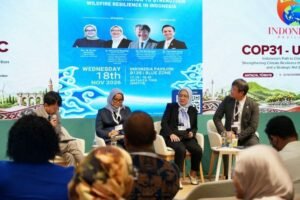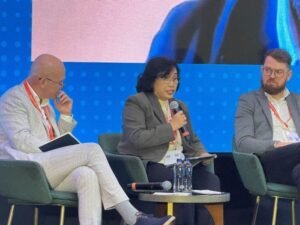






EduAsiNews, Antalya – Indonesia is promoting the development of sustainable financing that not only supports the restoration of degraded peatlands but also provides incentives for the protection of intact peat ecosystems as well as the empowerment of communities involved in their management. This approach was presented by the Forestry Minister’s Expert Staff for Climate Change, Haruni Krisnawati, during the session “The Peatlands Finance Case: Unparalleled Carbon, Water and Resilience Returns Based on Offer” at the 9th Global Landscapes Forum (GLF) Investment Case Symposium in Antalya, Türkiye, Wednesday (11/18), coinciding with the COP31 UNFCCC event.
The forum, organized by the Global Peatlands Initiative (GPI), discussed opportunities for developing peatland financing through various instruments, ranging from grants and results-based funding to blended finance and long-term investments. The discussion brought together international financial institutions, conservation organizations, investors, and experts to explore approaches that can expand the protection and restoration of peatland ecosystems.
At the forum, Haruni shared Indonesia’s experience in developing results-based REDD+ finance through cooperation with the Norwegian Government and the Green Climate Fund (GCF). Through partnerships with Norway, Indonesia previously contributed US$216 million to emission reduction achievements from the forestry sector. At the COP31 series, Norway again announced a fifth phase contribution of US$100 million in recognition of Indonesia’s performance in reducing emissions from deforestation and forest degradation.
According to Haruni, this experience shows that results-based funding can be implemented on a national scale if supported by strong policies, credible monitoring systems, clear institutions, and sustainable international partnerships. However, international financing support must be able to translate into concrete actions on the ground, including strengthening ecosystem management capacity and providing direct benefits to communities.
Indonesia has around 24 million hectares of peat ecosystems that play an important role in storing carbon, regulating water management, protecting biodiversity, and supporting community life. Therefore, peatland protection is a strategic part of implementing Indonesia’s FOLU Net Sink 2030 as well as efforts to mitigate and adapt to climate change.
Haruni emphasized that so far, peatland financing has largely been directed towards restoring degraded areas, rewetting, and emission reduction. In fact, protecting intact peat ecosystems also requires long-term financing support to maintain their ecological functions and prevent damage risks from an early stage.
“Keeping peatlands moist, preventing degradation, and reducing fire risk are important investments for climate resilience. Prevention efforts need to receive funding attention that is as important as restoration,” he explained.
The REDD+ experience can serve as a lesson for developing peatland protection incentive mechanisms. However, not all peat conservation activities automatically generate carbon credits. Therefore, Indonesia encourages the utilization of various complementary sources of financing, including public funding, concessional financing, performance-based incentives, and responsible private investment while maintaining environmental integrity.
In the session, Pascal Martinez from the Global Environment Facility (GEF) highlighted the importance of connecting sustainable investment with the needs of projects on the ground. Anton Willems from Profonanpe shared his experience financing conservation in Peru, while Felipe Lesmes-Palacio from The Nature Conservancy emphasized the ongoing funding opportunities for peat protection. Matt Robinson from the Landscape Finance Lab discusses the potential of carbon-based financing, biodiversity, and water management services. Alexander Kornelsen from Mission to Marsh highlighted the opportunity for peatland monitoring technology innovation, while Dianna Kopansky from the United Nations Environment Programme (UNEP) highlighted the importance of international cooperation in developing peat ecosystem funding.
Haruni also emphasized that local communities must be positioned as primary partners in peatland protection and management, not merely as beneficiaries. Financing support needs to open opportunities for community participation in monitoring peatland conditions, fire prevention, ecosystem restoration, as well as developing sustainable business and livelihood activities.
Through this international forum, Indonesia emphasized the importance of a financing approach that gives balanced attention to the restoration of degraded peatlands, damage prevention, and protection of intact peatlands. The Ministry of Forestry encourages strengthening collaboration with development partners, financing institutions, conservation organizations, and the business world so that peat investment not only yields climate benefits but also strengthens ecosystem resilience and sustainable community welfare. (*)