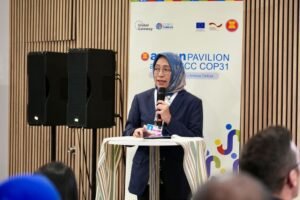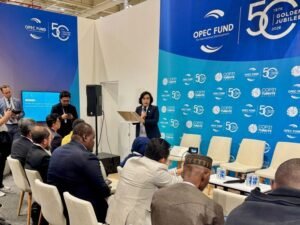





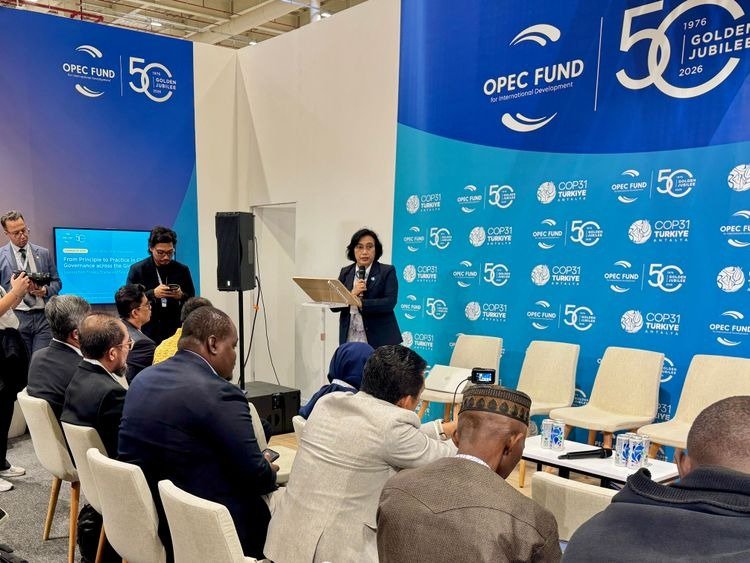
EduAsiaNews, Antalya Turkiye – The Forestry Ministry has stressed that the success of climate action cannot be measured by greenhouse gas emission cuts alone but must also deliver real and fair benefits to communities. The principle was outlined by Haruni Krisnawati, the forestry minister’s expert staff for climate change, in a keynote address at a session titled “Justice You Can Prove: From Principle to Practice in Climate Governance across the Global South: Lessons from Energy, Forests and Subnational Action” at the OPEC Fund for International Development Pavilion at the 31st session of the Conference of the Parties to the UN Framework Convention on Climate Change (COP31) on Monday.
At the forum, Haruni said credible climate action must integrate environmental targets with the protection of community rights, meaningful participation and the fair and transparent sharing of benefits. This is increasingly important in forest management, she said, because local and indigenous communities play a direct role in preserving ecosystems.
“Climate justice must be provable through emission reduction results as well as fair and tangible benefits for communities,” Haruni said.
According to Haruni, the forestry sector plays a strategic role in achieving Indonesia’s climate commitments under its Nationally Determined Contribution (NDC) and the Forestry and Other Land Use (FOLU) Net Sink 2030 agenda. Implementation covers reducing deforestation and forest degradation, protecting biodiversity, restoring ecosystems and managing forests sustainably. However, she said, the success of these efforts must be accompanied by stronger governance to ensure that communities also benefit from forest protection.
To achieve this, the ministry stressed three key aspects in applying climate justice in the forestry sector: stronger governance and environmental and social safeguards, recognition of community rights and equitable benefit sharing, and evidence-based transparency and accountability. These are needed so that climate action can be monitored, evaluated and openly held to account.
Indonesia continues to strengthen its policy framework to support these principles, including through Forestry Minister Regulation No. 6 of 2026 on forest carbon trading. Strengthening social forestry and recognizing customary forests are also important to ensure that forest protection goes hand in hand with stronger rights, better livelihoods and community participation in decision-making.
Indonesia’s experience in implementing REDD+ and results-based financing offers important lessons on applying social and environmental safeguards, involving communities and designing benefit-sharing mechanisms. Cooperation under the Green Climate Fund (GCF), the Indonesia-Norway partnership, the Forest Carbon Partnership Facility (FCPF) Carbon Fund in East Kalimantan and the BioCarbon Fund Initiative for Sustainable Forest Landscapes (BioCF-ISFL) in Jambi is part of the country’s experience in linking climate mitigation with governance and development benefits on the ground.
Haruni added that the success of the FOLU Net Sink 2030 agenda requires synergy among the central and regional governments, forest managers, communities and development partners. Such coordination is needed so that the national commitment can be translated into effective, measurable programs that deliver real benefits to communities that help protect forests.
The session, organized by the Research Center for Climate Change at the University of Indonesia (RCCC-UI) with support from the Ford Foundation, also featured a keynote address by the deputy for climate change control and carbon economic value governance at the Environment Ministry/Environmental Control Agency. The discussion involved RCCC-UI researchers and representatives of the Home Ministry, the Riau provincial administration, the OPEC Fund and other partners. One topic was the experience of the GREEN for Riau program in preparing jurisdictional REDD+ with attention to environmental and social safeguards, community rights and benefit-sharing mechanisms. The forum also discussed input for strengthening just climate governance, including in the context of the draft law on equitable climate change control.