




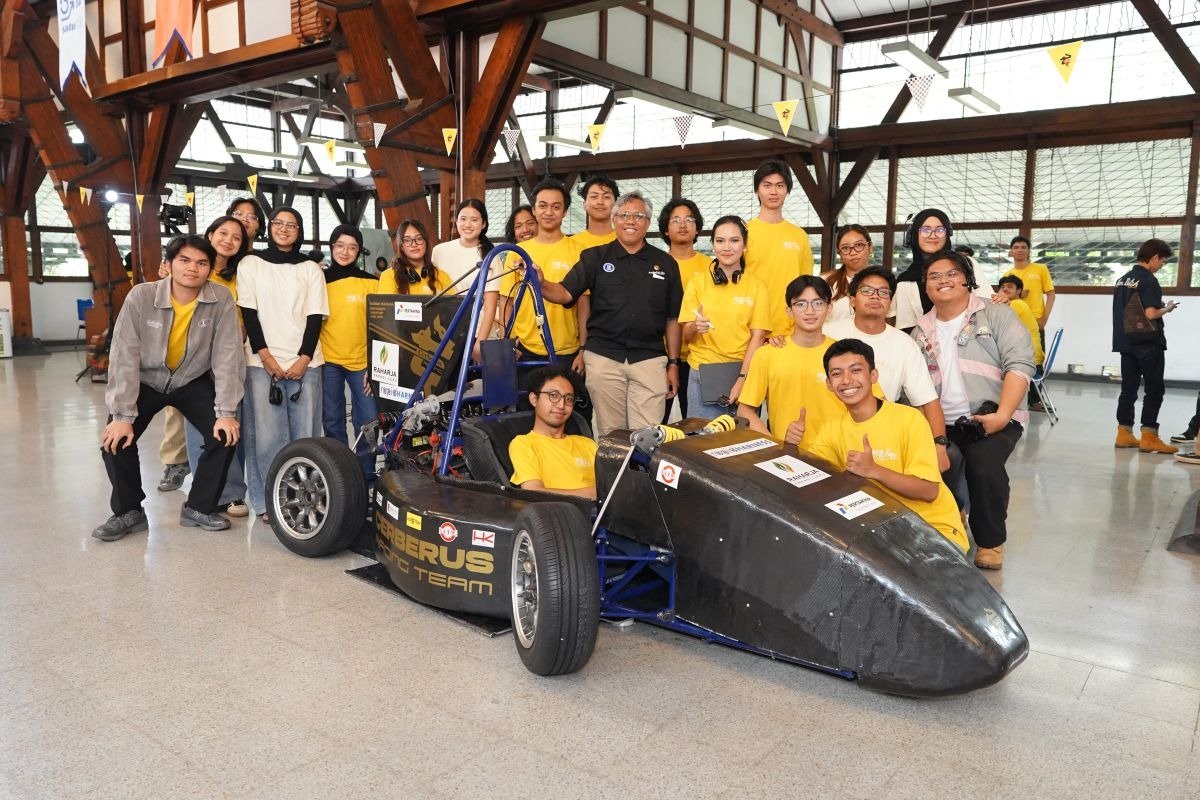
EduAsiaNews, Bandung – The Cerberus Racing Team (CRT) officially unveiled CRT-02, its latest Formula Student race car, developed as the result of a comprehensive evaluation of its predecessor. The launch took place at ITB’s West Hall on Monday (June 23, 2026) during the Grand Launch of CRT-02, marking the team’s readiness to compete in the Formula Student competition in Japan. The development of CRT-02 reflects an engineering approach centered on iterative improvement, cost efficiency, regulatory adaptation, and multidisciplinary collaboration involving students from various engineering programs at the Bandung Institute of Technology (ITB).
Development Background and Regulatory Adaptation
CRT-02 was conceived through a thorough evaluation of the previous-generation vehicle while incorporating adjustments to evolving international Formula Student regulations. Rather than merely refining the existing design, the team undertook a comprehensive redesign of the vehicle’s systems.
Muzhaffar Omar Priambodo, Team Leader of the Cerberus Racing Team ITB, explained that the new development strategy was strongly influenced by the team’s experience in previous competitions.
“CRT-02 is our second Formula Student car, developed based on the evaluation of CRT-01, which we competed with in Japan last year,” he said.
In addition to lessons learned from previous competitions, regulatory changes became a major driving force behind the redesign of the chassis and overall vehicle system. Consequently, CRT-02 features significant structural differences from its predecessor, including revised vehicle dimensions, improved driver ergonomics, and a simplified aerodynamic configuration.
Engineering Innovation: Student-Built ECU and an Efficient Aerodynamic Approach
CRT-02 incorporates a range of engineering innovations independently developed by students, most notably a student-built Electronic Control Unit (ECU) for engine management. The system was designed to optimize engine performance while significantly reducing costs compared to commercially available ECU systems.
The vehicle’s aerodynamic concept has also been substantially simplified. Components such as the front wing and rear wing have been eliminated and replaced with an alternative design approach utilizing a sharp rear fin, resulting in a more efficient and streamlined configuration.
The team also introduced innovations in steering system personalization and expanded the use of various carbon composite materials to achieve an optimal balance between structural strength and weight efficiency.
Omar emphasized that resource limitations became a catalyst for technical innovation.
“We developed our own ECU because commercially available ECUs are quite expensive, and we wanted to reduce costs,” he explained.
This approach demonstrates how resource constraints can encourage creative, context-driven engineering solutions while maintaining competitive performance.
Development Process
The development of CRT-02 encompassed multiple stages, including digital design, component fabrication, and gradual vehicle system integration carried out collaboratively by the team’s various technical divisions.
Multidisciplinary Collaboration and Future Development
The development of CRT-02 involved students from multiple disciplines, including mechanical engineering, electrical engineering, industrial engineering, and product design. The project was further strengthened through support from ITB faculty members, university laboratories, and industry partners.
The team also utilized facilities such as makerspaces, manufacturing engineering laboratories, and specialized vendors for the fabrication of selected components. This collaborative ecosystem created an integrated project-based learning environment that bridged academic knowledge with industrial practice.
Looking ahead, CRT-02 is expected to continue evolving through an iterative development cycle and may be utilized in more than one international competition.
Omar highlighted the importance of continuous learning throughout the team’s development process.
“We want this car to keep evolving, to be used in future competitions, and to continue improving based on the results of our testing,” he said.
During the launch event at ITB’s West Hall, ITB Rector Prof. Dr. Ir. Tatacipta Dirgantara, M.T. also emphasized the importance of consistency and perseverance in innovation. He encouraged the team to continue innovating and to appreciate every stage of the engineering journey, stressing that continuous development is the key to long-term success.
Through its iterative engineering approach, multidisciplinary collaboration, and innovations driven by practical constraints, CRT-02 represents more than a competition vehicle. It stands as a testament to modern engineering education at ITB, demonstrating the institution’s commitment to producing adaptive, innovative engineers capable of addressing global technological challenges.