




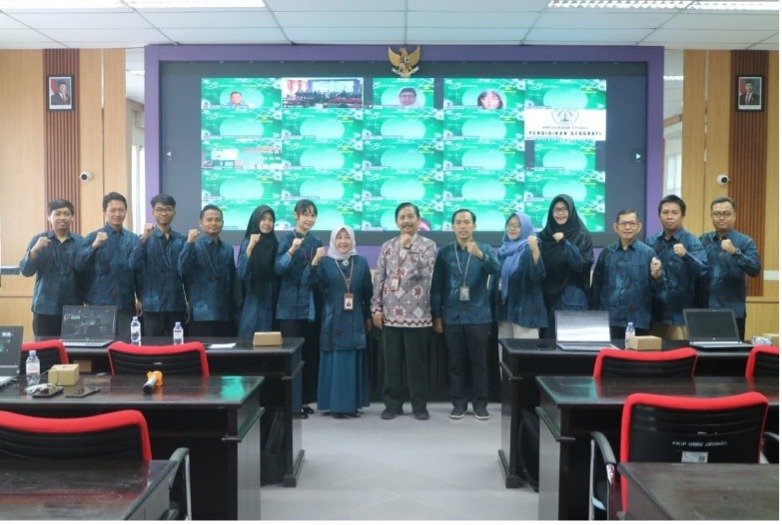
EduAsiaNews, Jember — Heavy rain that arrives suddenly, increasingly prolonged dry seasons, and recurring floods and landslides have become part of everyday life in Indonesia. Against this backdrop, the Geography Education Study Program at the Faculty of Teacher Training and Education (FKIP) of the University of Jember (UNEJ) held a book review session for Meteorology and Climatology, written by Prof. Dr. Sri Astutik, M.Si., on Thursday (Oct. 15, 2026).
The hybrid event, held in person at Building A of UNEJ’s FKIP and online via Zoom, featured two discussants with complementary backgrounds: Teguh Tri Susanto, S.Si., M.T., head of the Banyuwangi Meteorological Station, representing the Meteorology, Climatology and Geophysics Agency (BMKG), and Dr. Emilya Nurjani, S.Si., M.Si., a lecturer at the Faculty of Geography at Gadjah Mada University (UGM), representing academia. The discussion was moderated by Alif Putra Lestari, M.Pd., and attended by lecturers and students.
In her remarks, Prof. Sri Astutik, who also serves as coordinator of UNEJ’s Geography Education Study Program, emphasized that a book review is more than an opportunity to assess a publication; it is also a means of developing the competencies of students and lecturers.
“The book review process can help develop the competencies of both students and lecturers, as meteorology and climatology are fundamental to creating a healthy and sustainable environment,” she said.
UNEJ FKIP Dean Dr. Mohammad Na’im, M.Pd., echoed this view, describing book reviews as a way to broaden knowledge. He expressed hope that the discussants would offer valuable insights, particularly into strengthening competencies in meteorology and climatology.
A Textbook Developed to Meet Course Requirements
Opening the presentation session, Prof. Sri Astutik explained that the textbook, published in 2022 and assigned an International Standard Book Number (ISBN), was developed in accordance with the semester learning plan for the Meteorology and Climatology course and the university’s textbook guidelines. It is intended as introductory learning material for undergraduate students.
The book covers 13 main topics, including the atmosphere and its dynamics, air pressure and isobars, Earth’s movements, solar radiation, air masses and adiabatic processes, wind and evaporation, evapotranspiration, humidity and clouds, and rainfall and its distribution. Subsequent sections discuss meteorological instruments and field-practical data processing, before concluding with climate classification and the relationship between climate and human life, including agriculture, health and natural resource management.
According to Astutik, who has authored 12 ISBN-registered books, the review aimed to identify the textbook’s strengths, limitations and opportunities for improvement, while determining its potential benefits for teaching, research and community service.
A Practitioner’s Perspective: Theory Must Lead to Public Safety
As the first discussant, Teguh Tri Susanto said the book provides an important scientific foundation for students seeking to understand the atmosphere and weather phenomena. From BMKG’s perspective, however, theoretical knowledge must be complemented by the ability to analyze observational data, understand atmospheric dynamics, produce evidence-based forecasts, verify results and translate findings into early warnings for extreme weather that can help protect public safety.
He also offered several recommendations concerning terminology. He suggested replacing the Indonesian terms ramalan and peramal with prakiraan (forecast) and prakirawan (forecaster), respectively, in line with Law No. 31 of 2009 on Meteorology, Climatology and Geophysics and BMKG’s operational standards. He noted that the term pesawat meteorologi could be mistaken for an aircraft and recommended replacing it with peralatan meteorologi or instrumentasi meteorologi (meteorological equipment or instrumentation), accompanied by a discussion of Automatic Weather Stations (AWS).
Teguh also clarified several scientific concepts. El Niño and La Niña, for example, are not storms but climate phenomena involving interactions between sea-surface temperatures and the atmosphere in the Pacific Ocean, collectively known as the El Niño–Southern Oscillation (ENSO). He also stressed the importance of understanding atmospheric stability: an unstable atmosphere does not automatically produce heavy rain, as triggering mechanisms and sufficient water vapor are also required.
“A good forecast is not merely one that is scientifically accurate, but one that people can use,” Teguh said.
For future editions, he proposed adding local case studies based on observational data, exercises in interpreting radar and satellite imagery, synoptic charts and numerical model outputs, as well as material on extreme weather, hydrometeorological disasters and weather modification operations.
An Academic Perspective: Restructuring Content to Improve Learning
The second discussant, Dr. Emilya Nurjani, began by commending the author’s contribution to the body of knowledge in meteorology and climatology. She said textbooks of this kind were increasingly relevant amid changing rainfall patterns, rising temperatures and growing risks from hydrometeorological disasters.
“Understanding atmospheric processes and climate dynamics is no longer merely an academic requirement; it is also an important foundation for decision-making,” she said.
From a structural perspective, Emilya recommended reorganizing the 191-page textbook into 14 chapters to align with the number of class meetings in a semester. She also suggested adding chapter summaries, key terms, a glossary and an index. She noted that climatology needed greater emphasis and recommended consolidating the material on climate classification, which is currently spread across different sections, into a single chapter.
In terms of content, she proposed adding an introductory chapter distinguishing meteorology from climatology and weather from climate, as well as introducing weather parameters with solar radiation as the primary source of energy. She also recommended revising several chapter titles, including using “Precipitation” for the chapter on rainfall, “Air Circulation” for the chapter on wind, and “Meteorological Measurements” for the chapter on equipment.
In addition, she encouraged a more detailed discussion of the differences between climate change and climate variability, including the effects of ENSO and the Madden–Julian Oscillation (MJO) on Indonesia.
Two Perspectives, One Shared Goal
Although the two discussants approached the book from different perspectives, they agreed on one central point: meteorology and climatology textbooks must be closely connected to Indonesia’s atmospheric conditions, from monsoons, ENSO and MJO to extreme weather, as well as to data-processing practices that meet BMKG and World Meteorological Organization (WMO) standards.
The recommendations are expected to provide valuable input for improving future editions of the textbook.
Through the event, UNEJ’s Geography Education Study Program reaffirmed its commitment to bridging academia and professional practice, ensuring that graduates not only understand theory but are also prepared to contribute to climate change adaptation and mitigation efforts.