




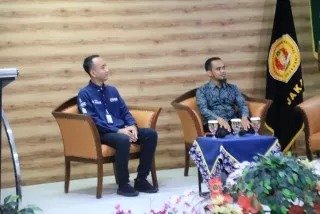
EduAsiaNews, Jakarta – Family financial management should focus not only on income, expenses, and investments, but also on maintaining harmonious relationships and fostering children’s character development. This was one of the key points raised by Dr. Krisno Septyan, S.E., M.S.Ak., SAS., a lecturer at the Faculty of Economics and Business at Universitas Pembangunan Nasional “Veteran” Jakarta (UPNVJ), during the 2026 UPNVJ Dharma Wanita Persatuan (DWP) webinar on Monday, October 26, 2026.
In his presentation, titled “Household Accounting: Digital Ethics, Parental Roles, and Financial Management,” Krisno invited participants to take a broader perspective on household management.
He explained that household accounting differs from corporate accounting. While corporate accounting focuses on resource management and financial performance, household accounting also encompasses social relationships, responsibilities, and the values upheld by a family.
Krisno noted that household accounting cannot be separated from other social sciences.
He emphasized that family financial management should aim not merely to increase material wealth, but also to foster a harmonious family life.
One topic he explored was the importance of distinguishing between a family’s needs and its desire to acquire assets.
Krisno explained that household financial planning generally covers budgeting, routine expenses, savings, and investments. However, he cautioned that peace of mind is not necessarily determined by the amount of wealth a family possesses.
Drawing on a religious values-based approach to household accounting, Krisno encouraged participants to view financial management as a means of building a better family life.
Beyond financial management, Krisno discussed the division of roles and responsibilities within the family.
He highlighted the importance of transparency in financial matters, including awareness of a family’s assets and liabilities. This is particularly relevant when a family faces unexpected circumstances, such as the death of a family member who has traditionally managed its finances.
The discussion then turned to parents’ role in determining their children’s educational priorities.
According to Krisno, high education costs do not necessarily guarantee a high-quality education. Parents should consider values, character development, and educational goals when choosing a learning environment for their children.
He also stressed that responsibility for educating children cannot be delegated entirely to schools.
Parents remain central to supporting their children’s growth and development, including by instilling good habits and setting an example in everyday life.
In the context of technological advances, Krisno highlighted the importance of supervising children’s use of digital devices.
He encouraged parents to pay attention to the content their children consume and their social circles, while setting appropriate limits on digital device use according to their needs and stages of development.
He noted that parental involvement is essential to maintaining a balance between the benefits of technology and children’s character development.
Krisno emphasized that family success cannot be measured solely by material wealth or children’s academic achievements.
Harmonious relationships, character education, and parental responsibility are also essential to building resilient families.
The discussion aligned with the theme of the UPNVJ DWP webinar, which focused on building resilient families in the digital era.
Through the event, UPNVJ provided an educational forum connecting academic knowledge with everyday challenges, particularly in financial management, children’s education, and the responsible use of technology.(www.upnvj.ac.id)