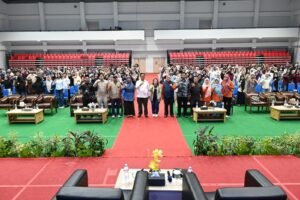





EduAsiaNews, Jakarta — Strengthening the quality of university lecturers is key to improving the quality and competitiveness of higher education. Through its fifth Masterclass, titled “Mapping Out Lecturers’ Career Paths: Assessing Academic Alignment for Functional Promotion,” held on Friday (Sept. 18), the Indonesian Association of Communication Science and Higher Education (ADPIKI) encouraged lecturers to plan their academic careers by linking expertise, research, publications and community service, so that career advancement reflects tangible contributions to the development of knowledge and the needs of society.
ADPIKI chairman Heri Budianto stressed the importance of career planning that connects the development of expertise, publication quality and contributions to society, ensuring that academic promotion goes hand in hand with improvements in the quality of higher education.
“Lecturers need to have a clear direction for developing their academic expertise from the outset. A career roadmap will help lecturers connect teaching, research and community service into a consistent and impactful academic track record,” Heri said.
The masterclass explored strategies for developing academic careers through portfolio management, research continuity and stronger links between education and areas of expertise.
Heri said that understanding the requirements for academic promotion must be accompanied by the ability to plan academic activities in a focused manner. This would allow research, publications and community service activities to reinforce one another while demonstrating lecturers’ contributions to their respective fields.
He said professional associations had an important role to play in providing learning opportunities, facilitating the exchange of experience and expanding networks to help lecturers plan their career development more systematically.
“Through this masterclass, we want to strengthen lecturers’ understanding of how to build high-quality academic portfolios, uphold integrity and produce work that benefits the development of knowledge and society,” he said.
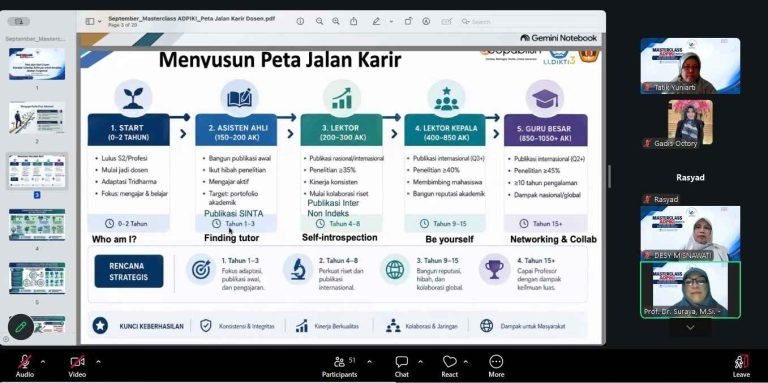
Meanwhile, ADPIKI’s Department of Lecturer Career Development head, Prof. Suraya, said a career roadmap helped lecturers identify their academic standing, set development targets and plan research and publications from an early stage.
She said such planning should be tailored to each stage of an academic career, from adapting to the implementation of the three pillars of higher education — teaching, research and community service — to strengthening research and collaboration, and eventually building academic reputation and leadership.
“A career roadmap helps lecturers set priorities. With clear direction, teaching, research, collaboration and publications can be planned to support the sustainable development of expertise,” she said.
Suraya stressed the importance of the quality of scholarly work, including its relevance, originality, methodological rigour and the usefulness of its findings. Publication productivity, she said, should be accompanied by recognisable contributions to the development of knowledge and the resolution of societal problems.
She also highlighted the importance of community service activities that are aligned with lecturers’ areas of expertise, involve students and are supported by documentation of their outcomes and benefits.
Such an approach would enable lecturers’ portfolios to demonstrate a coherent relationship between the learning process, knowledge development and its application in society.
Also speaking at the event, Prof. Aan Widodo, a professor of legal communication at Bhayangkara Jakarta Raya University and head of ADPIKI’s Central Executive Board’s Professional Certification Division, said academic alignment should be understood through the connection between educational background, expertise, scholarly work and the impact of the three pillars of higher education.
According to Aan, lecturers need to demonstrate a clear link between their educational background and their research focus, publications, teaching and community service.
“Alignment should be evident in the continuity of ideas. A doctoral degree provides the foundation for developing a research agenda, which is then strengthened through publications, teaching and community service that move in mutually supportive academic directions,” he said.
He explained that academic alignment had both administrative and substantive dimensions. The administrative dimension concerns the completeness and conformity of required documents, while the substantive dimension demonstrates the expertise and academic contributions developed through an academic track record.
Aan urged lecturers to continue developing their doctoral research into a long-term research agenda after completing their degrees. Such development could involve new contexts, approaches or problems while remaining connected to the original field of expertise.
“Research topics may evolve, but the connection between works should remain evident. That is how expertise develops and becomes recognisable through consistent contributions,” he said.
He cited the development of research on courtroom communication into expertise in legal communication, encompassing virtual court proceedings, courtroom journalism, judicial transparency and legal communication through social media.
The discussions at the masterclass underscored the importance of using career roadmaps as a guide for improving lecturers’ professional quality. Continuity of expertise, academic integrity, collaboration and contributions through the three pillars of higher education serve as foundations for career development while strengthening the benefits of higher education to society.