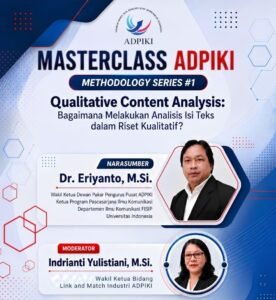





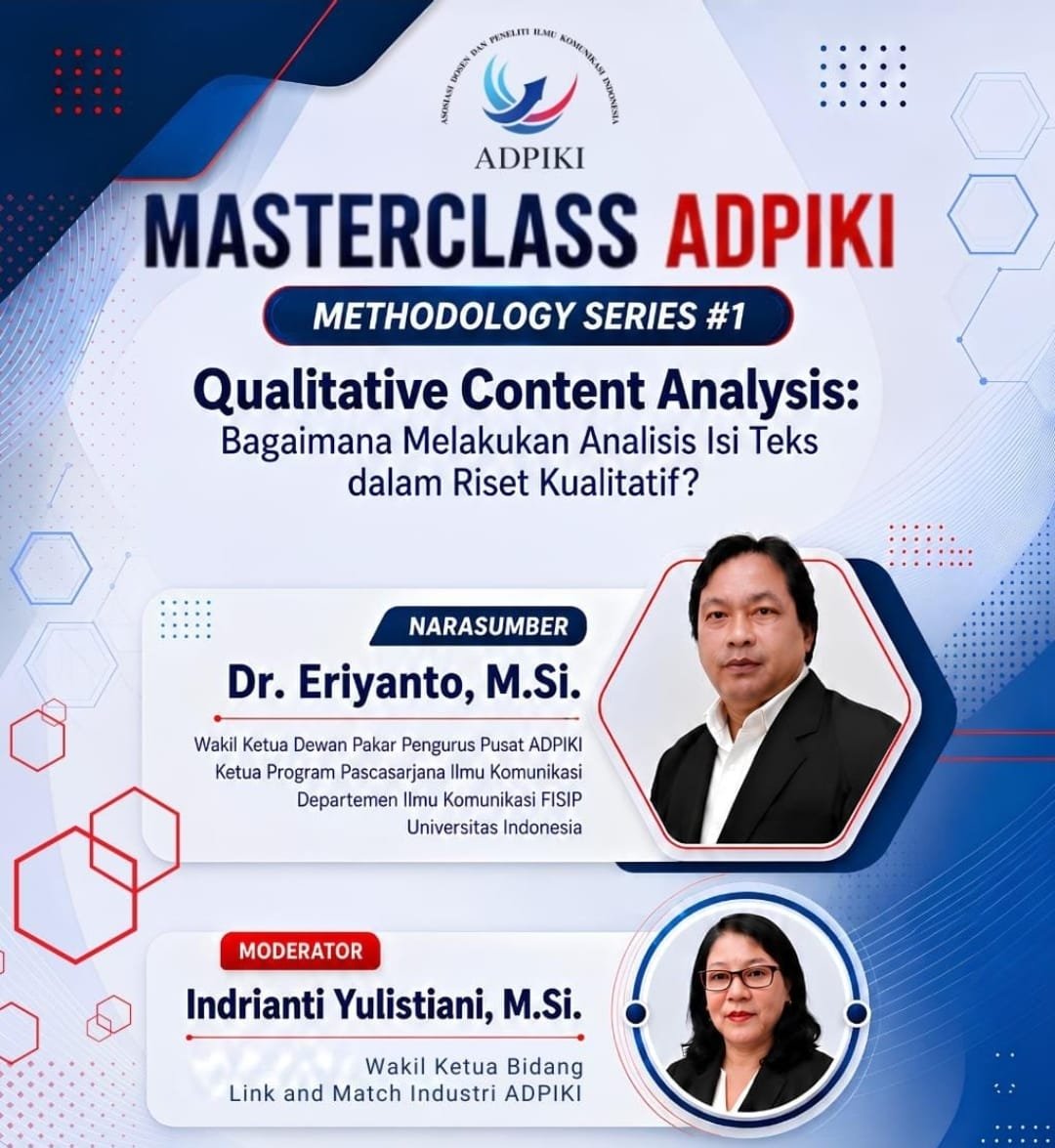
EduAsiaNews, Jakarta — The Indonesian Association of Communication Science Lecturers and Researchers (ADPIKI) is strengthening the methodological competencies of its members through the “ADPIKI Methodology Series #1” Masterclass, which focused on the application of qualitative content analysis in communication research on Friday (August 21, 2026).
Held online, the session featured Dr. Eriyanto, M.Si., Vice Chair of the ADPIKI Central Executive Board’s Expert Council and Head of the Graduate Program in Communication Science, Department of Communication Science, Faculty of Social and Political Sciences (FISIP), Universitas Indonesia, as the speaker.
“Qualitative content analysis is a method for systematically analyzing texts, images, news reports, advertisements, films, and other forms of communication by organizing data into categories to identify and interpret meanings relevant to the research question,” Eriyanto said.
He explained that categories in qualitative content analysis can be developed deductively based on theory, inductively from the data, or through a combination of both approaches.
According to Eriyanto, qualitative content analysis differs from quantitative content analysis, semiotics, and discourse analysis. Quantitative content analysis focuses more on measuring the frequency and distribution of categories, while semiotics examines the meaning of signs and discourse analysis explores the construction of language, identity, and power relations.
Qualitative content analysis, meanwhile, is used to systematically identify patterns, categories, themes, and meanings within communication materials while allowing researchers to account for the context of the data.
“Qualitative content analysis is not free-form interpretation. The interpretation process must be guided by clear rules, from determining the unit of analysis and developing categories to conducting coding trials and applying categories consistently across the entire research dataset,” he said.
Eriyanto also highlighted the importance of a coding frame, which consists of main categories and subcategories. Main categories establish the aspects that are the focus of the research, while subcategories describe more specific variations in meaning found in the data.
A coding framework helps researchers reduce complex data, focus on information relevant to their research questions, and identify patterns and relationships between categories in a more structured manner.
During the masterclass, Eriyanto also introduced three qualitative content analysis designs: structural qualitative content analysis, evaluative qualitative content analysis, and qualitative content analysis for developing types or typologies.
Structural analysis is used to organize and interpret thematic patterns in data. Evaluative analysis assesses the degree or orientation of particular content, while typology-building analysis groups cases according to similarities and differences in specific characteristics.
The masterclass also examined a range of research examples, including the representation of women activists on social media, the gender performativity of women politicians, visual framing of political candidates on Instagram, and the development of typologies of Indonesian horror films.
Eriyanto emphasized the importance of transparency throughout every stage of the research process, including explaining how categories are developed, data are coded, categories are revised, findings are interpreted, and empirical evidence is selected.
“Quotes are not merely illustrations; they are evidence showing that the researcher’s categories and arguments are genuinely grounded in the data,” he said.
Through Methodology Series #1, ADPIKI is providing a platform to strengthen the research capacity of lecturers and researchers, enabling them to produce qualitative studies that are systematic, transparent, contextual, and scientifically accountable.