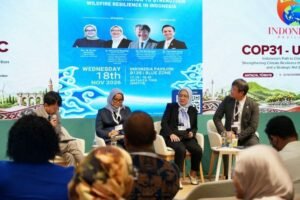





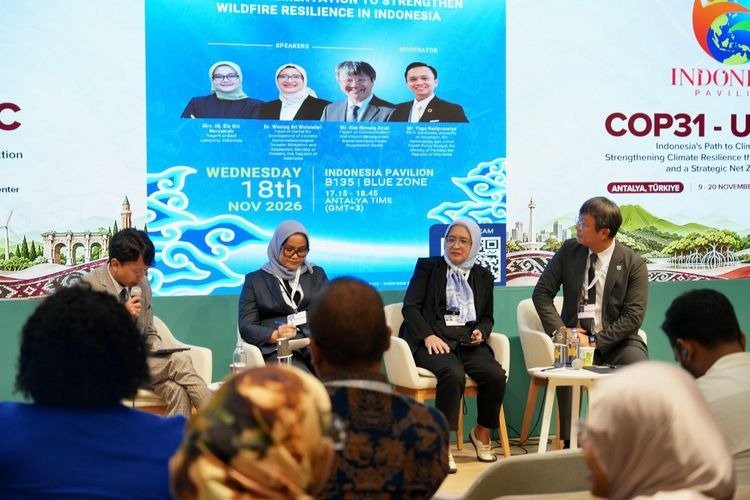
EduAsiaNews, Antalya – The Ministry of Forestry is strengthening community-based control of forest and land fires (karhutla) through capacity building of Fire Care Communities (MPA), technology utilization, and post-fire ecosystem restoration. This approach was discussed in the dialogue session “Community-Based Fire Management (CBFiM) Implementation to Strengthen Wildfire Resilience in Indonesia” at the Indonesia Pavilion at the 31st United Nations Climate Change Conference (COP31 UNFCCC), Antalya, Turkey.
Indonesia has developed the MPA program since 2004 to strengthen community involvement in the prevention and handling of forest and land fires. By 2026, there are 14,070 MPA members spread across 35 provinces. The presence of the MPA complements the role of the Ministry of Forestry’s Manggala Agni in patrol activities, fire risk monitoring, early detection, early extinguishing, and strengthening community preparedness.
The experience of cooperation between Indonesia and South Korea in restoring the Londerang Peatland Protected Forest (HLG) in Jambi Province is one example of applying this approach. Through a collaboration carried out by the Korea–Indonesia Forest Cooperation Center (KIFC), restoration was carried out on an area of 200 hectares involving communities from 10 villages around the area. The activity applied the 3R approach, namely rewetting peat, revegetation, and revitalization of community livelihoods.
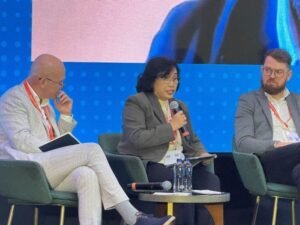
In his presentation, Kim Hyoung Gyun from KIFC explained that the program in Londerang includes the construction of 20 canal blocks, the installation of 12 automatic water level monitoring stations, and the planting of 120,560 local peat tree seedlings. Based on the crop census results presented, as many as 117,952 seedlings were recorded as alive, or about 97.8 percent. This program also involves the community in seed provision, infrastructure restoration development, monitoring, and the development of village economic activities.
In addition to ecosystem restoration, communities develop various productive businesses adapted to local potential, such as fish farming, animal husbandry, agricultural product processing, and agroforestry. Community involvement from the planning stage is an important lesson that peatland restoration will be more sustainable if the community gains economic benefits while also playing a role in protecting the area from recurring fire threats.
A similar experience was also developed through the RePeat approach in the Forest Area with Special Purpose (KHDTK) Tumbang Nusa, Central Kalimantan. The initiative, presented by Wening Sri Wulandari from the Ministry of Forestry, involved 169 organizations in 33 collaborative planting activities on an area of about 28 hectares of peatland. This program emphasizes the principle of ‘rewet first, then plant,’ which is ensuring peatland conditions are sufficiently wet before planting, as well as developing collaboration between the government, academics, business world, community, and media.
From the local government perspective, the Regent of East Lampung, Ella Siti Nurmayah, highlighted the importance of strengthening community resilience around Way Kambas National Park. The East Lampung Regency Government is finalizing the roadmap for developing the economy of villages around the national park by integrating livelihood strengthening, ecosystem protection, fire risk reduction, as well as handling human-wildlife conflicts. “Caring for nature and helping the community must go hand in hand. We want our children to grow up healthy and have better life opportunities,” Ella said in her speech.
Through the COP31 forum, the Ministry of Forestry emphasized that controlling forest and land fires requires a comprehensive approach that connects prevention, preparedness, early handling, ecosystem restoration, and improving community welfare. Strengthening collaboration between Manggala Agni Kemenhut, MPA, local governments, research institutions, the business world, and international partners is expected to enhance the resilience of forest and peatland areas to fire while supporting the achievement of Indonesia’s FOLU Net Sink 2030. (*)