




EduAsiaNews, Antalya — The Ministry of Forestry (Kemenhut) is bringing concrete breakthroughs to the global climate diplomacy stage at the United Nations Climate Change Conference (COP31) in Antalya, Türkiye. Rather than merely expressing its commitment to conservation, Indonesia is actively presenting a blueprint for the future of national conservation through three strategic initiatives.
At the international forum, the Indonesian Government, through the Ministry of Forestry, is promoting innovative financing schemes for 13 priority national parks, institutional transformation towards Public Service Agency (BLU) status, and stronger carbon investment cooperation with Japan to restore 12 million hectares of degraded land.
These integrated initiatives at the international forum reaffirm that, under the leadership of Minister of Forestry Raja Juli Antoni, Indonesia’s forestry diplomacy is directed towards delivering measurable ecological impacts and sustainable financing at the local level, while ensuring that management sovereignty remains entirely in the hands of the state.
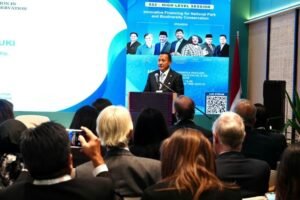
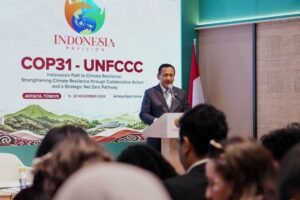
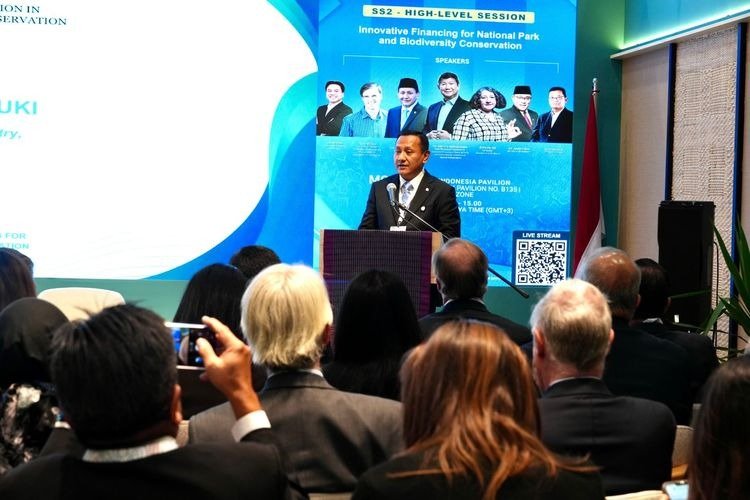
On the sidelines of COP31 in Antalya, Türkiye, Deputy Minister of Forestry Rohmat Marzuki reaffirmed the Ministry of Forestry’s strong commitment to developing innovative conservation financing schemes while strengthening the governance of national parks in Indonesia. These efforts are aimed at establishing a national platform capable of integrating four crucial elements: sustainable financing, institutional strengthening, effective field management, and measurable conservation outcomes.
During a presentation with the Task Force for Innovative National Park Management Financing at COP31, Indonesia proposed a long-term conservation financing plan covering 13 priority national parks and two iconic species conservation landscapes. The scheme is designed to develop various modern financing instruments and open opportunities for multi-stakeholder collaboration involving the government, private sector, and international partners.
Although the scheme opens broad opportunities for global financing collaboration, Deputy Minister Rohmat Marzuki emphasized one non-negotiable principle: the primary authority and responsibility for managing conservation areas must remain entirely in the hands of the Indonesian Government.
“We are directing the development of this innovative conservation financing scheme towards a national platform that integrates sustainable financing, institutional strengthening, effective field management, and measurable conservation outcomes, while ensuring that primary authority and responsibility remain in the hands of the government,” Deputy Minister of Forestry Rohmat Marzuki said at the COP31 forum in Antalya, Türkiye.
To ensure that the initiatives presented at COP31 do not stop at the international negotiation table, the Ministry of Forestry, under the leadership of Minister Raja Juli Antoni, has prepared a domestic implementation roadmap. The minister is committed to following up on this major plan by comprehensively strengthening conservation area governance and accelerating institutional transformation.
As a concrete initial step, the Ministry of Forestry is preparing to transform the management of four priority national parks into Public Service Agencies (BLUs): Komodo National Park, Bromo Tengger Semeru National Park, Mount Rinjani National Park, and Way Kambas National Park.
Through the BLU transformation at these four iconic national parks, greater flexibility in financial management and improvements in the quality of ecotourism and conservation services are expected, allowing them to become models for the management of other national parks across the country.
In addition to exploring innovative financing for conservation areas, the Ministry of Forestry delegation at COP31 is also strengthening green economic diplomacy by enhancing forestry carbon cooperation between Indonesia and Japan. This bilateral partnership focuses on attracting carbon investment that will be directed towards accelerating ecosystem rehabilitation in Indonesia.
Through this carbon cooperation with Japan, Indonesia is targeting strategic investment to restore at least 12 million hectares of degraded land across various regions. This approach demonstrates that government-led forestry carbon trading and cooperation are not merely transactions involving emission reductions on paper, but real financing instruments to restore millions of hectares of degraded land while driving the development of the national green economy.
The Ministry of Forestry’s series of breakthroughs at COP31 in Türkiye, ranging from the financing scheme for 13 national parks and two iconic species conservation landscapes, preparations for BLU transformation at four national parks, to Indonesia–Japan carbon cooperation to restore 12 million hectares of land, demonstrate Indonesia’s leadership in delivering sovereign, innovative climate solutions with direct impacts on global forest conservation. (*)