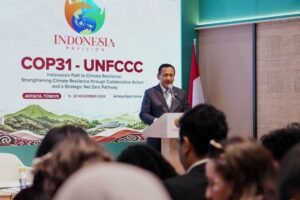






EduAsiaNews, Jakarta — Indonesia is bringing an integrated forest and land fire control strategy to regional and international forums, including the 49th ASEAN Summit in Manila and the 31st United Nations Climate Change Conference (COP31) in Türkiye, as it seeks to strengthen cross-border cooperation, improve forest protection and advance long-term ecosystem restoration.
The Forestry Ministry said on Nov. 12 that its diplomatic efforts were backed by domestic firefighting operations, enforcement measures against companies linked to fire-related violations and new financing mechanisms for conservation and ecosystem recovery.
At COP31, Indonesia is presenting an integrated approach that combines firefighting, prevention, satellite-based monitoring, law enforcement, cross-sector cooperation and accelerated reforestation to address emissions from forest and land fires, particularly amid the threat of El Niño.
The government is also presenting verified data on fire prevention and response as part of its climate diplomacy. These measures are linked to Indonesia’s Forestry and Other Land Use (FOLU) Net Sink 2030 target and include forest protection, peatland restoration, mangrove rehabilitation and reforestation.
Under Forestry Minister Raja Juli Antoni, the ministry is also promoting innovative conservation financing through its National Park Management Financing Innovation Task Force at COP31. The proposed scheme involves the government, philanthropic organizations and the private sector, covering 13 priority national parks and two conservation landscapes focused on iconic species.
Four national parks are also being prepared for potential transformation into public service agencies, known as BLUs, to secure more sustainable funding for conservation and biodiversity protection.
At the regional level, Indonesia is pushing for faster ratification of the agreement establishing the ASEAN Coordinating Centre for Transboundary Haze Pollution Control (ACCTHPC) at the 49th ASEAN Summit in Manila.
The centre, which already has a secretariat in Jakarta, requires ratification by at least six ASEAN member states to become fully operational. According to information from the Foreign Ministry cited in the statement, Vietnam was the only member state to have completed the ratification process at the time of the announcement.
The ACCTHPC is intended to strengthen implementation of the ASEAN Agreement on Transboundary Haze Pollution, which has been in force since 2003. Its operational responsibilities include exchanging air quality data, monitoring hotspots and fire information, providing technical assistance and coordinating cross-border responses.
Indonesia is also strengthening bilateral cooperation with Singapore on information-sharing related to fire management and action against irresponsible business practices.
The ministry said domestic firefighting results had helped underpin Indonesia’s international engagement. Data from its SiPongi monitoring system recorded 55 high-confidence hotspots nationwide, down from 338 the previous day. Hotspots across six priority provinces also fell from 86 to 14.
The ministry noted that monitoring on the night of Nov. 7 had recorded 165 hotspots nationwide, including 17 in the six priority provinces, with Central Kalimantan accounting for most of those detections.
Despite the decline, firefighting, patrols, ground verification, land wetting and mop-up operations are continuing. Particular attention is being given to underground fires in peatlands in South Sumatra and Central Kalimantan, including areas in Pulang Pisau and Barito Utara, where smouldering peat can trigger renewed fires.
Ground and aerial operations are being combined with supporting technologies. The ministry said protecting wildlife habitats, threatened species and affected ecosystems was also a priority.
Alongside prevention and restoration, Indonesia is pursuing administrative and criminal action against individuals and companies linked to forest and land fires.
The ministry has imposed administrative sanctions on 32 corporate legal entities over fire-related violations involving a combined 12,926.74 hectares of land. The sanctions comprise five permit revocations, 19 permit suspensions and eight written warnings or orders to undertake restoration.
The ministry said legal accountability could extend to companies’ beneficial owners, including claims for compensation.
In cooperation with the National Police and the Attorney General’s Office, authorities have issued 334 investigation commencement notices, known as SPDPs, involving 241 individuals and 93 corporations. The cases follow the discovery of fires covering 33,514.01 hectares within concessions held by 57 business entities across eight provinces.
The government has also revoked land-use rights held by 11 companies suspected of involvement in fires in South, West and East Kalimantan. Some of the companies have investors from South Korea, Malaysia and Singapore, according to the ministry.
Field verification is also being strengthened with the National Disaster Mitigation Agency (BNPB) and regional governments for forest-utilization permit holders suspected of fire-related violations in South Papua.
Enforcement has extended to illegal plantations inside conservation areas. In Lamandau Wildlife Reserve, authorities felled 11,180 illegally planted oil palm trees across 88 hectares.
Meanwhile, habitat restoration at Tesso Nilo National Park in Riau has been accompanied by an increase in the number of recorded wildlife species, from 17 in 2024 to 25 in 2026. The species monitored include Sumatran elephants and Sumatran tigers.
The Forestry Ministry said Indonesia’s international proposals were intended to connect immediate fire suppression with stronger regional coordination, corporate accountability and long-term financing for forest conservation and restoration. (*)