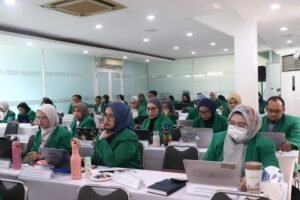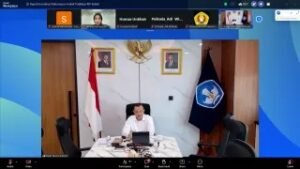




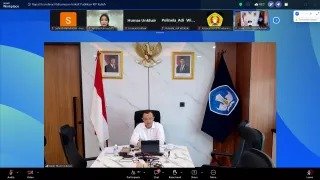
EduAsiaNews, Jakarta — The Public Relations Office of Universitas Pembangunan Nasional “Veteran” Jakarta (UPNVJ) participated in a public relations coordination meeting organized by the Ministry of Higher Education, Science, and Technology (Kemdiktisaintek) on Tuesday (Oct. 27, 2026). Held online via Zoom, the meeting aimed to optimize public communication and strengthen the dissemination of information about the Indonesia Smart College Card (KIP Kuliah) program.
The meeting brought together public relations representatives from state universities (PTNs) and Higher Education Service Institutions (LLDikti) Regions I–XVII. It aimed to strengthen coordination and institutional collaboration to ensure that information about KIP Kuliah is communicated to the public accurately, consistently, and continuously.
The meeting was opened by Kemdiktisaintek Secretary-General Badri Munir Sukoco. In his remarks, he emphasized that KIP Kuliah is an important government instrument for expanding access to higher education for students from economically disadvantaged backgrounds.
He said the program’s success depends not only on the distribution of financial assistance but also on effective public communication to ensure that people understand its benefits, eligibility requirements, procedures, and recipients’ rights.
“University public relations offices are not merely responsible for publications; they are strategic partners of the ministry in ensuring that ministry policies are understood in accordance with their objectives and provisions,” he said.
He also underscored the role of public relations offices in providing accessible information and responding to public questions and emerging issues based on official sources. Effective public communication, he said, should help people gain an accurate understanding of the KIP Kuliah program.
Meanwhile, Sandro Miradi, head of the Center for Higher Education Financing and Assessment (PPAPT), encouraged universities in a recorded video message to strengthen KIP Kuliah publicity through a more people-centered approach. One way to achieve this is by sharing inspiring stories from student and alumni beneficiaries that illustrate how the program has expanded their access to higher education.
He encouraged universities to document the achievements of KIP Kuliah recipients, ranging from academic and extracurricular accomplishments to mentoring activities, skills development, and alumni contributions. Such documentation can serve as material for publications demonstrating the program’s benefits through recipients’ real-life experiences.
“Positive news coverage must be grounded in beneficiaries’ actual experiences and outcomes that can be verified and accounted for,” he said.
At the same meeting, Dina Handini, head of the Public Relations Publication and Documentation Team at Kemdiktisaintek, outlined the ministry’s public communication strategy for KIP Kuliah. The strategy focuses on strengthening narratives about the program’s benefits, optimizing social media, and fostering publication partnerships among the ministry, state universities, LLDikti, and private universities.
The strategy encourages universities to develop regular content plans, feature testimonials from KIP Kuliah recipients, and use storytelling to illustrate the program’s tangible impact. Content should also cover official information, program benefits, recipients’ achievements, and students’ experiences throughout their studies.
“We hope this effort will not be limited to the current period but will continue throughout the year, with content published in rotation covering testimonials, achievements, benefits, official information, and other relevant topics,” she explained.
Kemdiktisaintek called on all state universities and LLDikti offices to publish KIP Kuliah information regularly through their respective communication channels, including social media, official university websites, and partner media outlets. Consistent publication is expected to broaden the reach of information and improve public understanding of the higher education assistance program.
UPNVJ Public Relations’ participation in the coordination meeting forms part of its efforts to strengthen informative and accountable public communication. By disseminating information based on official sources and publishing verified accounts of beneficiaries’ experiences, universities can help promote information transparency and broaden public understanding of access to higher education through KIP Kuliah.(www.upnvj.ac.id)