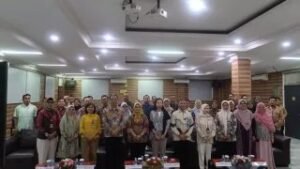





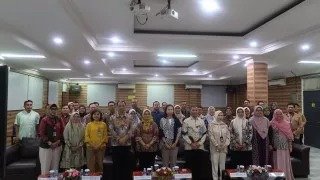
EduAsiaNews, Jakarta – Universitas Pembangunan Nasional “Veteran” Jakarta (UPNVJ) is strengthening risk management practices within its Internal Quality Assurance System (SPMI) through a knowledge-sharing session with the Internal Supervisory Unit of Universitas Jember (SPI UNEJ) on Friday, Oct. 23, 2026. Titled “Implementing Risk Management in the Internal Quality Assurance System,” the event featured two experts from SPI UNEJ who discussed strategies for identifying, evaluating and mitigating risks in higher education. The initiative is part of UPNVJ’s ongoing efforts to improve governance effectiveness, accountability and the quality of academic services.
The speakers were Prof. Dr. Ika Barokah Suryaningsih, S.E., M.M., CRP., QIA., head of SPI UNEJ, and Nova Elmaidah, S.Si., M.Cs., CRP., CPIA., head of the Risk Management Division at SPI UNEJ. They shared their knowledge and experience in implementing risk management as a tool to support oversight and improve the quality of higher education institutions.
Strengthening risk management is a priority for UPNVJ as higher education faces various challenges, ranging from effective resource management and performance target achievement to improving services for the academic community. Risks that are not properly identified and addressed can hinder program implementation and prevent universities from achieving their strategic objectives.
Through the event, UPNVJ aims to improve work units’ understanding of the importance of systematic risk management. The process includes identifying potential obstacles, analyzing the likelihood and impact of risks, determining priorities for handling them, and developing mitigation measures tailored to the organization’s needs.
Integrating risk management into SPMI is also expected to strengthen the implementation of the cycle of Establishment, Implementation, Evaluation, Control and Improvement (PPEPP). This approach ensures that quality management focuses not only on evaluating outcomes but also on considering factors that could affect program success from the planning stage onward.
UPNVJ Rector Emphasizes Risk Management as a Workplace Culture
UPNVJ Rector Prof. Dr. Anter Venus stressed that strengthening risk management is essential to building professional, adaptive and quality-oriented university governance.
“Risk management should not be viewed merely as an effort to anticipate problems; it must become part of the institution’s workplace culture. Every unit needs to be able to identify potential risks, implement mitigation measures and ensure that every program and policy is carried out in accordance with established objectives. In this way, the internal quality assurance system can serve as a strategic instrument for improving university performance and service quality,” Venus said.
According to the rector, implementing risk management must be a shared responsibility across all work units. Greater awareness of potential risks is expected to promote more informed decision-making, improve program implementation and strengthen accountability in institutional management.
This approach also positions risk management as an integral part of decision-making rather than merely an administrative requirement. Each unit is therefore expected to identify potential obstacles early and determine appropriate responses before risks affect service quality or the achievement of university targets.
Exchange of Best Practices to Strengthen Governance
The participation of speakers from SPI UNEJ provided UPNVJ with an opportunity to learn from another institution’s approaches and experience in developing risk management systems.
This exchange of knowledge is important because each university has its own organizational characteristics, operational challenges and control requirements. SPI UNEJ’s experience is expected to inform UPNVJ’s efforts to refine its risk identification, monitoring and evaluation mechanisms to suit the university’s internal conditions.
Beyond strengthening oversight, integrating risk management into SPMI is expected to improve the institution’s readiness to respond to regulatory changes, evolving higher education needs, and growing demands for public transparency and accountability.
These efforts align with the need for universities to establish governance systems that not only meet quality standards but also ensure the continuity of education, research and community service programs.
By strengthening risk-based SPMI, UPNVJ aims to establish a more structured, measurable and continuously improving control mechanism.
For UPNVJ Rector Prof. Dr. Anter Venus, M.A., Comm., stronger governance is part of the university’s transformation agenda to improve institutional capacity and higher education services. Integrating risk management into the quality assurance system is expected to support more effective policy implementation, strengthen public trust and advance UPNVJ’s strategic objectives in line with its commitment to “Transforming to Achieve Excellence.”(www.upnvj.ac.id)