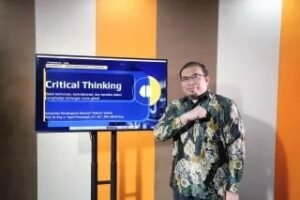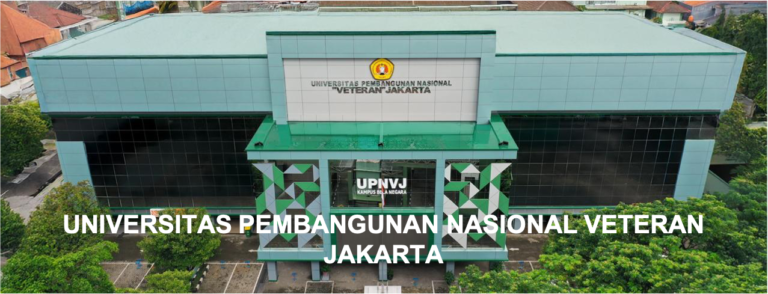





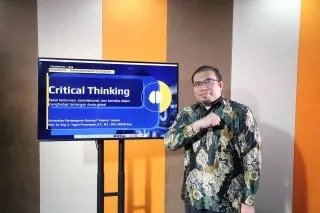
EduAsiaNews, Jakarta — Universitas Pembangunan Nasional “Veteran” Jakarta (UPNVJ) is strengthening new students’ critical thinking skills through a module on Critical Thinking in its PROSPEKTIV 2026 program. During the production of instructional videos for the program, UPNVJ Faculty of Engineering Dean Prof. Dr. Eng. Ir. Teguh Firmansyah, S.T., M.T., IPM., ASEAN Eng., emphasized the importance of reasoning, verifying information and making evidence-based decisions amid the rapid development of artificial intelligence (AI). The material, prepared for students entering the 2026/2027 academic year, links critical thinking skills with innovation, collaboration and academic integrity in addressing global challenges.
In his presentation during the production of the PROSPEKTIV 2026 videos, Teguh explained that critical thinking has become increasingly important as workplace skill requirements evolve. According to the World Economic Forum’s (WEF) Future of Jobs Report 2025, 69 percent of employers identify analytical thinking as a core skill for workers. The same report estimates that 39 percent of workers’ key skills will change by 2030.
These findings indicate that technical knowledge alone is insufficient to keep pace with change. Students need to be able to analyze problems, evaluate information and adapt to evolving circumstances to make sound decisions.
To illustrate the importance of critical thinking, Teguh presented a simple example involving a bat and a ball that cost Rp110,000 in total. If the bat costs Rp100,000 more than the ball, the spontaneous answer is often Rp10,000 for the ball. However, the correct answer is Rp5,000.
Adapted from the Cognitive Reflection Test, the example demonstrates that intuitive answers are not always correct unless subjected to logical scrutiny. Through this exercise, students are encouraged to avoid jumping to conclusions before examining the information and reasoning behind them.
Teguh also outlined six core critical thinking skills: interpretation, analysis, evaluation, inference, explanation and self-regulation. These skills help students understand information, assess source credibility, construct arguments and evaluate their own thinking processes.
Students were also introduced to various cognitive biases that can influence decision-making. Confirmation bias, the tendency to follow majority opinion and the inclination to believe information simply because it comes from a well-known figure illustrate how people can accept claims without adequate scrutiny.
Critical Thinking in the Age of Artificial Intelligence
A major focus of Teguh’s presentation was the use of AI in academic life. The technology makes it easier for students to find information, summarize references and develop ideas. However, excessive reliance on AI may reduce students’ engagement in independent thinking and information evaluation.
The material cited a 2025 study by Gerlich involving 666 participants, which found an association between AI use and the tendency to delegate some thinking processes to technology. Another study by Lee and colleagues in 2025, involving 319 knowledge workers, found that trust in AI was associated with the frequency of critical thinking.
Both studies serve as reminders that technology use should be accompanied by a conscious effort to maintain independent reasoning skills. Nevertheless, the associations identified in these studies do not, by themselves, establish that AI use causes a decline in critical thinking ability.
In higher education, students are encouraged to use AI as a tool to develop and test ideas rather than as a substitute for their own thinking. Information, data and references generated by AI must still be verified to ensure that their use does not compromise learning quality or academic integrity.
Teguh also introduced the SIFT method — Stop, Investigate, Find and Trace — as a practical approach to verifying digital information. The method encourages students to pause before accepting information, investigate source credibility, find corroborating references and trace statements or data back to their original context.
Innovation and Collaboration Begin with Sound Reasoning
Beyond technological challenges, Teguh emphasized that critical thinking provides the foundation for innovation that addresses society’s needs. Students need to develop divergent thinking to generate a range of ideas, then apply convergent thinking to select the best solutions based on evidence and rational consideration.
These skills are also essential when addressing complex problems without a single definitive answer, such as climate change, public health issues, social inequality and sustainable development challenges. Tackling such problems requires interdisciplinary understanding, collaboration and ethical consideration.
On teamwork, Teguh highlighted the importance of creating discussion spaces that welcome differing opinions. A group’s success depends not only on the abilities of its strongest individual members but also on social awareness, equal opportunities to contribute and each member’s willingness to listen to and evaluate ideas collectively.
The material also emphasized the importance of distinguishing criticism of ideas from personal attacks. Students are encouraged to foster a discussion culture that respects differing perspectives, welcomes feedback and uses reasoned argument to improve decision-making.
Academic Integrity as the Foundation of Critical Thinking
The development of critical thinking through PROSPEKTIV 2026 is also linked to character building and academic ethics. Teguh explained the importance of intellectual honesty, openness to evidence, accountability and the ability to acknowledge the limits of one’s own knowledge.
Students were reminded to avoid academic misconduct, including plagiarism, data fabrication, falsification and improper authorship. Proper referencing in academic writing is a fundamental responsibility that students should develop from the beginning of their university studies.
As a practical application, the material also provided guidance on reading academic articles in three stages: gaining an overall understanding of the research, examining its main content and arguments, and scrutinizing the methods and conclusions presented by the authors.
Through this approach, students are expected not merely to repeat information from their reading but also to compare different perspectives, assess the strength of evidence and draw defensible conclusions.
Strengthening critical thinking skills is in line with Minister of Higher Education, Science and Technology Regulation No. 39 of 2025 on Higher Education Quality Assurance, which recognizes independent and critical thinking as part of graduate learning outcomes.
The instructional videos produced for PROSPEKTIV 2026 also align with the policy direction of UPNVJ Rector Prof. Dr. Anter Venus, M.A., Comm., who has promoted student-centered learning, competency development and the responsible use of technology.
Previously, during a coordination meeting of lecturers teaching Compulsory Curriculum Courses (MKWK) on Aug. 13, 2026, the rector emphasized that AI should enrich the learning process without replacing students’ thinking abilities and character.
“AI must be positioned as a tool to enrich the learning process, not as a replacement for students’ critical reasoning, creativity, responsibility and character,” Venus said.
Through the development of video-based learning materials for PROSPEKTIV 2026, UPNVJ is reinforcing its commitment to providing education that responds to technological advances and the needs of younger generations. Strengthening critical thinking is expected to lay the foundation for students to become innovative, collaborative and principled individuals who make meaningful contributions to society while upholding the values of Bela Negara.(www.upnvj.ac.id)