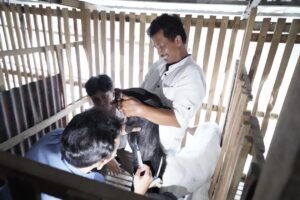





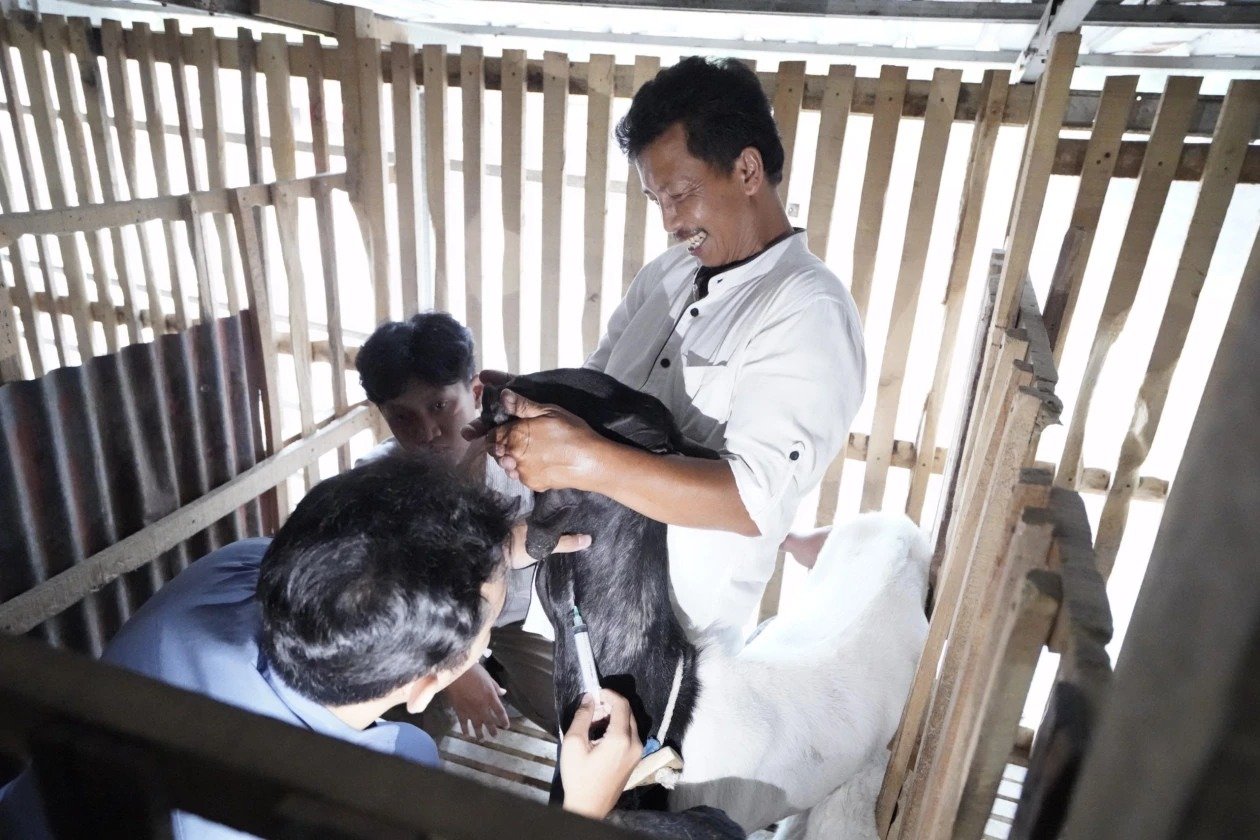
EduAsiaNews, Yogyakarta – The Department of Pathology at Universitas Gadjah Mada’s (UGM) Faculty of Veterinary Medicine (FKH UGM) collected blood samples from dairy goats owned by residents of Kayumas Village, Jatinom District, Klaten Regency, Central Java, on Wednesday (Oct. 14). The activity aimed to examine mineral levels in the animals’ blood and evaluate the use of iodine-enriched Nutrition Blocks (Nubokai) as a supplement to support livestock health.
The sampling followed reports from farmers who had found cases of goiter in Etawa crossbred (PE) dairy goats. Residents had also reported cases of abortion among female goats.
“Farmers reported a disease affecting their dairy goats, specifically Etawa crossbred goats, known as goiter, which is caused by a deficiency of a particular mineral,” said Afif Muhammad Akrom, a lecturer at FKH UGM’s Department of Pathology, on Friday (Oct. 16).
To address these cases, Afif said his team collected blood samples from dairy goats owned by local residents. He explained that the sampling was conducted in two stages: before and after the administration of mineral blocks. The initial examination was intended to establish baseline mineral levels, while the follow-up test would be conducted after the animals had received the supplement for one to two months.
“Blood samples are collected to determine mineral levels before the mineral blocks are administered. Further samples will then be collected after one to two months of supplementation to determine whether mineral levels in the blood have changed,” he explained.
In addition to testing the blood samples, other FKH UGM team members, including veterinarian Sugiyono, M.Sc., and Dr. Yanuartono, M.P., administered iodine-enriched Nutrition Blocks (Nubokai), a mineral supplement containing iodine. The supplementation was based on the suspicion that iodine levels in the area surrounding Kayumas Village were low.
Iodine is an essential mineral that supports thyroid function. The thyroid gland produces hormones that regulate various metabolic processes in the body and are also associated with hormonal balance in female animals.
“This mineral block contains iodine because the soil in the surrounding area is suspected to be low in iodine. Iodine primarily supports thyroid function, which indirectly also affects hormonal balance in female animals. Therefore, the supplement is intended to provide additional nutritional support,” said Muhammad Baihaqi Prakuso, a member of the veterinary clinical rotation student team.
By collecting blood samples before and after Nubokai supplementation, the FKH UGM team aims to monitor changes in mineral levels in the animals’ blood. The test results are expected to provide a basis for evaluating the animals’ condition and help inform efforts to address the health problems reported by farmers.
Afif expressed hope that the community service initiative would mark the beginning of sustained collaboration between the village government and FKH UGM. Such cooperation, he said, would enable continued assistance and the development of livestock health interventions tailored to the community’s needs.