




EduAsiaNews, Bali -The 22nd Annual Scientific Meeting (Pertemuan Ilmiah Tahunan, PIT) of the Indonesian Association of Oceanologists (ISOI) was held in Bali on Oct. 15–16, 2026. Opened by ISOI Chair Dr. Nani Hendiarti, the event brought together 300 ocean scientists, researchers, lecturers, students and marine industry practitioners. Participants discussed 170 papers covering a wide range of topics, from ocean–climate interactions, ocean dynamics and climate change to physical oceanography, marine pollution, blue carbon, marine biodiversity, marine spatial planning, ocean policy, the blue economy and ocean literacy.
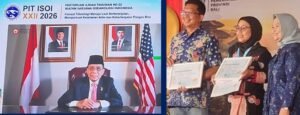
In his opening remarks at the 22nd ISOI Annual Scientific Meeting, Indonesian Minister of Marine Affairs and Fisheries Sakti Wahyu Trenggono said he welcomed input from all stakeholders, including academics and researchers, on the implementation of blue economy policies in the marine and fisheries sectors. He particularly emphasized efforts to protect marine ecosystems, develop aquaculture, and master technologies and innovations to strengthen the global competitiveness of Indonesian fishery products.
“My hope is that we will receive recommendations that help determine our direction and show how Indonesia can keep its seas healthy over a given period. If we want to gain a competitive advantage, we need to identify the capabilities and technologies we must master,” Trenggono said.
He also expressed hope that oceanology academics and researchers would provide science-based recommendations to strengthen Indonesia’s maritime policies. He said the main challenge in marine management today was mounting pressure from economic activities amid continued growth in the global population. This situation requires Indonesia to strike a balance between meeting human needs and protecting marine ecosystems.
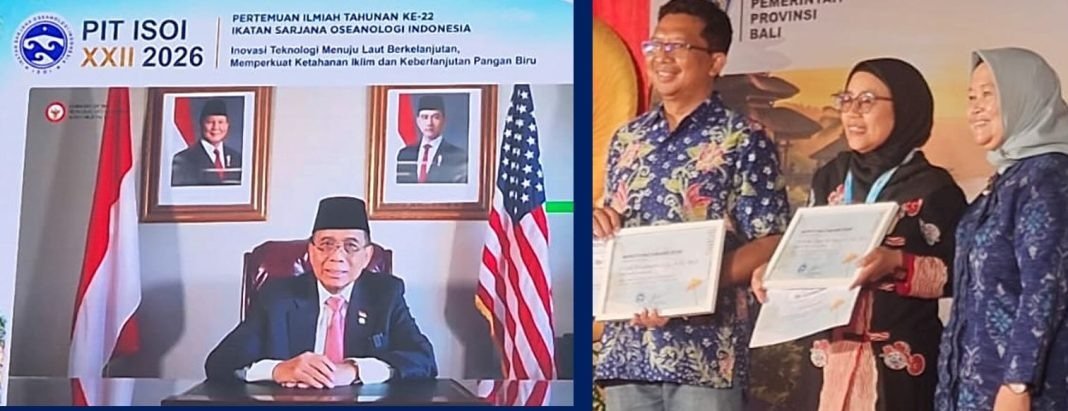
Indonesia’s Ambassador to the United States, Indroyono Soesilo, who previously served as coordinating minister for maritime affairs and ISOI chair from 2010 to 2012, emphasized that Indonesia is the world’s largest maritime nation. In his view, the sea is a source of life, food, energy, employment and the nation’s future.
Marine science operates across several disciplines. Oceanography examines currents, waves, tides and changes in the ocean to support fishing safety and coastal development. Marine geology helps scientists understand the seabed and assess energy and mineral resources, while also anticipating coastal erosion, tidal flooding and undersea earthquakes. Biological oceanography studies marine life, from plankton and fish to coral reefs and seaweed, providing a scientific basis for sustainable fisheries and aquaculture.
Ambassador Indroyono highlighted three major roles for marine science graduates. First, they can strengthen food security by supporting healthy aquaculture of fish, seaweed and shrimp, as well as sustainable fishing practices. Second, they can help develop energy security by mapping the potential of ocean currents, waves, tides and offshore winds. Third, they can promote downstream processing by turning fish into higher-value products and processing seaweed for use in food, cosmetics and pharmaceuticals.
The role of marine scientists is becoming increasingly urgent amid El Niño. This climate variability phenomenon can trigger droughts, forest and land fires, crop failures, and shifts in fish distribution that affect fishermen’s catches. Indonesia therefore needs satellites, ocean buoys, sensors, predictive models and field research. Scientific data must be translated into practical information that can benefit fishermen, aquaculture farmers, local governments and communities.
At the 22nd ISOI Annual Scientific Meeting, the association also presented awards to Dr. I Wayan Gede Hendrawan of Udayana University, an expert in ocean modeling, and Dr. Rima Rachmayani of the Bandung Institute of Technology (ITB), an expert in marine geology and paleoceanography.
The 22nd ISOI Annual Scientific Meeting is expected to strengthen collaboration among scientists, the government, businesses and coastal communities. Its goals are clear: ensure food security, maintain energy security, develop industry, improve fishermen’s welfare and keep Indonesia’s seas healthy.