




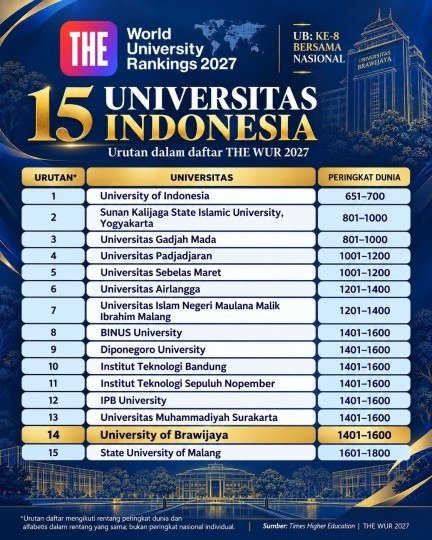
EduAsiaNews, Malang – Universitas Brawijaya (UB) has risen from ninth to eighth place in the national standings, sharing the position with six other universities in the Times Higher Education World University Rankings (THE WUR) 2026–2027.
The shared ranking follows THE’s methodology, under which universities within the same world ranking band are considered to hold an equal position.
UB also recorded improvements across all five THE WUR 2027 indicators compared with the 2026 edition. In the list of Indonesian universities following THE’s table structure, UB moved from 33rd to 14th, an improvement of 19 positions. This position refers to the order of universities listed alphabetically within each ranking band and does not represent THE’s official individual national ranking.
Based on this numbering, UB recorded the largest upward movement among the 35 Indonesian universities that were ranked in both editions. Universitas Mataram moved from 35th to 20th, while Universitas Syiah Kuala rose from 32nd to 19th.
UB Vice Rector I Prof. Imam Santoso said the achievement would serve as an impetus to strengthen the university as a whole. Improvements across all indicators, he said, reflected the success of a number of strategic programs aimed at encouraging the entire academic community to continue delivering its best work to advance UB.
He added that the achievement was the result of collective efforts by the university’s academic community and administrative staff, as well as collaboration through various programs with UB’s strategic partners.
“We are committed to strengthening the quality of education, research, innovation, governance, and national and international partnerships so that the university’s progress can generate tangible benefits for society while also gaining greater recognition at the international level,” Prof. Imam said.
In the global rankings, UB was placed in the 1,401–1,600 band in 2027, compared with the 1,501+ band in 2026.
UB is now in the same ranking band as BINUS, Universitas Diponegoro, Institut Teknologi Bandung, Institut Teknologi Sepuluh Nopember, IPB University and Universitas Muhammadiyah Surakarta.
Improvements Across All Assessment Areas
UB’s industry indicator increased by 7.4 points, from 36.2 to 43.6, marking the largest point increase. Its international outlook rose by 7.3 points, from 43.8 to 51.1, which was also UB’s highest score.
The research environment increased by 7.1 points, from 13.3 to 20.4, representing growth of around 53.4 percent from the previous score. Research quality rose by 6.8 points, from 23.7 to 30.5. Meanwhile, teaching increased by 2.4 points, from 24.9 to 27.3.
UB’s Progress Compared with Peer Universities
Compared with Universitas Diponegoro (Undip), Institut Teknologi Sepuluh Nopember (ITS) and IPB University — three universities in the same global ranking band as UB in both editions — UB recorded larger increases in research environment, research quality, industry and international outlook.
In research quality, UB’s 6.8-point increase exceeded IPB’s 5.3-point increase, Undip’s 3.3 points and ITS’s 1.8 points.
The comparison reflects the magnitude of score increases and does not mean that UB’s final score was always higher than those of its peers.
Among the seven Indonesian universities in the 1,401–1,600 global ranking band in 2027, UB’s international outlook score of 51.1 was the second highest after ITS, which scored 53.0. UB ranked above Undip at 45.2, IPB at 44.7, BINUS at 40.4, ITB at 38.0 and UMS at 29.2.
UB’s GPR head, Hendrix Setyawan, emphasized the importance of interpreting the ranking results by looking at changes in scores and comparisons with peer universities.
“The data show that UB has made progress across all five indicators. For evaluation purposes, we need to examine changes in the national listing alongside changes in scores and global ranking bands. Comparisons with peer universities help identify UB’s strengths in international outlook as well as areas for further development in its research environment and research quality,” Hendrix said.
In research environment, UB’s score of 20.4 was higher than ITS at 15.6, IPB at 15.4 and UMS at 12.2, but remained below BINUS at 27.2, ITB at 23.2 and Undip at 22.0. The comparison provides a basis for sharpening UB’s research development priorities.
The development took place as the number of Indonesian universities receiving rankings in the analyzed data increased from 35 to 42. Improvements across all indicators remain the main evidence of UB’s progress in terms of scores amid the growing number of participating universities.
(*/UB Public Relations)