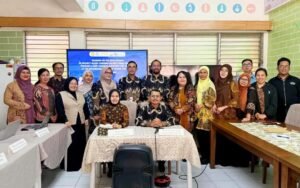





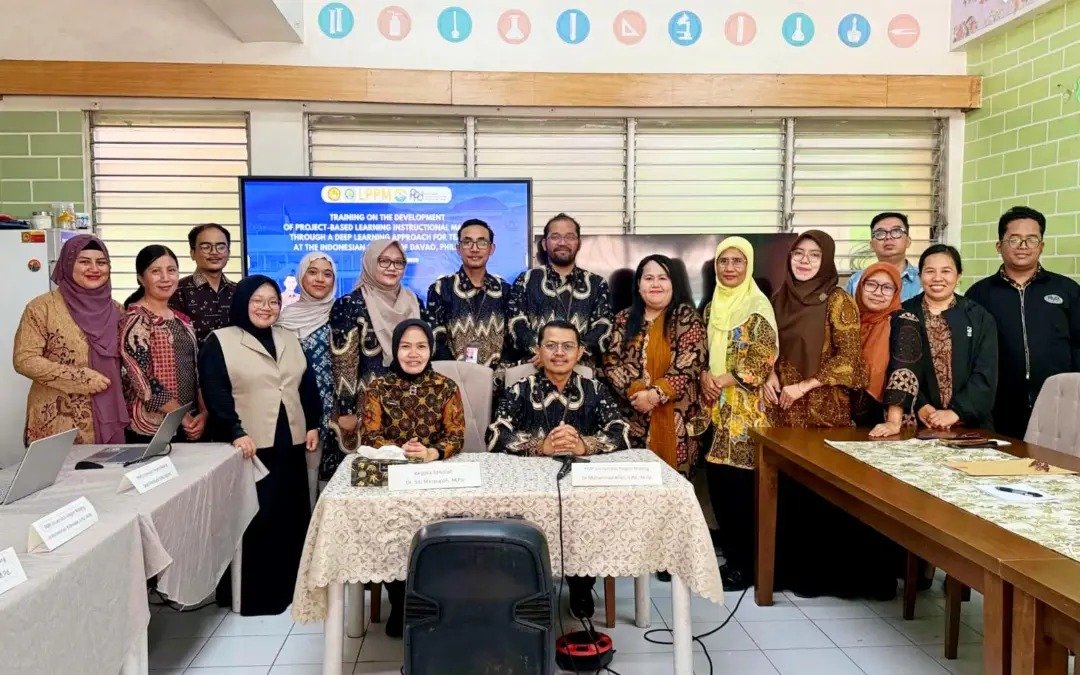
EduAsiaNews, Malang — A team of lecturers from the Teacher Professional Education (PPG) Study Program at Universitas Negeri Malang (UM) conducted an international community service program at Sekolah Indonesia Davao (SID) in the Philippines on Friday (Sept. 25, 2026), aiming to strengthen teachers’ competencies through training on developing learning tools based on Project-Based Learning (PjBL) using a Deep Learning approach. The program, funded through the 2026 UM PPG Community Service Grant, was enthusiastically attended by SID Davao teachers.
The training aimed to strengthen teachers’ ability to design meaningful, relevant and contextual learning. Through the program, teachers gained practical knowledge and experience that could be applied to meet classroom learning needs. The initiative is expected to contribute to improving the quality of education at Indonesian schools overseas.
SID Davao Principal Dr. Siti Maspupah, M.Pd., expressed her support for the program. She said access to information about Deep Learning in Davao remained more limited than in Indonesia. The participation of UM PPG lecturers therefore provided valuable benefits for teachers.
According to Siti, the training provided an opportunity for teachers to gain updated knowledge and insights into learning strategies. She expressed hope that similar programs could continue in the future. Support from the school also helped ensure the smooth implementation of the entire program.
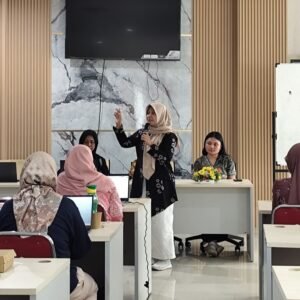
The training featured three main sessions delivered by UM PPG lecturers. The first was presented by Dr. Muhammad Alfan, S.Pd., M.Pd., who discussed the fundamentals of Deep Learning in developing students’ competencies. He emphasized that Deep Learning was not merely a memorization method but an approach that encouraged students to understand, analyze and develop solutions to real-world problems.
The approach focuses on developing Higher Order Thinking Skills (HOTS), ensuring that students are not merely passive recipients of information. Teachers were introduced to ways of designing thought-provoking questions and learning activities that foster students’ critical thinking skills. Learning, therefore, goes beyond knowledge acquisition to support the development of students’ character and competencies as a whole.
The second session was delivered by Fatiya Rosyida, S.Pd., M.Pd., who discussed the structure and practical steps involved in developing Project-Based Learning (PjBL) learning tools. She explained that PjBL places students at the center of the learning process, actively engaging them in producing works or products through projects.
Teachers were guided through the stages of developing PjBL learning tools, from formulating essential questions and designing project activities to preparing schedules and developing authentic assessment instruments. She also emphasized the importance of selecting projects that are relevant to students’ real-life experiences to make learning more meaningful. Through the guidance, teachers were expected to develop learning tools that are not only theoretical but also practical and contextual.
The third session was delivered by Dedi Prestiadi, S.Pd.I., M.Pd., who discussed strategies for optimizing the use of Artificial Intelligence (AI) to improve the efficiency of developing learning tools. He explained that AI could be used to assist in preparing teaching modules, developing HOTS-based questions and designing presentation materials.
However, he stressed that AI was not a substitute for teachers but a tool that should be used wisely and guided by pedagogical considerations. Teachers were also introduced to ways of providing appropriate prompts to AI to ensure that the resulting materials meet their learning needs. The effective use of AI is expected to help teachers save time on administrative tasks so they can focus more on supporting students.
Following the presentations, the program continued with a practical session. Teachers had the opportunity to develop learning tools directly by applying the concepts of Deep Learning, PjBL and AI in accordance with their respective subjects.
A discussion session was then led by Mochammad Rizal Ramadhan, S.Pd.I., M.Pd., who facilitated teachers in sharing their experiences and challenges during the development of learning tools. The discussion was interactive, with participants exchanging feedback and solutions to various learning challenges.
The session also served as a space for teachers to reflect on their understanding of the materials presented. The practical and discussion sessions were expected to reinforce participants’ understanding and enable them to directly implement the training outcomes in their classrooms.
At the end of the program, all participants took part in a reflection session. In addition to sharing their impressions and understanding, the teachers completed a self-assessment to measure their comprehension of the materials presented.
The reflection results served as a basis for teachers to identify concrete steps for implementing what they had learned. The program therefore went beyond the delivery of training materials by encouraging participants to develop follow-up measures that could be applied in classroom practice.
The community service program contributed to the achievement of the Sustainable Development Goals (SDGs), particularly SDG 4 on Quality Education and SDG 17 on Partnerships for the Goals.
In the context of SDG 4, particularly Target 4.c, the program supported efforts to strengthen teacher competencies by enhancing their knowledge and skills in designing learning activities. The application of Deep Learning, PjBL and AI is expected to promote more meaningful and contextual learning while developing students’ higher-order thinking skills.
The program also reflected SDG 17 through the partnership between UM and Sekolah Indonesia Davao. The cross-border collaboration provided a platform for exchanging knowledge, experience and teaching practices between a higher education institution and an Indonesian school overseas.
For UM, the program represented the university’s contribution to strengthening educators’ capacities while expanding international education cooperation. For SID Davao, the initiative provided access to professional development and updated learning strategies. The partnership is expected to continue and generate a sustainable impact on the quality of Indonesian education in the Philippines.