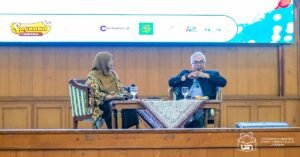





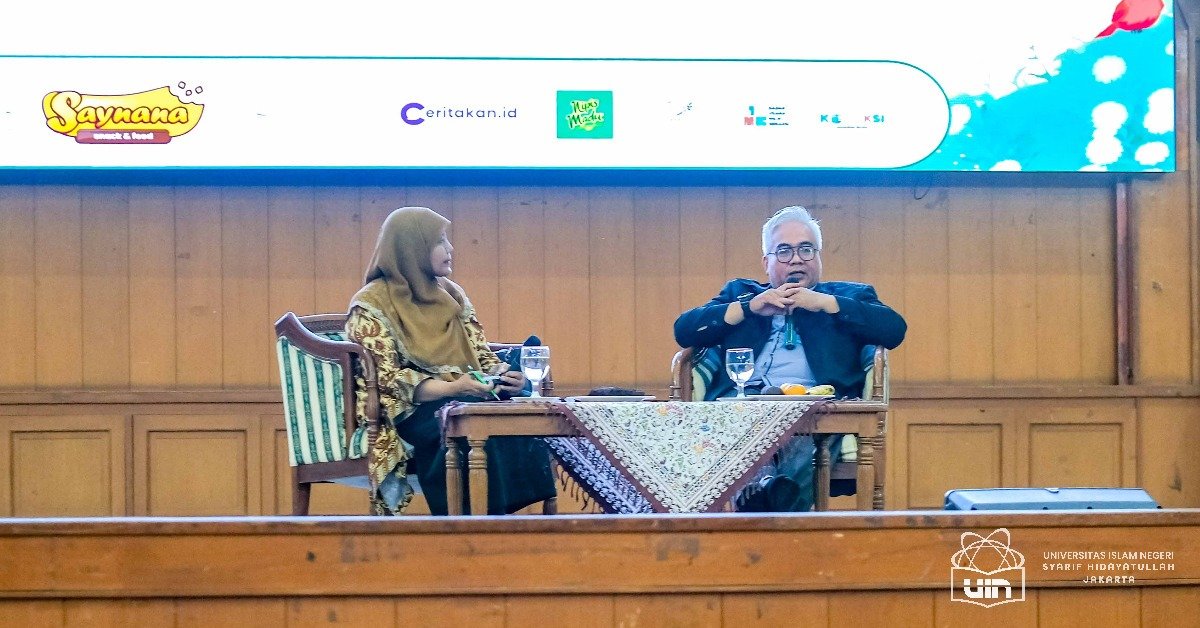
EduAsiaNews, Jakarta — The Biology Students Association (HIMBIO) at UIN Syarif Hidayatullah Jakarta held the ninth Ecology Festival seminar, focusing on “Ecological Restoration as a Real Solution for Conservation-Based Disaster Mitigation.”
The seminar was organized in collaboration with the National Research and Innovation Agency (BRIN) and the National Disaster Management Agency (BNPB), which provided speakers for the event. The seminar, held at the Harun Nasution Auditorium on Saturday (Sept. 26, 2026), sought to explore ideas and solutions to current ecological and environmental challenges.
The event featured BRIN Ecology Research Head Prof. Dr. drh. Anang Setiawan Achmadi, M.Sc.; UIN Jakarta Biology Study Program Head Fahri Fahrudin, M.Si.; UIN Jakarta Biology lecturer and deputy head of the Jakarta branch of the Indonesian Biology Association (PBI), Dr. Fahma Wijayanti, M.Si.; BNPB disaster analyst Adelina, S.A.B., M.Ling.; and UIN Jakarta Biology lecturer Narti Fitriana, M.Si. The seminar was also attended by competition participants from universities across Indonesia and members of the UIN Jakarta academic community.
Ecosystem Damage and Disaster Risk
In his opening remarks, Fahri Fahrudin stressed the importance of raising awareness among members of the academic community about disaster preparedness and mitigation.
“We believe that ecosystem degradation and environmental damage contribute significantly to the increasing intensity of disasters. Therefore, as stewards of the Earth, academics and rational human beings, we have a responsibility to protect, conserve and restore our ecosystems and environment,” he said.
He added that the Ecology Festival had been held for the ninth time, combining community service activities, training, sports competitions, as well as national-level art and scientific essay competitions.
The educational forum was intended to encourage students to take an active role rather than simply observe amid the growing number of reports about environmental degradation.
“Our responsibility is clear. We cannot simply watch or read about environmental damage. We have to participate in efforts to restore the environment, at least on a small scale within our own communities,” he said.
Ecosystem Degradation as a Driver of Disaster Risk
The discussion began with a presentation by BRIN Ecology Research Head Prof. Anang Setiawan Achmadi, an expert in biosystematics, taxonomy, evolution, geography and mammalian ecology.
He highlighted a series of natural disasters in various parts of Indonesia, including Aceh, North Sumatra and Central Java. He said the underlying causes of many such disasters were closely linked to ecosystem degradation, including widespread loss of vegetation cover resulting from inadequate environmental management.
“Let us look back at the flash floods in Aceh and North Sumatra, as well as the flash floods in Central Java. Why did they happen? Because of ecosystem degradation, environmental damage and the loss of vegetation cover,” he said.
Anang also noted that the situation had been exacerbated by a sharp increase in forest and land fires between January and July 2026, which affected around 200,000 hectares, a 69 percent increase from the same period the previous year.
Citing data from the Ministry of Forestry as of Sept. 20, 2026, he said 1,532 hotspots had been detected, mainly in Central Kalimantan, South Sumatra, West Kalimantan, South Kalimantan, Jambi and Riau.
The phenomenon, he said, raised concerns over the long-term threats to the well-being of future generations.
“Prolonged dry seasons increase the threat of extreme drought and raise disaster risks for younger generations if ecological restoration is not carried out immediately,” he said.
Referring to the framework of the United Nations Office for Disaster Risk Reduction (UNDRR), Anang said damage to watersheds, the loss of mangrove vegetation, drought and fires widely reported on social media demonstrated that ecosystems were not merely victims of disasters but key factors determining the level of disaster risk.
In Indonesia, he said, one of the most extensive forms of ecosystem degradation stemmed from the conversion of 13.5 million hectares of peatland into oil palm plantations without adequate environmental management.
“Therefore, I can conclude that ecosystems are not only victims but also determinants of disaster risk. The most extensive land conversion taking place today is for oil palm plantations,” he said.
Ecological Restoration as Natural Infrastructure
Concluding his presentation, Anang emphasized that healthy ecosystems function as natural infrastructure by regulating water cycles, stabilizing soil, absorbing carbon emissions and reducing erosion risks.
He also stressed the importance of ecological restoration.
“Sustainable ecosystem management is key to reducing disaster risks and protecting communities. Ecological restoration is not simply about planting trees and then leaving them behind. There are six indicators of successful restoration: increased vegetation cover, improved soil quality, improved water quality, increased carbon stocks, greater habitat connectivity and benefits for local communities,” he said.
He encouraged students to contribute directly through undergraduate research or pursue careers in nongovernmental organizations and the private sector.
Disaster Recovery Must Consider Communities and the Environment
The disaster management perspective was further discussed by BNPB disaster analyst Adelina, who emphasized that post-disaster recovery should not stop at rebuilding physical infrastructure and buildings. Instead, it should consider the long-term sustainability of environmental carrying capacity and community life.
“Recovery is not simply about rebuilding. It is about ensuring that the effects and sustainability of recovery have a positive and lasting impact on communities and the environment,” she said.
She also highlighted the deep psychological impact of disasters, particularly on vulnerable groups who lose their homes and livelihoods.
BNPB, she said, often faces complex challenges when relocating residents living along disaster-prone riverbanks.
“We face difficulties in the field when asking residents living along riverbanks to relocate to safer areas. They refuse, saying that their land is there. This is where we need to educate and gradually engage with communities through focus group discussions (FGDs) so that they can move to safer locations,” she said.
Students Encouraged to Support Ecological Assessments
Adelina encouraged Biology students at UIN Jakarta to become directly involved in assessing ecological suitability before restoration or tree-planting activities are carried out.
“When we conduct field surveys, such as for tree planting, we greatly welcome the help of Biology students in assessing whether a site is suitable, including for ecosystem restoration and marine cultivation,” she said.
The ninth Ecology Festival, themed “Ecological Restoration as a Real Solution for Conservation-Based Disaster Mitigation,” reaffirmed UIN Jakarta’s commitment to serving as an academic center that not only produces critical thinking but also promotes practical solutions through cross-institutional collaboration to protect the sustainability of Indonesia’s terrestrial and marine ecosystems.