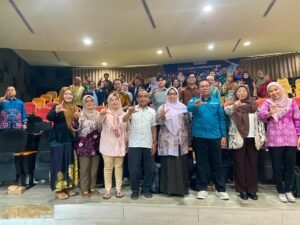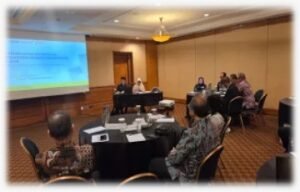





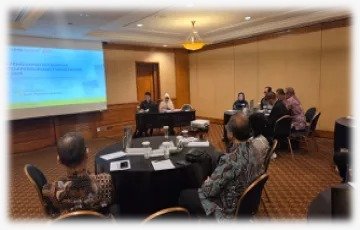
EduAsiaNews, Jakarta – Universitas Pembangunan Nasional “Veteran” Jakarta (UPNVJ) is strengthening its anti-corruption governance through service digitalization, enhanced internal control systems, and the integration of anti-corruption education into the learning process. These efforts form part of UPNVJ’s commitment presented at the 2026 Forum for Strengthening the Integrity of the State Higher Education Ecosystem (PIEPTN), organized by the Corruption Eradication Commission (KPK) at Hotel Aryaduta Menteng, Jakarta, on Thursday (August 20, 2026).
The UPNVJ delegation was led by Vice Rector for Planning, Finance, and General Affairs, Prof. Dr. Ir. Netti Herawati, M.Si., together with Head of the Institute for Research and Community Service (LPPM), Dr. Sri Lestari Wahyuningroem, and Head of the Institute for Quality Assurance and Learning Development (LPMPP), Satria Yudhia Wijaya, S.E., M.S., Ak.
The PIEPTN Forum brought together the KPK, leaders of state universities and state Islamic higher education institutions, as well as academic networks to evaluate and strengthen a transparent, accountable, and integrity-based higher education ecosystem. The program has been developed by the KPK since 2022 through the mapping of risk areas and the development of anti-corruption prevention instruments as a framework for higher education institutions to assess their governance.
At the forum, UPNVJ presented a number of initiatives that have been implemented to strengthen institutional governance. One of these was the establishment of a Bureaucratic Reform team and the implementation of an integrated system for the new student admissions process to improve the orderliness, traceability, and accountability of services.
Strengthening efforts have also been undertaken in the procurement of goods and services. UPNVJ assigns certified personnel to procurement processes and utilizes digital systems, including SI-Dapet and SI-Tender, to support processes that are more transparent, well-documented, and accountable. Digitalization serves as an instrument to minimize opportunities for irregularities while improving the effectiveness of oversight.
These efforts are relevant to the findings of the PIEPTN evaluation, which identified the procurement of goods and services, financial management, as well as publications, research, and community service as areas requiring greater attention in strengthening integrity within higher education institutions.
The KPK has developed PIEPTN to cover 12 risk areas, ranging from the selection of university leaders and officials, new student admissions, learning, research and community service and the downstream development of innovations, publications, human resource management, financial management, educational administration, accreditation and licensing, procurement of goods and services, asset management, to institutional partnerships.
Strengthening these areas is supported by anti-corruption instruments, including conflict-of-interest management, gratification and bribery controls, the implementation of standard operating procedures, reward and sanction regulations, optimization of information technology, information transparency, whistleblowing systems, and the integration of integrity values into codes of ethics and conduct.
Integrating Anti-Corruption Education with National Defense Education
In addition to improving its governance systems, UPNVJ regards education as a strategic avenue for fostering an anti-corruption culture within the university environment. Anti-Corruption Education (PAK) has been integrated into several Compulsory Curriculum Courses (MKWK), particularly Pancasila, Citizenship Education, and National Defense Education.
This integration positions corruption prevention not merely as a matter of regulatory compliance, but also as a process of character building among students. National Defense Education, which is a compulsory course at UPNVJ, also provides a platform for strengthening responsibility, discipline, commitment to the public interest, and integrity as essential elements of graduate character.
UPNVJ also encourages the enhancement of MKWK lecturers’ competencies through a certification scheme administered by the National Professional Certification Agency (BNSP) for Anti-Corruption Counselors. Further efforts are focused on developing internal regulations, enhancing lecturers’ capacity in collaboration with the KPK, utilizing anti-corruption e-learning platforms, and expanding the integration of anti-corruption values into relevant courses.
This approach also brings together anti-corruption education with the PIKIR and National Defense values developed by UPNVJ. The internalization of these values does not stop in the classroom but is intended to become part of the institutional culture and serve as a foundation for service delivery, decision-making, and university management.
For the KPK, PIEPTN serves not merely as a monitoring mechanism. Higher education institutions are encouraged to use the assessment as a kind of “medical check-up” for governance, enabling them to identify vulnerabilities, evaluate existing systems, and determine improvement measures based on the specific needs of each institution.
The 2026 PIEPTN Forum also provided an opportunity to evaluate program implementation, refine the self-assessment instruments, and establish directions for strengthening integrity in higher education for the 2026–2027 period. The control of gratification, management of conflicts of interest, and integrity of institutional partners remain important areas of focus, alongside improvements in other high-risk governance areas.
UPNVJ’s participation in the forum is in line with the policy of UPNVJ Rector Prof. Dr. Anter Venus, M.A., Comm., who places integrity-based governance as one of the foundations for improving the university’s quality. In 2026, UPNVJ has also cascaded integrity-based governance indicators across faculties, institutes, and administrative bureaus as part of the institution’s performance management system.
Through strengthened internal control systems, digital transformation, information transparency, anti-corruption education, and the internalization of National Defense values, UPNVJ continues to promote Good University Governance based on transparency, accountability, effectiveness, efficiency, and continuous quality improvement. These efforts form part of the university’s policy to maintain public trust while building an excellent and integrity-driven higher education ecosystem.(www.upnvj.ac.id)