




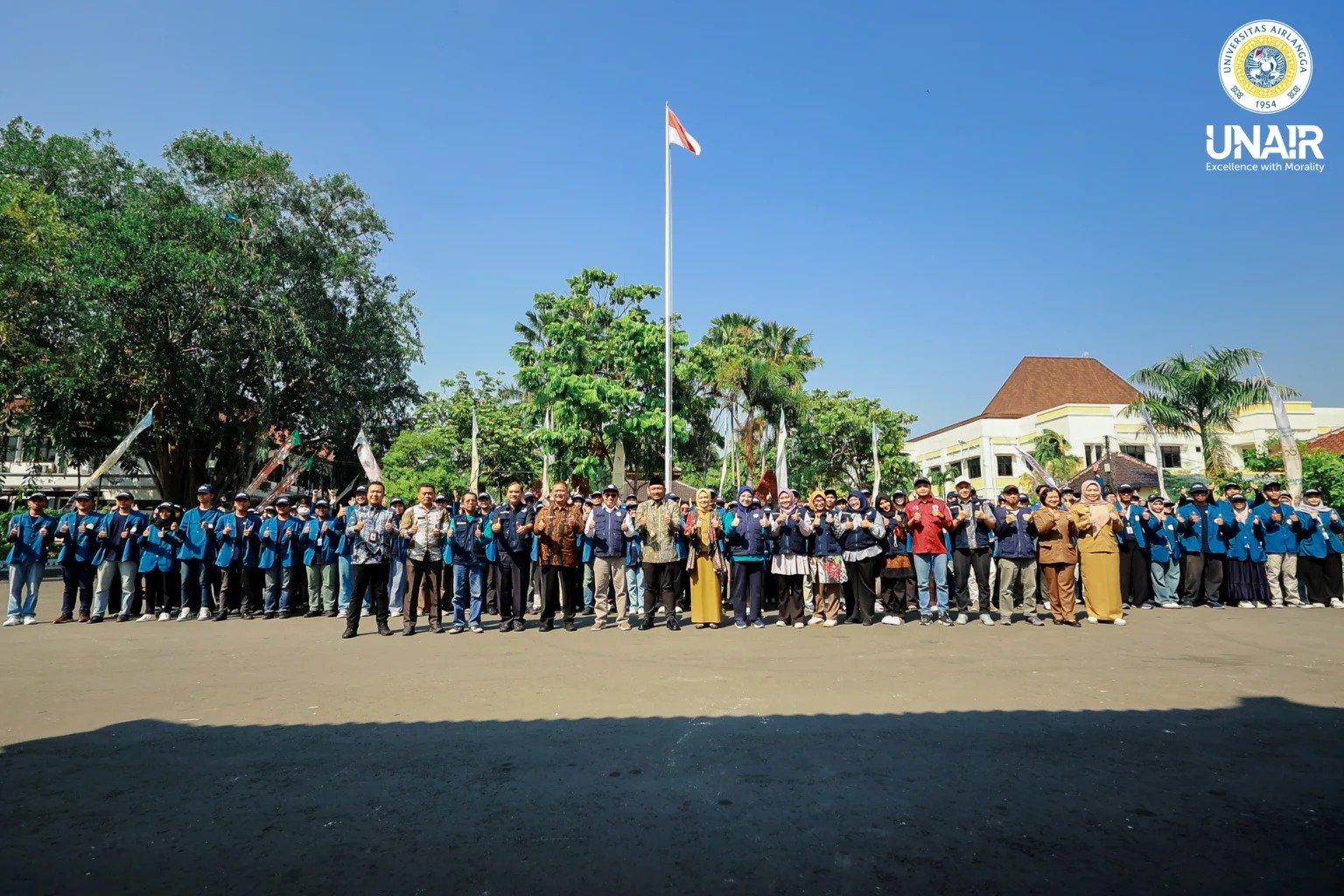
EduAsiaNews, Ngawi – In support of accelerating the achievement of the Sustainable Development Goals (SDGs), 171 students from Universitas Airlangga (UNAIR) have officially begun their Community-Based Student Service Program (KKN-BBK) in Ngawi Regency as of Monday (July 13, 2026). The multidisciplinary student cohort will be deployed across villages in two sub-districts—Pitu and Kasreman.
The Dean of UNAIR’s Faculty of Social and Political Sciences (FISIP), M. Muttaqien, S.IP., M.A., Ph.D., stated that the program focuses on four key areas: education, economic development, environmental sustainability, and community welfare. He explained that the initial phase of the program will involve a comprehensive one-month assessment and mapping of local conditions.
“Prior to deployment, the students received intensive online and in-person training covering the regional profile and the socio-cultural characteristics of the communities in Ngawi Regency,” he said.
Although the KKN program officially runs for one month, the community engagement initiative has been designed as a three-year sustainable program.
“This initiative will continue over the next three years to ensure the continuity of UNAIR’s assisted village development program in Ngawi,” he added.
Addressing Poverty Through Local Development
The arrival of the UNAIR delegation was warmly welcomed by the Regent of Ngawi, Hj. Ony Anwar Harsono, S.T., M.H., who expressed his appreciation for the university’s commitment to supporting regional development through community service.
He explained that Pitu and Kasreman are among the poverty-prone areas in Ngawi Regency due to their geographical conditions.
“From a topographical perspective, Ngawi is divided into three regions: northern, central, and southern. Pitu and Kasreman are part of the northern region, together with Karanganyar, Ngawi, Bringin, and Karangjati,” Ony explained.
According to the Regent, the northern region is characterized by karst (limestone) highlands with a relatively hot climate. Although the area previously experienced recurring clean water shortages during the dry season, those challenges have gradually been addressed through various government intervention programs.
He further noted that the majority of residents in the northern region are forest farmers cultivating state-owned forestry land under Indonesia’s Social Forestry Program. They primarily grow corn, cassava, and tobacco rather than irrigated rice.
“Because they are not rice farmers, the standard of living and overall welfare of communities in the northern region remain relatively low,” he said.
Strengthening Human Capital Through Sustainable Collaboration
Regent Ony emphasized that the deployment of UNAIR students aligns closely with the second phase of Ngawi Regency’s Medium-Term Regional Development Plan (RPJMD). After successfully achieving more than 90 percent of its targets in basic public services—including education, healthcare through Universal Health Coverage, and environmentally friendly agriculture—the regency is now shifting its development priorities toward human capital development.
“Our second mission focuses on strengthening human resources with strong character, integrity, and holistic personal development—not merely physical infrastructure and economic growth,” he stated.
Promoting Knowledge Transfer for Sustainable Rural Development
Through the KKN program, the Regent sees broad opportunities for collaboration between UNAIR and the Ngawi Regency Government, particularly in promoting knowledge transfer and strategies to improve the livelihoods of forest farming communities.
He encouraged students to apply their academic expertise to address local challenges. For example, economics students could assist farmers in developing basic financial management and accounting systems, while students from health and social science disciplines could provide education on healthy lifestyles and community well-being.
“Recommendations and evidence-based strategies developed by students in the field will be invaluable in supporting our regional government programs,” he concluded.