




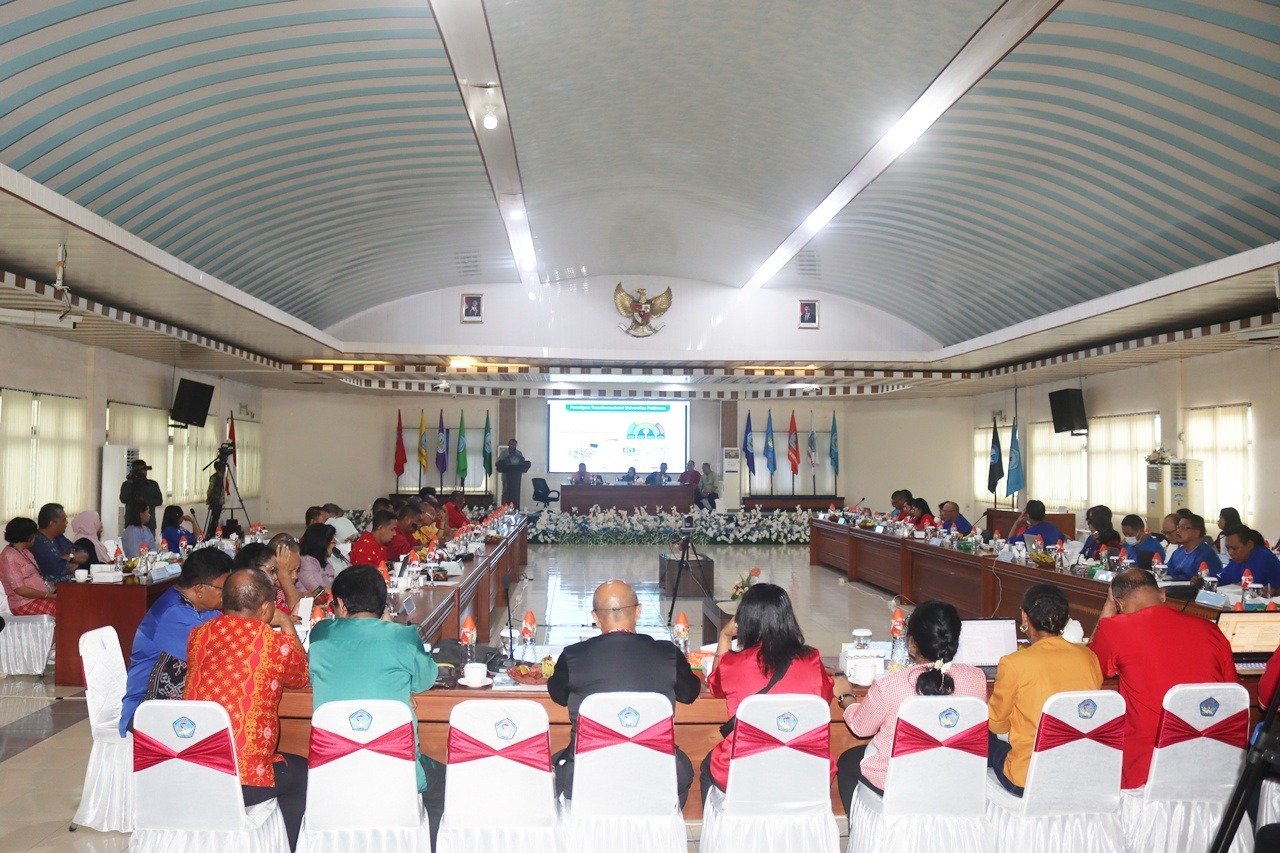
EduAsiaNews, Maluku – Pattimura University (Unpatti) officially opened its Leadership Working Meeting (Rapat Kerja Pimpinan – Rakerpim) at the Rectorate Hall on the second floor of the university’s main administration building on Thursday (April 10, 2025). The 2025 Rakerpim is held under the theme “Transforming Unpatti’s Role in Development to Support the National ASTA CITA Agenda.”
The two-day meeting, taking place from April 10–11, 2025, aims to evaluate the University’s 2024 program and budget performance, formulate policy directions for the 2026 programs and budget, and establish other strategic and relevant institutional recommendations.
In his report, Chair of the Organizing Committee, Dr. Hanock Mandaku, S.T., M.T., expressed his hope that the Leadership Working Meeting would serve as a pivotal milestone in shaping Unpatti’s future direction. The meeting brings together the University’s executive leadership, heads of institutes, deans, the Director of the Graduate School, bureau chiefs, as well as leaders of various teams and units across the University.
He emphasized that Pattimura University is not only an institution for higher education and graduate production but also an agent of change that must remain relevant, responsive, and proactive in addressing local, national, and global challenges. To effectively contribute to national development, academic knowledge must be transformed into practical and solution-oriented applications. Likewise, the implementation of the Tri Dharma of Higher Education should evolve from routine activities into initiatives that generate tangible benefits for society, while institutional governance should shift from a bureaucratic approach toward one that is innovative and collaborative. These principles form the foundation of the 2025 Rakerpim theme, “Transforming Unpatti’s Role in Development to Support the National ASTA CITA Agenda.”
Opening the meeting, Rector of Pattimura University, Prof. Dr. Fredy Leiwakabessy, M.Pd., noted that a range of important issues has emerged alongside new policies introduced by the Ministry of Higher Education, Science, and Technology. These developments, combined with evolving geostrategic, geopolitical, and geoeconomic conditions, will significantly influence the University’s future planning.
“The central issue is efficiency. We are also facing challenges that require collective reflection and improvement,” the Rector stated.
He explained that, in line with the objectives of the Leadership Working Meeting, participants are expected to evaluate the programs implemented in 2024, formulate priority programs for 2026, and adjust the 2025 work programs in response to the budget relaxation policies communicated by the Ministry to higher education institutions, including Pattimura University. According to the Rector, these matters should be discussed openly while upholding the principles of transparency, accountability, effectiveness, and efficient budget utilization.
“We will continue to organize and strengthen Pattimura University through a phased leadership approach. During the first two years, our focus will be on developing institutional capacity, formulating strategic priorities, and aligning programs with the Rector’s vision and mission through carefully designed strategies supported by our best teams. By the third year, we expect to consolidate these development programs in order to build a stronger, more established, and more distinguished university that shines on its path toward becoming a world-class university, founded upon the principles of integrity, synergy, good governance, and strong character,” the Rector explained.
The Rakerpim agenda continued with presentations by the Rector on the University’s General Policy Direction and Program Framework for 2026, followed by presentations from the Vice Rectors, Chair of the Academic Senate, Deans, Heads of Institutes, and leaders of various institutional teams and units. On the second day, the program was scheduled to continue with presentations by the Director of the Graduate School, followed by discussions, conclusions, and the official closing ceremony, which was planned to be combined with a Halal Bihalal gathering.
Through this Leadership Working Meeting, Pattimura University expects the transformation of its institutional role to be reflected in concrete policy formulations, strategic programs, and actionable initiatives. These efforts are intended not only to address the multidimensional challenges of national development but also to strengthen Unpatti’s contribution to the development of Maluku. Ultimately, the meeting is expected to accelerate the realization of the Rector’s vision of establishing Pattimura University as a distinguished institution that shines on its journey toward becoming a world-class university.