




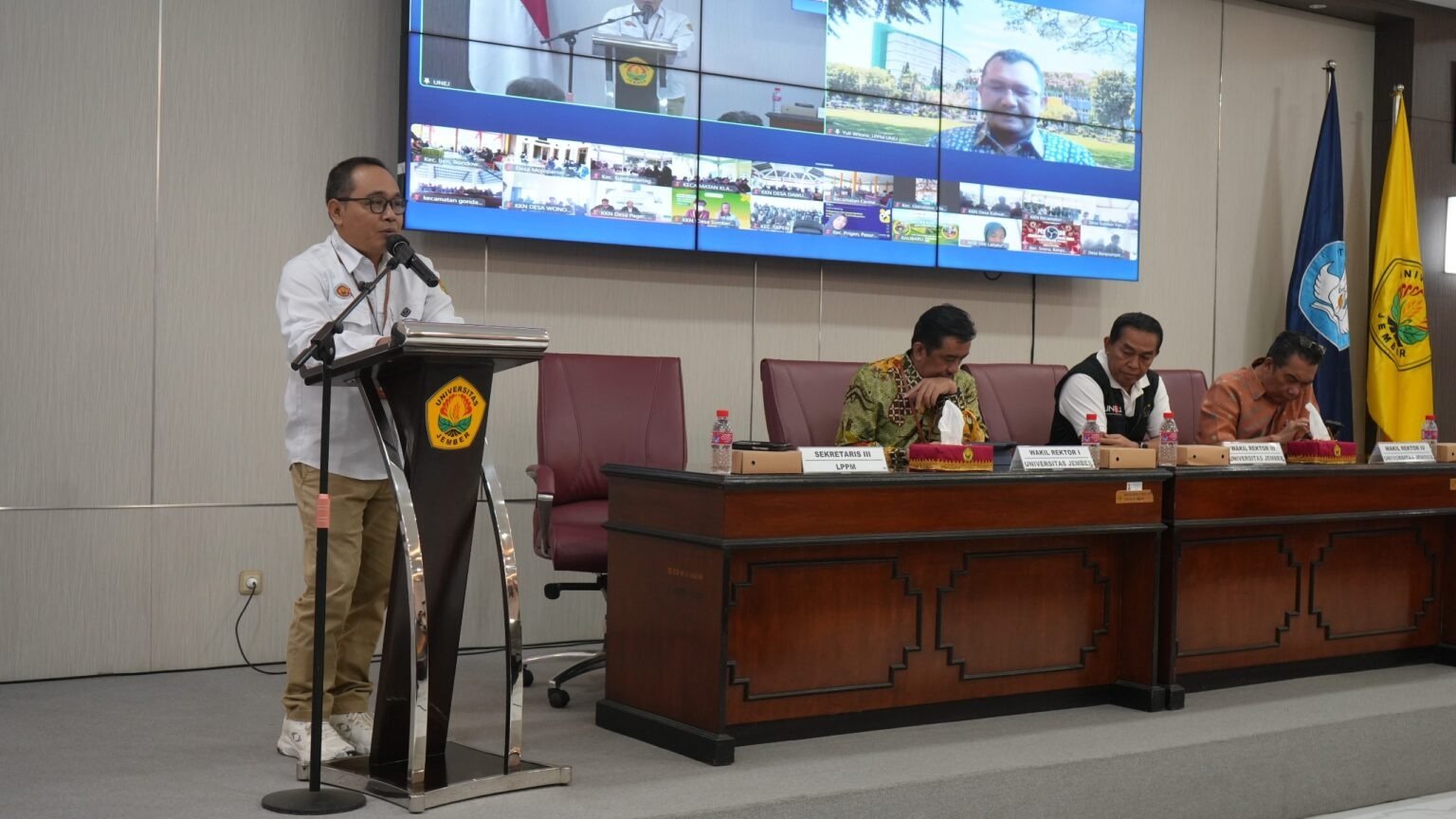
EduAsiaNews, Jember – The Vice Rector for Academic Affairs of the University of Jember (UNEJ) officially dispatched 2,385 students from various faculties to participate in the University’s Community Service Program (Kuliah Kerja Nyata or KKN) through several initiatives on Friday (July 10, 2026).
The programs include the UNEJ Village Development KKN (UNEJ Membangun Desa/UMD), the Sekar Kijang Collaborative KKN, the 3T KKN (Frontier, Outermost, and Underdeveloped Regions), and the International KKN. In his farewell remarks, Prof. Slamin emphasized four key messages to the participating students.
First, he urged students to uphold the good name of their alma mater. As guests in their host communities, students are expected to respect and adapt to local customs and cultural traditions. This is especially important as this year’s KKN is being conducted not only across the Sekar Kijang region (the former Besuki Residency) but also in East Nusa Tenggara (NTT) Province and even in the neighboring country of Timor-Leste.
Second, he reminded students not to assume the role of instructors, but rather to approach the program with a willingness to learn. According to Prof. Slamin, KKN is designed to provide practical experiences and valuable lessons that cannot be obtained through classroom learning alone.
“Third, provide solutions, no matter how small, so that UNEJ’s Community Service Program truly creates a positive impact. Finally, make the most of KKN as an opportunity to develop your soft skills, including teamwork, leadership, and persuasive communication, as these are competencies best acquired through real-world experience,” Prof. Slamin said.
According to Ali Badrudin, Secretary III of UNEJ’s Institute for Research and Community Service (LP2M), the official send-off was conducted in a hybrid format, as some participants had already arrived at their assigned locations. He explained that LP2M continues to strengthen the impact of the KKN program, including through the Sekar Kijang Collaborative KKN, which involves partnerships with other higher education institutions.
During the second KKN period of the 2025/2026 Academic Year, 2,024 UNEJ students are participating in the collaborative program alongside students from other universities in Banyuwangi, Situbondo, and Bondowoso.
“For the UNEJ Village Development (UMD) KKN program, 115 students have been assigned, comprising 25 students in Malang Regency and 90 students in Pasuruan Regency. The remaining participants are assigned to the 3T KKN program in East Nusa Tenggara Province and the International KKN program in Timor-Leste,” Ali Badrudin explained.
Meanwhile, Yohana Butu, one of the students participating in the International KKN program, expressed her enthusiasm and readiness. Originally from Atambua, East Nusa Tenggara, she intentionally chose the international program because of the cultural ties between her hometown and Timor-Leste. Together with five teammates, she hopes to successfully implement community initiatives focusing on healthy villages, stunting prevention, and mapping local development potential.
“Fortunately, I can speak Tetum, although I am not yet fully fluent. I hope this ability will help us successfully implement all of our planned programs. It will also be an opportunity to return to my hometown, as traveling by land from Atambua to Baucau in Timor-Leste takes only about three hours,” said the Television and Film Study Program student, who also plans to produce a short documentary about her KKN experience.
The official send-off ceremony for the second KKN period of the 2025/2026 Academic Year was attended by the university’s deans as well as the Head of BPJS Ketenagakerjaan Jember. All UNEJ students participating in the KKN program will receive insurance protection through the employment social security program provided by BPJS Ketenagakerjaan.
(Source: UNEJ Public Relations)