




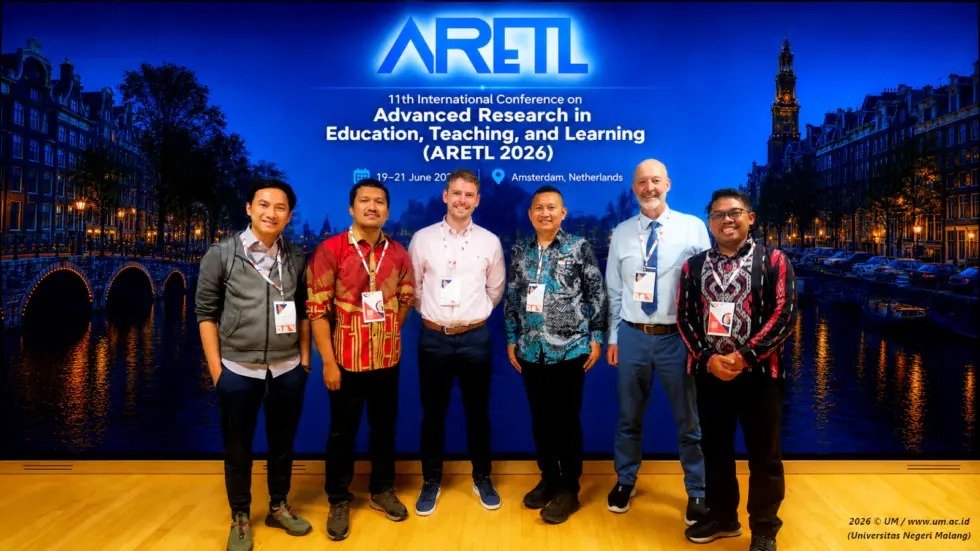
EduAsiaNews, Amsterdam – Universitas Negeri Malang (UM) once again demonstrated its presence on the international academic stage through the participation of two doctoral students from its Educational Technology Doctoral Program, I Gede Purwana Edi Saputra and Rikardus Feribertus Nikat, as oral presenters at the 11th International Conference on Advanced Research in Education, Teaching, and Learning (ARETL) 2026. Held at the University of Amsterdam, the Netherlands, from Friday to Sunday (June 19–21), the conference provided a platform for both scholars to present their Artificial Intelligence (AI)-based research innovations while reinforcing UM’s contribution to the global advancement of educational technology.
The conference brought together academics, researchers, education practitioners, and educational technology developers from countries including Austria, Ireland, Brazil, Canada, Slovakia, Hong Kong, China, Georgia, Lithuania, Türkiye, and Indonesia. The forum focused on educational transformation, learning innovation, digitalization, and the application of Artificial Intelligence to enhance the quality of teaching and learning.
The participation of UM’s two doctoral students represented not only a significant academic achievement but also a meaningful contribution to the advancement of education in Indonesia. Through this international forum, their research received valuable feedback from leading global experts, creating opportunities to accelerate the development of more adaptive, personalized, and learner-centered educational innovations for the digital era.
One of the studies, presented by I Gede Purwana Edi Saputra, was titled “Design and Evaluation of Socratic AI-Based Adaptive Scaffolding to Foster Critical Thinking in Secondary Physics Education in Indonesia.” The research developed an AI-integrated virtual learning environment based on an E-Laboratory platform to support physics education at the secondary school level.
Using a Socratic AI-Based Adaptive Scaffolding approach, the AI system functions not as an instant answer provider but as a learning companion that guides students through reflective and adaptive questioning. The approach is designed to help learners build conceptual understanding while strengthening their critical thinking skills in solving physics-related problems.
Meanwhile, Rikardus Feribertus Nikat presented a study entitled “Artificial Intelligence Perception Acceptance Evaluation Model: Indonesian Students’ Perspective.” The research examines Indonesian students’ perceptions and acceptance of AI in education through the development of an evaluation model that can serve as a reference for schools and universities in implementing AI technologies effectively while remaining student-centered.
Gede explained that the rapid development of AI offers significant opportunities to improve educational quality, provided that the technology continues to complement, rather than replace, the role of teachers.
“Artificial Intelligence is not intended to replace teachers, but to become a partner in delivering more adaptive learning experiences. Through the Socratic approach, students are not given immediate answers; instead, they are guided through questions that encourage them to think critically, analyze problems, and independently construct their understanding,” he said.
He added that the research forms part of his doctoral dissertation in UM’s Educational Technology Doctoral Program, which focuses on developing an E-Laboratory-based virtual learning environment to enhance students’ critical thinking skills, conceptual mastery, and overall learning experience.
During ARETL 2026, Gede and Rikardus also engaged in discussions with academics from various countries on the latest developments in AI-based educational research. These exchanges opened opportunities for future international collaborations aimed at strengthening research quality, expanding publications in reputable international journals, and accelerating the implementation of educational innovations in Indonesia.
For UM’s Educational Technology Doctoral Program, student participation in international scientific forums is a strategic effort to strengthen its research culture, enhance academic competitiveness, and expand partnerships with universities and research institutions worldwide. Such participation not only enriches students’ academic capabilities but also reinforces Universitas Negeri Malang’s reputation as a university committed to producing technology-driven educational innovations.
Concluding the conference, Gede expressed his hope that the research would make a meaningful contribution to Indonesia’s education sector.
“International forums like this provide invaluable opportunities to learn from leading researchers around the world while introducing the innovations we have developed at Universitas Negeri Malang. We hope these innovations will continue to be refined through international collaboration and ultimately make a meaningful contribution to the advancement of education in Indonesia,” he said.
On the occasion, Gede and Rikardus also expressed their appreciation to UM for its International Seminar Assistance Program, which provided financial support for their participation. They described the support as a strategic investment in enhancing research quality, expanding global academic networks, and strengthening UM’s position as a university that actively contributes to scientific advancement and educational innovation at the international level.
The participation of the two doctoral students also aligns with the United Nations Sustainable Development Goals (SDGs), particularly SDG 4 (Quality Education) through the development of technology-based learning innovations, and SDG 17 (Partnerships for the Goals) through strengthened international research collaboration and academic partnerships that foster sustainable educational solutions.