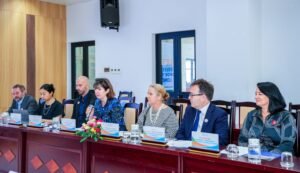





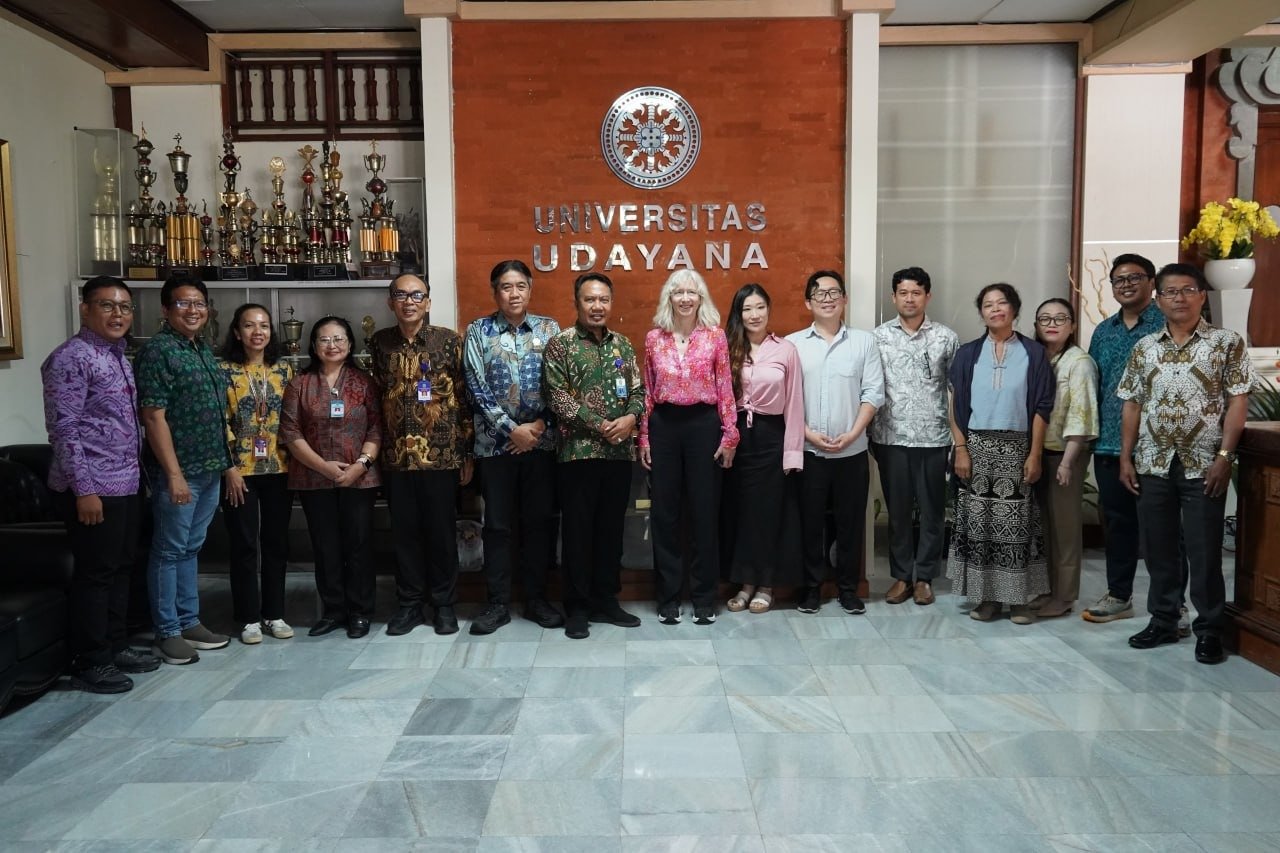
EduAsiaNews, Jimbaran – Udayana University welcomed a delegation from the Natural Capital Alliance at Stanford University, accompanied by representatives from the School of Government and Public Policy (SGPP) Indonesia, at the Language Room on the second floor of the Rectorate Building, Jimbaran Campus, on Wednesday, July 8, 2026. The meeting marked the beginning of discussions on a strategic partnership in mangrove conservation, environmental science, and sustainable development. The program continued with a field visit to the Simbar Segara Mangrove area.
The Stanford University delegation was led by Prof. Gretchen Daily, Co-Founder and Faculty Director of the Natural Capital Alliance, accompanied by Dr. Tong Wu, Dr. Mengye Zhu, and Dr. Fakhrizal Nashr from the School of Government and Public Policy (SGPP) Indonesia.
Also attending the meeting were Udayana University Rector Prof. Ir. I Ketut Sudarsana, S.T., Ph.D., the Vice Rector for Planning, Cooperation, and Information, the Dean of the Faculty of Mathematics and Natural Sciences, the Dean of the Faculty of Marine Science and Fisheries, the Secretary of the Institute for Research and Community Service, the Vice Dean of the Faculty of Agriculture, the Head of the Udayana University SDGs Center, the Coordinator for Cooperation and Public Relations, along with researchers and faculty members.
In his welcoming remarks, Rector Prof. I Ketut Sudarsana expressed his appreciation for the visit by the Stanford University academics and researchers, describing it as an important milestone in strengthening international collaborative networks.
“We are honored to welcome distinguished scientists and experts who have made significant contributions to environmental science, natural capital, and sustainable development. We hope this meeting marks the beginning of a stronger collaboration between Udayana University and Stanford University,” the Rector said.
The Rector explained that, as a comprehensive university, Udayana University is committed to addressing national and global challenges through interdisciplinary research and international collaboration. The university has developed research initiatives in mangrove conservation, coastal ecosystem restoration, climate resilience, sustainable tourism, and marine resource management.
He noted that Bali currently faces a range of environmental challenges resulting from increasing tourism activities, including waste management, infrastructure development, and the preservation of coastal and mangrove ecosystems. In response, Udayana University continues to develop science-based solutions to support the policies of the Bali Provincial Government.
The Rector also highlighted the university’s active research on mangrove mapping and carbon sequestration potential as part of its support for the development of the International Mangrove Center in the Ngurah Rai Grand Forest Park (Tahura Ngurah Rai). In addition, members of the university community regularly conduct community engagement activities through mangrove planting and clean-up campaigns in mangrove areas surrounding the campus.
Furthermore, the Rector emphasized that all academic activities at Udayana University are guided by the philosophy of Tri Hita Karana, which promotes harmony between humanity and God, among people, and with the environment. He noted that these values are closely aligned with the implementation of the Sustainable Development Goals (SDGs), which form an integral part of the university’s commitment to sustainable development.
He also expressed hope that the meeting would create broader opportunities for collaboration, extending beyond research to include student and faculty mobility, human resource capacity building, and other academic programs.
Meanwhile, Prof. Gretchen Daily emphasized that global challenges such as climate change, biodiversity loss, and environmental degradation cannot be addressed by a single institution or academic discipline alone.
According to her, collaboration is essential to generating innovations capable of producing meaningful outcomes for environmental conservation while improving community well-being.
During her presentation, Prof. Daily introduced the concept of Natural Capital, an approach that integrates environmental, social, and economic data into decision-making processes. Through this framework, development policies can better balance economic growth, environmental conservation, and societal well-being.
She also highlighted various applications of the Natural Capital approach that have been implemented in more than 75 countries, including the development of spatial mapping tools to support mangrove conservation, coastal protection, water resource management, food security, and public health improvement.
The meeting marked an important first step toward building a strategic partnership between Udayana University and Stanford University to advance collaborative research, academic exchange, and science-based policymaking in support of mangrove conservation and sustainable development in Bali, Indonesia, and at the global level.