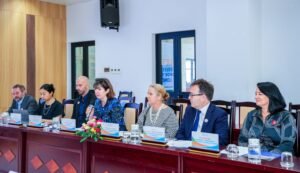





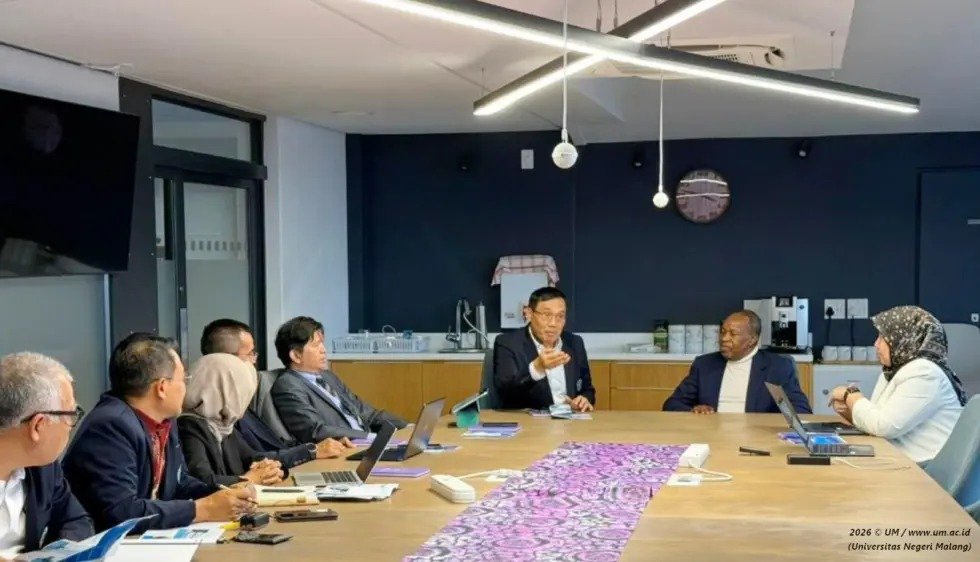
EduAsiaNews, Cape Town – Universitas Negeri Malang (UM) has strengthened its international presence by establishing a strategic partnership with the University of Cape Town (UCT), the top-ranked university in South Africa, and the International Science, Technology and Innovation Centre for South-South Cooperation under the auspices of UNESCO (ISTIC). The meeting, held in Cape Town, South Africa, on Tuesday (June 23), marked a significant step toward expanding academic collaboration, research, and cross-continental innovation to accelerate the achievement of the Sustainable Development Goals (SDGs), while reinforcing UM’s role in science diplomacy and sustainable development at the global level.
This collaboration offers tangible benefits for UM through the expansion of international research networks, enhancement of educational quality, advancement of sustainable technological innovation, and the creation of opportunities for faculty and student exchanges. At the same time, the partnership strengthens Indonesia’s contribution to global science diplomacy through the South-South Cooperation framework.
UM Rector, Prof. Dr. Hariyono, M.Pd., led the delegation, which included Prof. Adi Atmoko, Vice Rector for Finance and General Affairs; Prof. Markus Dinatoro, Vice Rector for Student Affairs and Alumni; Dr. Sari Karmina, Director of the Office of International Affairs; Dr. Abdul Kodir, Vice Dean III of the Faculty of Social Sciences; Prof. Dr. Ir. Andoko, S.T., M.T., Dean of the Faculty of Engineering; Dr. Ir. R. Machmud Sugandi, S.T., M.T., Vice Dean II of the Faculty of Engineering; and Prof. Ir. Rr. Poppy Puspitasari, S.Pd., M.T., Ph.D., Vice Dean III of the Faculty of Engineering.
The ISTIC delegation was led by Professor ChM. Dr. Mohd Basyaruddin Abdul Rahman, Chair of the ISTIC Governing Board, accompanied by Madam Tengku Sharizad Tengku Dahlan, Director of ISTIC, and Mr. Hazman Al-Hafiz Hazal, Assistant Programme Executive. Representing UCT were Prof. Maano Ramutsindela, Prof. Hussein Suleman, Dean of the Faculty of Science, and Prof. Muthama Muasya.
Prof. Maano Ramutsindela warmly welcomed the strengthened partnership, emphasizing that the collaboration among UCT, UM, and ISTIC would create broader research opportunities while generating scientific solutions to address global challenges.
“We see tremendous potential in this collaboration. The synergy between universities and international organizations will enhance the quality of research while delivering meaningful benefits to communities across Asia and Africa,” he said.
The trilateral meeting resulted in several strategic initiatives aligned with the implementation of the Sustainable Development Goals.
In the area of climate change research, the three institutions agreed to collaborate on research addressing climate change as part of the implementation of SDG 13 (Climate Action). The joint research is expected to generate innovative climate adaptation and mitigation solutions that can be applied across developing countries.
In engineering and technology, UM and UCT will strengthen their collaboration in developing environmentally friendly technologies to support SDG 7 (Affordable and Clean Energy). This partnership is expected to produce more efficient clean energy innovations while contributing to the transition toward low-carbon development.
Beyond science and technology, the two institutions also discussed opportunities for collaborative research on the historical relations between Indonesia and South Africa. UCT is currently seeking historians from Indonesia to participate in this initiative. The collaboration forms part of the implementation of SDG 4 (Quality Education) by strengthening education grounded in history, culture, and inclusive global perspectives for students.
As a demonstration of their long-term commitment, the Faculty of Engineering at UM and the Faculty of Science at UCT agreed to review the draft Memorandum of Understanding (MoU) previously submitted by UM’s Faculty of Engineering. This initiative represents the implementation of SDG 17 (Partnerships for the Goals), which serves as the foundation for sustainable collaboration in research, innovation, scientific publications, academic mobility, and community engagement.
Through this strategic partnership, UM continues to reinforce its position as a globally competitive university. Its collaboration with UCT and ISTIC not only expands access to international research ecosystems but also creates opportunities for innovations that deliver tangible benefits to society while accelerating the achievement of the Sustainable Development Goals at both the national and global levels.