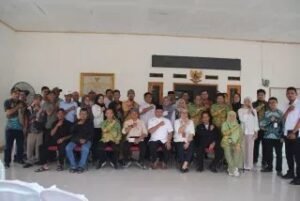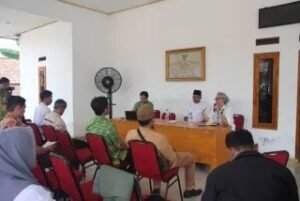





EduAsiaNews, Jakarta — The efforts of the leadership of UPN “Veteran” Jakarta (UPNVJ) to advocate for the welfare of non-civil servant (non-ASN) employees affected by the government’s staff restructuring program have been ongoing for more than a year, at least since mid-2025. This staff restructuring is, in fact, a national government agenda aimed at improving personnel governance within government institutions. All state universities (PTN), with the exception of those holding PTN-BH status, are confronted with the same challenge. By the grace of God, UPNVJ has taken the initiative to address this issue proactively, so that sound human resource governance at UPNVJ may be achieved more swiftly, systematically, effectively, and in an integrated manner with overall civil service management.
Personnel restructuring within government institutions is, in fact, a long-standing program, dating back at least to the enactment of the Civil Service Law (ASN Law) in 2014, subsequently reinforced by various Presidential and Government Regulations that serve as implementation guidelines. In 2023, a new Civil Service Law (No. 20/2023) was enacted, essentially mandating that all personnel within government institutions hold civil servant (ASN) status. The deadline for completing this restructuring was originally set for December 2024; however, the government subsequently granted an extension until December 2025.
As of September 2025, a total of 334 UPNVJ lecturers and administrative staff were required to participate in the Government Employees with Work Agreements (ASN-PPPK) selection process. Of that number, 278 individuals took part in the selection. All participants who chose the ASN-PPPK pathway were passed by the government, as this scheme was specifically designed to fulfil the national target for personnel restructuring within government institutions.
“Those who have transitioned to ASN-PPPK status now hold the rights and obligations broadly equivalent to those of permanent civil servants (ASN-PNS). This is a very positive step for UPNVJ’s human resource management going forward,” said UPNVJ Rector, Prof. Dr. Anter Venus, MA.Comm.
Among the 44 employees who currently retain non-ASN status at UPNVJ, some chose not to transition to PPPK status, others were unable to pass the civil servant candidate (CPNS) examination and therefore became ineligible for PPPK status, while the remainder were prevented from participating in the PPPK selection process due to various administrative, geographical, or health-related constraints at the time — such as being engaged in postgraduate studies, residing abroad or in another city, illness, or other similar circumstances.
UPNVJ remains firmly committed to advocating for these non-ASN lecturers and continues to seek the best possible solutions on their behalf. “Many of them have made UPNVJ their sole place of employment and the institution to which they have dedicated their professional lives as lecturers. Some have even made significant contributions to the advancement of UPNVJ, such as leading accreditation processes and strengthening research centres. They must, therefore, continue to be championed,” Prof. Venus elaborated.
Over the past year, the transition team has engaged in extensive discussions, examining the issue from multiple perspectives — including legal, public policy, ethical, and philosophical-logical dimensions — in pursuit of the most sound and rational resolution. From a legal standpoint, virtually every regulatory dimension has been deliberated with various parties and ministries.
Prof. Venus stated, “We have comprehensively addressed the legal aspects throughout 2025, examining fundamental legal principles through to legal logic. We have discussed the non-retroactivity principle — the rule that regulations cannot be applied retrospectively — as well as the principle of lex superior derogat legi inferior, which holds that a lower regulation ceases to be applicable when a higher regulation provides otherwise. After all of these legal studies were deemed sufficient, we collectively agreed that it is now time to act. No more talking — time for action.”
By the grace of God, the concrete and solution-oriented actions undertaken by the transition team have yielded considerable results. The ‘Professional Staff’ solution has emerged as the primary alternative. This solution addresses, at minimum, the personnel aspects closely tied to UPNVJ’s status as a Public Service Agency (BLU) — a status that provides at least a legitimate legal basis for processing the continuation of their entitlements.
Another effort that has been and continues to be intensively coordinated is the elevation of these professional staff members to the position of lecturer, thereby granting them the status of permanent professional lecturers. This would resolve the professional dimension of their roles as lecturers, which falls under the purview of the Ministry of Higher Education, Science, and Technology. The Ministry itself is actively working towards the best possible solution.
Such efforts, of course, cannot be achieved overnight. Further regulatory consolidation is required to enable the synchronisation of personnel aspects and the professional standing of lecturers to proceed in tandem.
Prof. Anter Venus concluded the discussion on an optimistic note, expressing confidence that the non-ASN lecturer issue will be resolved in due course.
“This is not a straightforward matter, as it involves multiple government agencies and a variety of regulations that must be synchronised. It must therefore be understood in its entirety and comprehensively. However, God willing, the government is genuinely committed to resolving this issue. If the matter at UPNVJ is resolved, then it will be resolved at the national level as well. The solution implemented at UPNVJ can subsequently be replicated at other state universities,” Prof. Venus concluded.(www.upnvj.ac.id)