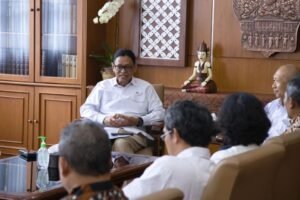





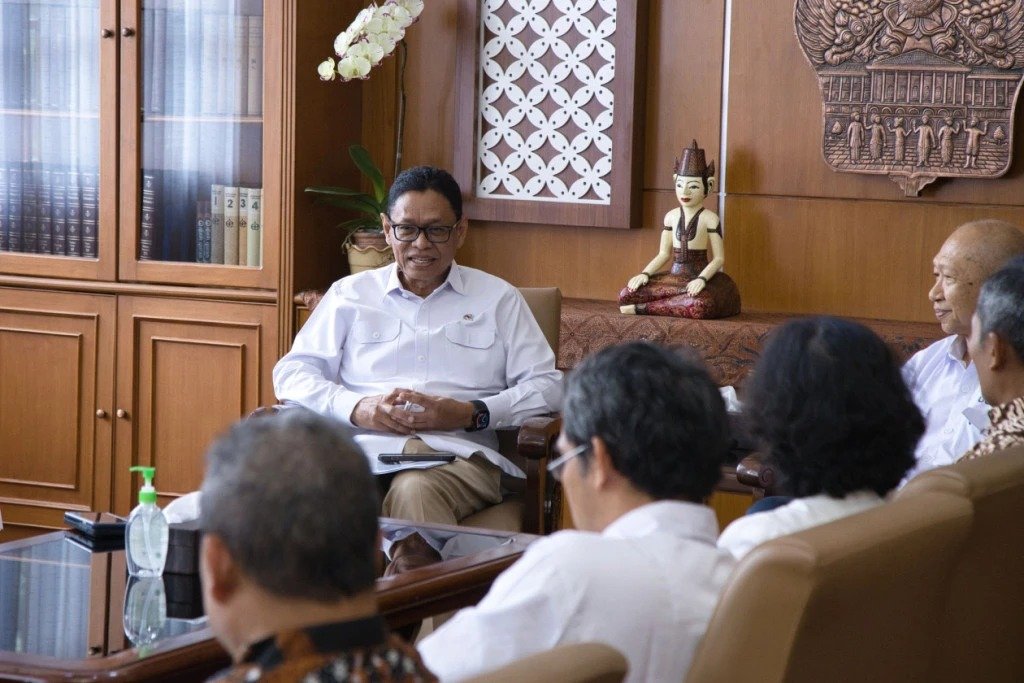
EduAsiaNews, Yogyakarta – Wamen ESDM Yuliot Tanjung said Universitas Gadjah Mada (UGM) has a strong pool of experts and researchers across disciplines who can support the government in addressing various challenges facing Indonesia’s energy sector. He made the remarks during a meeting between the Ministry of Energy and Mineral Resources (ESDM) and UGM’s leadership and academic community on Monday (Aug. 10).
The meeting brought together ESDM officials and UGM experts from a range of fields, including nuclear engineering, geology, geophysics, economics, law, and social sciences. Cross-disciplinary collaboration was seen as essential to developing breakthroughs that can address national energy needs while preparing human resources for the evolving demands of industry.
Yuliot said the meeting was part of an ongoing partnership between the Ministry of ESDM and UGM. One example is the development of an information system for the minerals and coal sector, which is now being used to support licensing processes, the Work Plan and Budget (RKAB), and the management of non-tax state revenue.
“We have already collaborated with colleagues at UGM. One example is the development of an information system, and thankfully, the system is now operational,” Yuliot said.
UGM Board of Trustees (MWA) Chair Prof. Tumiran said universities need to take a long-term view of development challenges so that their education and research can address future needs. He said UGM’s multidisciplinary strengths should be brought together to help formulate development strategies while preparing human resources aligned with industry requirements.
“Our professors also need to be forward-looking and consider the challenges ahead. These challenges must become opportunities for our young people,” Tumiran said.
He said stronger links between universities and the government are needed to ensure that graduates can meet the demands of national development. Energy-sector challenges, he added, cannot be separated from industrial and economic development or from the need for highly skilled human resources.
One of UGM’s key strengths lies in its Center for Energy Studies (PSE), which conducts multidisciplinary research involving researchers from various faculties. PSE Head Prof. Ir. Sarjiya, S.T., M.T., Ph.D., IPU, said the center’s studies cover technical, economic, legal, social, and political aspects.
In the nuclear sector, PSE has previously been tasked with assessing nuclear power plant (NPP) technology options and procurement schemes by bringing together technical and legal expertise.
“When a study requires a multidisciplinary approach—technical, economic, legal, social, and political—we usually handle it because we involve researchers from various faculties,” Sarjiya said.
This capacity is complemented by UGM’s Nuclear Engineering Study Program, which has expertise in various aspects of the peaceful use of nuclear technology. Ir. Dr.-Ing. Kusnanto, a nuclear engineering researcher, said the expertise developed includes safety and security, power plant facilities, technology selection, and techno-economic assessment.
Human-resource readiness is also a key consideration, including the fulfillment of competencies and certifications based on international standards. Beyond technological readiness, he said, public acceptance must also be cultivated from an early stage through communication and outreach.
“Equally important is public outreach. Before the project begins, we ask to be given the opportunity to conduct outreach,” he said.
In terms of site assessment, UGM’s Geological Engineering program has experience in evaluating potential power plant sites and is ready to support NPP site studies through collaboration with geophysics experts. Such studies can involve measurements to depths of up to 200 meters to obtain a more comprehensive picture of subsurface conditions. Social considerations can also be incorporated into site feasibility assessments.
Prof. Ferian Anggara, a Geological Engineering researcher at UGM, said the university’s energy expertise extends beyond nuclear technology. UGM’s Geological Engineering program is also involved in the development of critical minerals and geothermal exploration, including resource mapping and the development of technologies to increase added value.
UGM has also developed technologies for utilizing humic compounds in the mining and plantation sectors, as well as extraction technology for rare earth elements (REE) that has been developed to produce elemental oxides.
These experiences demonstrate UGM’s capacity to connect academic expertise, research, and development needs in the energy and natural resources sectors. With its multidisciplinary strengths, UGM has significant potential to further contribute to Indonesia’s national energy agenda while preparing human resources capable of addressing future development challenges.