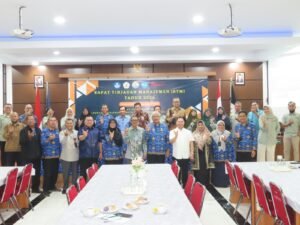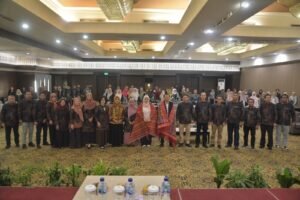





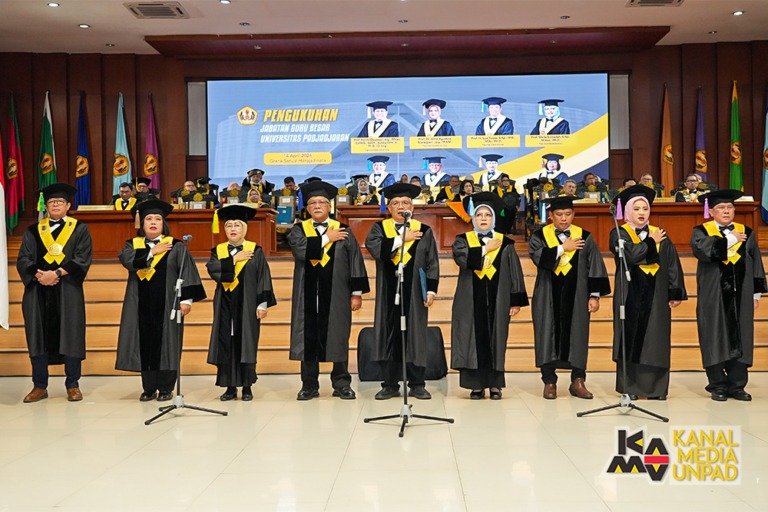
The eight professors come from five faculties at Universitas Padjadjaran. (Photo by Dadan Triawan)
EduAsiaNews, Bandung – Universitas Padjadjaran has officially inaugurated eight new professors from five faculties, namely the Faculty of Dentistry, Faculty of Nursing, Faculty of Social and Political Sciences, Faculty of Communication Sciences, and Faculty of Animal Husbandry. The inauguration ceremony was officially opened by the Rector of Unpad, Prof. Arief S. Kartasasmita, during the Professor Inauguration Ceremony held at Graha Sanusi Hardjadinata, Iwa Koesoemasoemantri Campus, Bandung, on Tuesday, April 14, 2026.
The eight professors inaugurated are Prof. Fahmi Oscandar, dr., M.Kes., SpRKG., SpOF., SubSp OFK (K)., Ph.D. (Cr.Img), Prof. Dr. Anne Agustina Suwargiani, drg., M.KM., Prof. H. Iyus Yosep, S.Kp., M.Si., M.Sc., Ph.D., Prof. Maria Komariah, S.Kp., M.Kes., Ph.D., Prof. Dr. R. Dudy Heryadi, M.Si., Prof. Dr. Herijanto Bekti, M.Si., Prof. Dr. Jenny Ratna Suminar, M.Si., and Prof. Dr. Ir. Lilis Suryaningsih, M.Si.
The ceremony began with opening remarks from the Chair of the Unpad Board of Professors, Prof. Atwar Bajari, followed by the reading of the professors’ curricula vitae by the Secretary of the Board of Professors, Prof. Iman Hernaman.
In his scientific presentation titled “Radioidentification: A New Paradigm in Individual Identification Based on Oral and Cranio-Maxillofacial Radiological Imaging and Forensic Odontology for Strengthening Law Enforcement in Indonesia,” Prof. Fahmi Oscandar, Professor of Forensic Radiology Imaging in Oral and Craniofacial Dentistry, explained that radioidentification represents a new paradigm in individual identification that integrates dental radiology, forensic odontology, and digital technology to improve accuracy and efficiency. This approach utilizes internal structural imaging supported by CBCT and AI to strengthen law enforcement and future identification systems.
“Radioidentification represents a transformation of knowledge that is not only oriented toward technological advancement, but also toward human values in preserving identity, respecting dignity, and providing certainty for individuals,” said Prof. Fahmi.
Meanwhile, Prof. Anne Agustina Suwargiani, Professor in Oral Health Promotion, delivered her scientific presentation titled “Strengthening Oral Health Promotion Approaches Based on Primary Care and Community to Support the Transformation of Oral Health Policy in Indonesia.” She explained that oral health encompasses essential functions as well as psychosocial aspects, yet it remains a major issue in Indonesia due to the high prevalence of dental caries and limited access to services. Therefore, preventive, community-based, and technology-driven health promotion must be strengthened.
“The four main pillars of strengthening oral health promotion are oral health literacy, maternal and early childhood oral health and caries prevention in children, community empowerment in oral health, and the integration of oral health with public health through community service programs (KKN),” Prof. Anne explained.
Prof. Iyus Yosep, Professor of Psychosocial Mental Health Nursing, presented his work titled “Triple-P e-Parenting: A Mental Health Nursing Strategy to Prevent Cyberbullying in Adolescents.” He explained that cyberbullying has become a serious adolescent mental health issue due to increased social media use. Prevention requires a multidisciplinary approach involving family roles, digital literacy, and innovations such as the Triple-P Parenting Program (Positive Parenting Program).
“Triple-P e-Parenting is a mental health nursing innovation that positions the family as the main actor in protecting adolescent mental health. This model consists of three main components: Positive Digital Parenting, Parental Monitoring, and Parental Communication,” he said.
Prof. Maria Komariah, Professor of Basic Nursing, presented her scientific work titled “Reconstruction of Basic Nursing toward Integrative Holistic Nursing in the Digital Era.” She explained that basic nursing is the foundation of the nursing profession, which is holistic and human-centered. Therefore, reconstruction is needed through the integration of human values, digital technology, leadership, and holistic approaches to maintain the quality of care.
“Nursing care rests on a strength that can never be replicated by machines. Maintaining the balance between digital sophistication and the sincerity of care is the essence of the Integrative Holistic Nursing concept,” she stated.
Prof. Dudy Heryadi, Professor of International Relations, presented his work titled “Artificial Intelligence, Unilateralism, and the Crisis of Global Governance: International Cooperation in the Perspective of Critical Global Governance.” He explained that the rapid development of AI alongside rising great-power unilateralism has triggered a crisis in global governance and weakened multilateral cooperation systems.
“The convergence of the global AI race, increasing unilateralism, and the erosion of multilateral institutions creates a potentially explosive combination for global stability. We need a governance framework that ensures these transformative technologies are beneficial,” he said.
Prof. Herijanto Bekti, Professor of Public Administration, delivered a presentation titled “Adaptive Public Leadership in the Context of Digital Governance in Indonesia.” He emphasized that public leadership in the digital era requires adaptive capacity to integrate technology, policy, public participation, and local cultural values into inclusive and sustainable governance.
“The development of digital governance in Indonesia needs to adopt a hybrid approach that combines technological innovation with local wisdom as a source of social legitimacy,” he explained.
Prof. Jenny Ratna Suminar, Professor of Health Communication and Family Communication, presented her work titled “Health Communication: Caring for the Nation’s Life from Sabang to Merauke.” She explained that health communication is a crucial process that shapes individuals’ health behaviors and decisions through social interaction, particularly in the digital era where literacy and trust are essential.
“Health communication builds understanding, fosters trust, and bridges scientific knowledge with community life. It will continue to form a network of knowledge, care, and hope connecting people across Indonesia from Sabang to Merauke,” she said.
Prof. Lilis Suryaningsih, Professor of Meat Processing Technology, presented her scientific paper titled “Enzymatic Potential and Natural Antimicrobials in Marination as a Safe and Sustainable Meat Processing Technology.” She stated that natural meat processing through marination is an effective solution to improve quality, safety, and shelf life while reducing synthetic additives.
“Marination utilizes natural ingredients such as spices, plant extracts, and natural acids to inhibit microbial growth while improving the sensory quality of meat,” she explained.