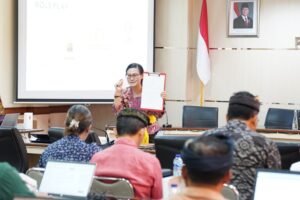





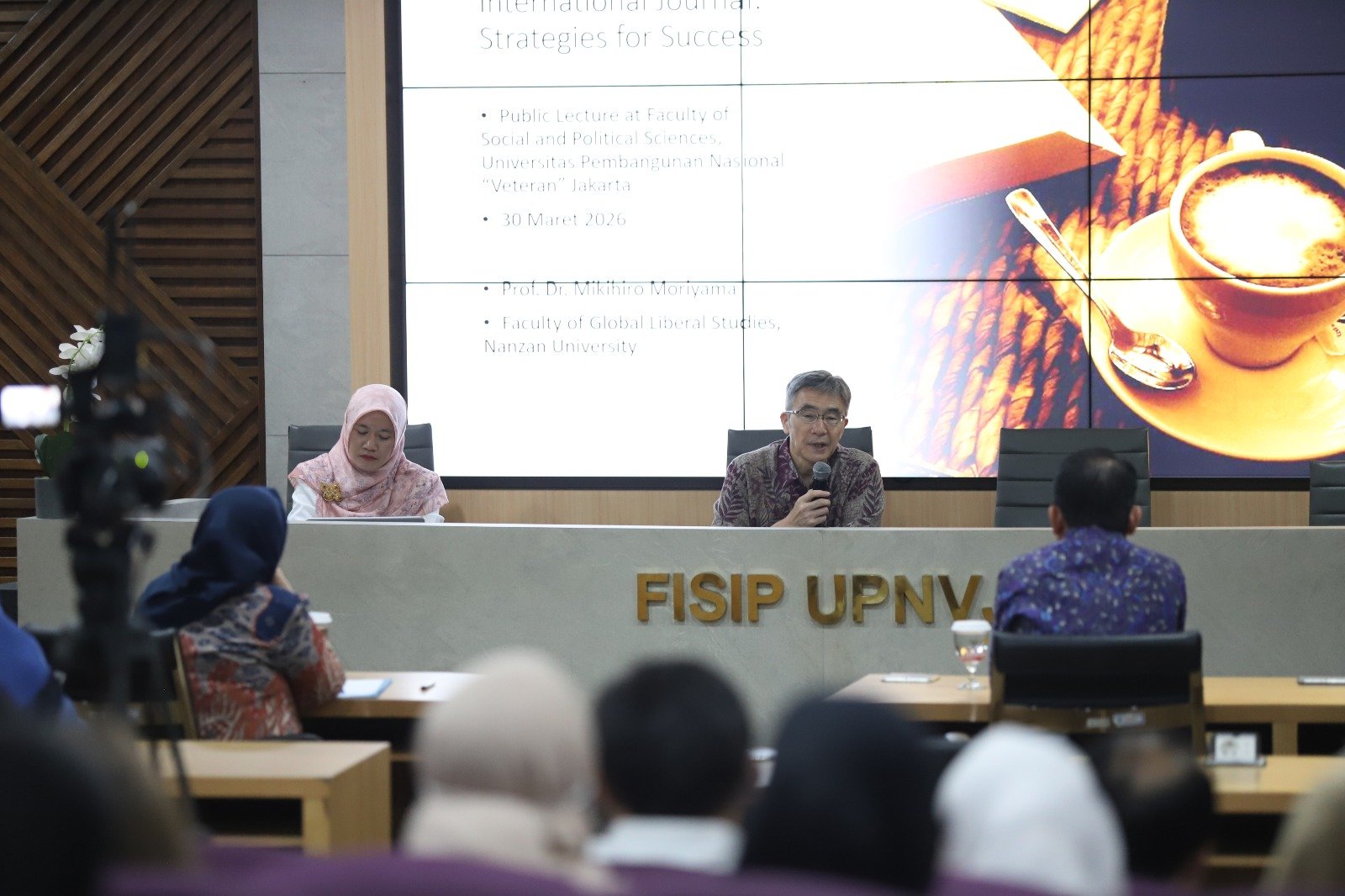
EduAsiaNews, Jakarta – The session during the International Visiting Professor program with Prof. Mikihiro Moriyama, a lecturer and professor at Nanzan University, Nagoya, Japan, was conducted in an interactive atmosphere filled with enthusiasm. The event took place on Monday, March 30, 2026, at the auditorium of the Faculty of Social and Political Sciences (FISIP), UPN “Veteran” Jakarta. Graduate students from various programs—Communication Studies, International Relations, and Political Science—actively posed critical questions concerning research methodology, scientific publication, and the dynamics of the global academic landscape.
One of the participants, Tuti Oktaviani, a Master’s student in Communication Studies, highlighted the challenge of balancing uniqueness (local context) and universality in academic writing. She also inquired about strategies to maintain focus in writing and sought inspiration from the characteristics of Japanese society.
In response, Prof. Moriyama emphasized that the primary key to academic writing lies in the clarity and sharpness of the research question. “What matters most is not the proportion between the local and the universal, but how clearly the research question is formulated,” he explained.
The next question was raised by Fitra Ramadani, a Master’s student in Political Science, who addressed the dilemma of defining a “research problem” when observed social phenomena appear more as processes of societal adaptation. According to Prof. Moriyama, such phenomena remain valid subjects of study as long as they are guided by a clear research question and well-defined objectives.
Meanwhile, Grisel Aranis, a Master’s student in Communication Studies, questioned the influence of co-authorship on publication opportunities. Prof. Moriyama responded by asserting that the quality of content is far more important than the identity of the authors. He also underscored the importance of maintaining academic integrity, including ensuring meaningful contributions from all listed authors and adhering to the blind review process in scholarly publishing.
Another question came from Marwa Ulfa, a Master’s student in Communication Studies, who asked about career prospects as a researcher and the choice of disciplinary focus. Prof. Moriyama advised young researchers to first develop deep expertise in a single discipline before expanding into multidisciplinary approaches.
Marwa also raised the issue of research funding. Prof. Moriyama explained that in Japan, research funding is transparent and available through university allocations as well as research grants, although academia is not primarily oriented toward financial gain.
The final question was delivered by Desi Harjianti, a Master’s student in International Relations, who asked about strategies for determining research novelty. Prof. Moriyama explained that novelty does not solely stem from new findings, but can also arise from methodological innovation, analytical approaches, or clearer and more precise writing styles.
He also reminded participants of the importance of exercising caution in managing research ideas, particularly on sensitive topics such as security and energy, to prevent potential misuse by other parties.
The discussion session, moderated by Dr. Ana Sabhana Azmy, M.I.P., concluded with a summary highlighting that successful scientific publication is determined by several key factors: the clarity of the research question, the strength of data, the novelty of the research approach, proper use of footnotes and references, and the ability to write systematically and concisely.
Through this Q&A session, the International Visiting Professor program served not only as a platform for knowledge transfer but also as a space for academic dialogue that enriches perspectives and enhances the research capacity of both students and faculty at FISIP UPNVJ.(www.upnvj.ac.id)