




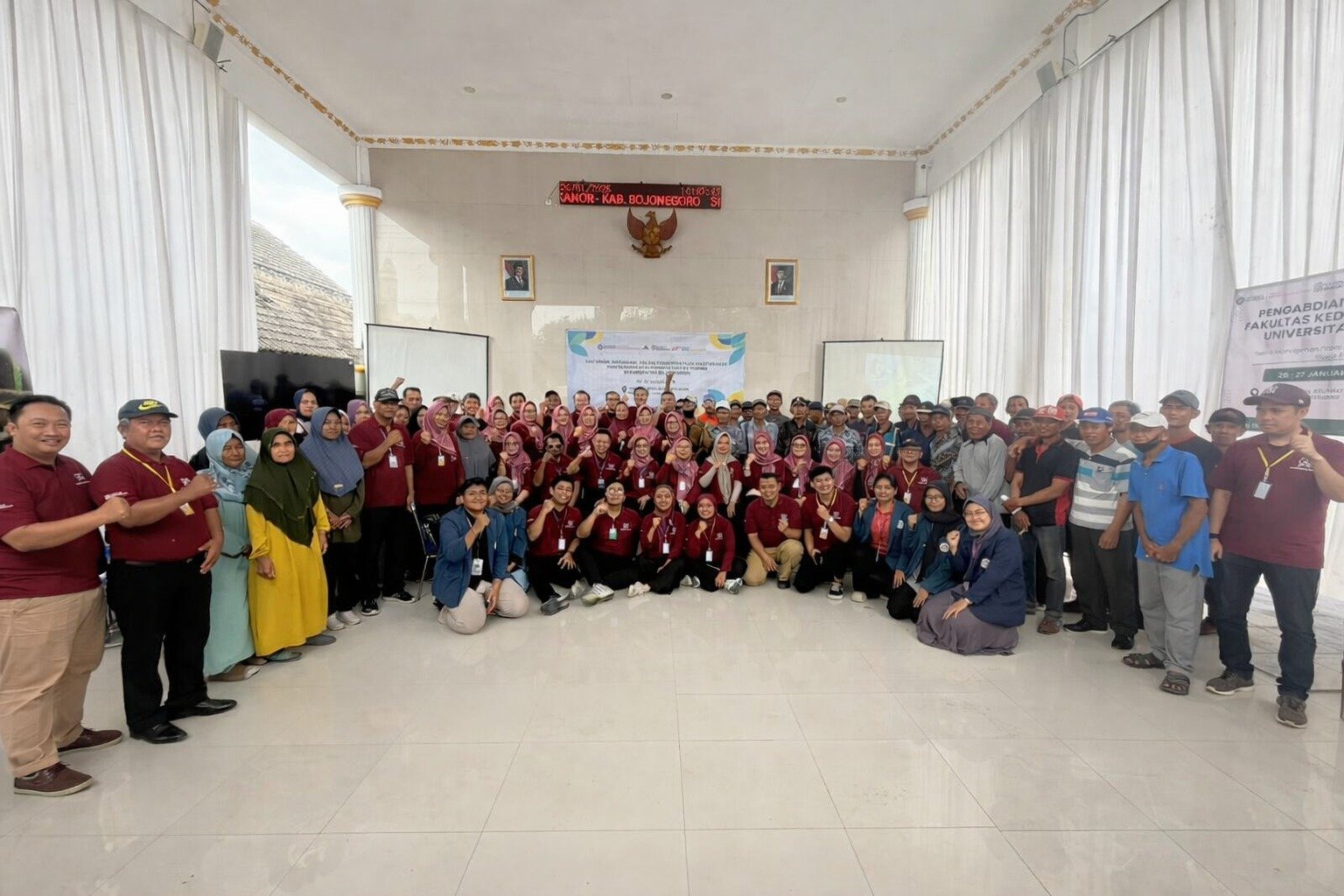
EduAsiaNews,Surabaya – The Faculty of Veterinary Medicine (FKH) of Universitas Airlangga (UNAIR) has once again reaffirmed its commitment to strengthening the livestock sector. This time, FKH UNAIR conducted a Community Service Program (Pengabdian Masyarakat) entitled Assisted Village and Livestock Health in Palembon Village, Kanor Subdistrict, Bojonegoro Regency, on Monday (January 26, 2026).
As part of the program, FKH UNAIR distributed 300 ducks to 20 aid recipients, along with supporting facilities.
The event was attended by the Dean of FKH UNAIR, Prof. Dr. Lilik Maslachah, DVM, M.Kes, along with the faculty leadership, the program coordinator Prof. Dr. Widjiati, DVM, M.Si, and the Secretary of the Bojonegoro Regency Office of Livestock and Fisheries, Ir. Elfia Nuraini, S.Pt., M.P. The presence of these stakeholders underscored the importance of cross-sector collaboration in building a healthy, productive, and sustainable livestock system.
Implementation of the Tri Dharma of Higher Education
In her remarks, the Dean of FKH UNAIR stated that the assisted village program represents a concrete implementation of the Tri Dharma of Higher Education, particularly in the area of sustainable community service. Through continuous mentoring, FKH UNAIR seeks to enhance farmers’ capacity in livestock health management, disease prevention, and the application of biosecurity at the farm level. She also emphasized that the program is expected to generate positive economic impacts for local residents.
“This activity represents the implementation of the Tri Dharma of higher education—not only teaching, but also serving the community in a way that creates real impact. We hope that the distribution of ducks will ensure sustainability and help transform Palembon into a center for duck production. This initiative is also intended to go hand in hand with the economic empowerment of the local community,” Prof. Lilik stated.
Meanwhile, the program coordinator, Prof. Dr. Widjiati, DVM, M.Si, emphasized that the initiative is a long-term program of FKH UNAIR. She explained that the assisted village program will run for the next five years and will continue to be closely supervised by the faculty.
“This program reflects our concern at FKH UNAIR and is carried out in collaboration with the Bojonegoro Regency Government. It is a long-term program spanning five years. We will return in May and July, including to provide stunting-related services for children. We hope to receive feedback from the community to further develop the duck farming initiative,” she said.
A Program with Sustainable Benefits
The Secretary of the Bojonegoro Regency Office of Livestock and Fisheries, Ir. Elfia Nuraini, S.Pt., M.P., expressed her appreciation for the initiative. She noted that the livestock assistance would be highly beneficial to the community, both in terms of education and welfare.
“This is a very meaningful program for us, especially in the livestock sector. Palembon Village is known to have several livestock farms, but duck farming has not yet been developed specifically. We are grateful for and greatly appreciate FKH UNAIR for providing assistance that is not merely short-term, but sustainable. It is truly outstanding,” she remarked.
The series of activities also included livestock health education, animal health examinations, and outreach on disease prevention conducted by experts from FKH UNAIR. Interactive discussions with local farmers were also held. The enthusiasm of the Palembon Village community was evident through their active participation in question-and-answer sessions addressing livestock health issues encountered in the field.
Through the Assisted Village Program, FKH UNAIR hopes to establish an integrated livestock mentoring model that can be replicated in other regions. By strengthening farmers’ capacities and fostering cross-sector support, villages are expected to develop into healthy, productive, and competitive livestock centers.