




EduAsiaNews, Washington DC – Many Indonesian students believe that pursuing doctoral studies in the United States is synonymous with high costs and a long, exhausting period of study. According to Professor Haryadi Gunawi, that assumption is misguided. The Indonesian diaspora scholar who teaches at the University of Chicago emphasized that earning a PhD in the United States can be done without tuition fees—and even with a monthly income.
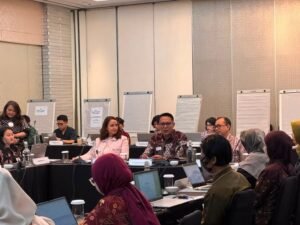
“PhD program? Money is no problem. Preparation is more important,” Haryadi said during a webinar hosted by the Indonesian Embassy in Washington, DC, on Thursday, January 8, 2026. His presentation was titled Garuda ACE: From Open Research Training to a Guide for Securing Master’s and PhD Scholarships at Overseas Universities.
In the online forum attended by around 500 participants from across the globe, Haryadi dissected five common myths surrounding doctoral studies in the United States. The first myth is that PhD graduates inevitably end up as lecturers or professors. In reality, data in the United States show that only about 30 percent of PhD holders pursue academic careers. Around 60 percent enter industry—particularly the technology sector—while the rest choose entrepreneurship. “At Google alone, about 60 percent of its employees hold doctoral degrees,” Haryadi said.
The second myth is that doctoral studies require substantial personal funding. In the United States, PhD students are typically recruited by their supervisors as research assistants or teaching assistants. These positions exempt them from tuition fees while providing a monthly salary.
The notion that pursuing a PhD means “coming home broke” is also unfounded. Especially in Science, Technology, Engineering, and Mathematics (STEM) fields, doctoral students not only receive full tuition waivers but also earn regular income. “Many of them are actually able to save money,” Haryadi explained.
Another misconception is that a doctoral program can only be taken after completing a master’s degree. At many U.S. universities, students can enter a PhD program immediately after earning a bachelor’s degree. What matters is not a master’s diploma, but a strong research track record beginning from the fifth to the eighth semester: participating in research projects, publishing articles in reputable journals with professors, and committing at least 20 hours per week to research activities.
This accelerated pathway is packaged by Haryadi under the Garuda ACE program. Since its pilot phase from 2014 to 2025, involving around 200 Indonesian students, one-third successfully passed the selection process. Of those admitted, 95 percent secured fully funded doctoral scholarships at leading U.S. universities. One of the alumni is Mohammad H. Santiaji, a University of Chicago graduate who moderated the webinar.
The fifth myth concerns the length of doctoral studies, often perceived as tedious and socially stressful—frequently accompanied by the question, “When will you start working?” According to Haryadi, when research becomes a paid profession, the process is far from boring. “You conduct research, you get paid, and you enjoy the journey,” he said.
Students mentored by Haryadi come from a wide range of Indonesian universities, including the University of Indonesia, Bandung Institute of Technology (ITB), Sepuluh Nopember Institute of Technology (ITS), Gadjah Mada University (UGM), as well as private institutions such as Binus University and Amikom. They are now pursuing doctoral studies at top U.S. universities, including the University of Chicago, Purdue University, Johns Hopkins University, New York University, Georgia Institute of Technology, and Carnegie Mellon University.
At the same webinar, Deputy Minister of Higher Education, Science, and Technology Stella Christie introduced the GARUDA Program. The initiative selects outstanding high school students and funds their undergraduate studies at top 100 universities worldwide, particularly in STEM fields. To date, 368 students have been sent abroad, most of them to the United States.
From the outset, GARUDA participants are projected to proceed directly to doctoral programs after completing their bachelor’s degrees. Starting in their fifth semester, they are encouraged to actively engage in faculty research and co-author academic journal articles to prepare for PhD applications through LPDP scholarships or university funding. According to Stella, the program reflects President Prabowo Subianto’s vision to develop a strong pool of STEM experts as Indonesia aims to become a newly industrialized nation by 2045.
Stella also opened opportunities for research collaboration between Indonesian diaspora professionals in the United States and professors at Indonesian universities. With national research funding reaching Rp 3.2 trillion, she invited young Indonesian scientists to participate as research assistants through master’s and doctoral pathways. “Funding is provided by LPDP, with prior recommendations from the ministry,” she said.
Following up on this initiative, Indonesian Ambassador to the United States Indroyono Soesilo pledged to mobilize Indonesian professional diaspora and academics to submit joint research proposals. These projects are expected to serve as platforms for doctoral training for Indonesian graduate students studying in the United States.
The number of Indonesian PhD graduates from U.S. universities remains strikingly low. In 2018 alone, American universities awarded around 55,000 doctoral degrees. More than 6,000 of them went to graduates from China. Indonesia, by contrast, produced only 82 PhD graduates that year—an unmistakable reminder that the path to the world’s research laboratories remains wide open, provided there is preparation, perseverance, and the courage to challenge prevailing myths. (**)