




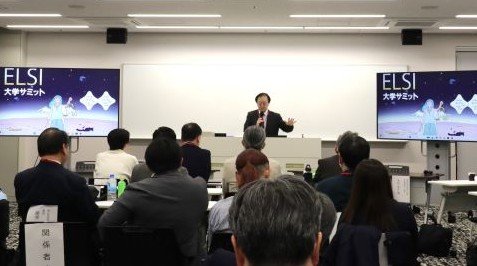
EduAsiaNews, Tokyo — The rapid advancement of artificial intelligence has brought with it a range of ethical, legal, and social challenges. These issues formed the common thread of the University ELSI Summit, a two-day forum recently held at Chuo University’s Korakuen Campus in Tokyo. The event was jointly organized by the Chuo University ELSI Center and The University of Osaka ELSI Center, bringing together hundreds of cross-sector stakeholders.
ELSI—short for Ethical, Legal and Social Issues—along with the Responsible Research and Innovation (RRI) approach, has gained global attention as advanced artificial intelligence is increasingly applied across various fields. At the forum, academics, government officials, industry players, science and engineering researchers, and humanities scholars sat at the same table. Through panel discussions and question-and-answer sessions, they examined their respective roles and the importance of collaboration in addressing the social challenges posed by AI. A total of no fewer than 607 participants took part in the summit, both in person and online.
The discussions opened with keynote addresses by Professor Sudo Osamu, then Director of the Chuo University ELSI Center, and Professor Kishimoto Atsuo, Director of The University of Osaka ELSI Center. Sudo highlighted the phenomenon of the “democratization of AI,” driven by the use of natural language in advanced AI technologies. According to him, the development of multimodal AI and versatile robots will transform vital systems, ranging from disaster management and healthcare to education and national defense. In such a context, the ELSI perspective is becoming increasingly important to ensure that technological progress does not outpace institutional and societal readiness.
Meanwhile, Kishimoto emphasized the importance of what he described as “social technology”—knowledge that bridges the gap between technological innovation and social acceptance. He argued that legal regulation often lags behind the pace of innovation and can even create new divides in unstable societies. For this reason, Kishimoto suggested that ethics will play a more dominant role in the future. He noted that ethical review processes are now being introduced not only in medical research, but also in corporate AI development and university research activities.
In addition to the keynote speeches, the forum featured seven special lectures and 14 general presentations showcasing case studies and future challenges. The Japanese government outlined global AI governance directions through the Hiroshima AI Process, while research institutions and industry players—from NICT to NTT, IBM Japan, and Microsoft Japan—shared practical experiences. From a media perspective, Asahi Shimbun President Tsunoda Katsu reminded participants that journalism in the AI era carries an important responsibility: bridging technical discourse among industry, government, and academia with the broader public interest.