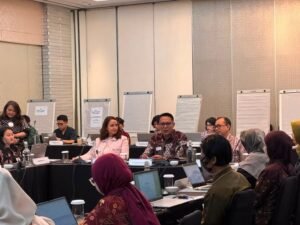





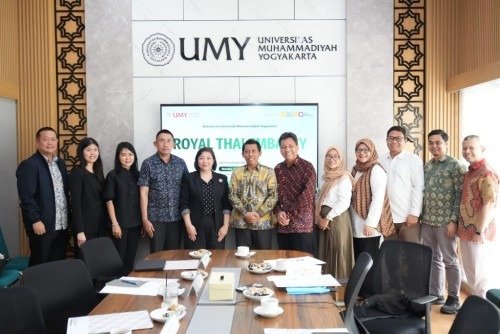
EduNewsAsia, Yogyakarta — In a conference room on the ground floor of the AR Fachruddin A Building, Universitas Muhammadiyah Yogyakarta (UMY) opened a cross-border dialogue. On Monday afternoon, December 15, a delegation from the Royal Thai Embassy in Indonesia sat down with UMY’s leadership to discuss one key word: collaboration.
The meeting was more than a ceremonial visit. Concrete agendas were on the table—strengthening educational cooperation, ranging from scholarship schemes to opportunities for double degree programs. The Thai Embassy delegation was led by Hathaichanok Riddhagni Frumau, Minister and Deputy Chief of Mission of the Royal Thai Embassy in Jakarta. UMY was represented by its Vice Rector for Quality, Reputation, and Global Partnerships, Ir. Slamet Riyadi, Ph.D.
Scholarships became the main topic of discussion. Slamet explained that UMY’s capacity to provide scholarships for international students remains limited. Next year, the university will only be able to offer scholarships to around 60 foreign students from across the globe. This figure appears modest compared to the growing interest from Thai students.
For that reason, UMY encouraged stronger support from the Thai Government, whether through local government schemes or central government programs, to ensure that opportunities to study in Yogyakarta remain accessible for Thai students.
Interestingly, UMY also proposed a more specific and strategic collaboration: a special scholarship scheme for Muslim soldiers from Thailand who wish to pursue master’s degree programs. This scheme is designed as a shared commitment rather than a one-sided responsibility.
“We can share the roles,” Slamet said. He illustrated the idea with a simple example: out of five soldiers pursuing master’s studies, two could be funded by UMY and the remaining three by the Thai Government.
Beyond numbers, the scheme carries a broader purpose. UMY aims to provide Muslim soldiers from Thailand with an academic environment where they can learn about diversity and multi-religious life—values that are deeply embedded in the university’s daily campus experience.
In addition to scholarships, UMY also expressed its interest in developing double degree programs. Slamet hopes the Thai Government will offer regulatory facilitation and policy support, particularly for Indonesian students who wish to undertake part of their studies in Thailand.
The meeting concluded on an optimistic note. For UMY, the audience marked more than a diplomatic exchange; it became an important first step toward building a direct partnership with the Thai Government.
“We highly appreciate this visit,” Slamet said. “Through this meeting, UMY has gained direct access and connections with the Thai Government to strengthen educational collaboration in the future.”
Amid the growing push for internationalization in higher education, the conversation in Yogyakarta signaled one thing: cross-country cooperation is no longer confined to bureaucratic tables, but is increasingly being shaped within university campuses. (*)