




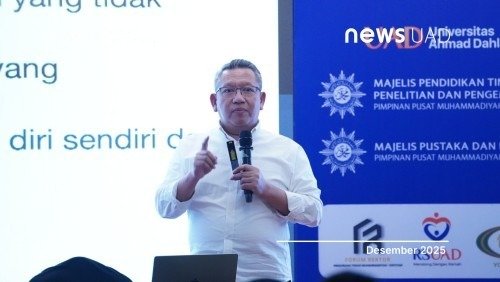
EduAsiaNews, Yogyakarta — Amid the growing dominance of State Universities with Legal Entity Status (PTNBH), private universities (PTS) are being pushed to recalibrate their direction. This message emerged during the first National Coordination Meeting (Rakornas) of Public Relations of Muhammadiyah and ’Aisyiyah Universities (PTMA), held in Yogyakarta on 5–7 December 2025.
In the second session, Professor of the Faculty of Industrial Technology at the Islamic University of Indonesia (UII), Prof. Fathul Wahid, presented strategies for PTS to navigate the “onslaught” of PTNBH. He emphasized that many external factors—state policies, the expansion of PTNBH, and the dynamics of the education market—are beyond the control of PTS. Therefore, he said, private universities must focus on what they can control.
“We cannot change this asymmetrical condition, but we can adapt, collaborate, and strengthen our internal strategies,” he stated.
Prof. Fathul outlined two main approaches to university marketing: ground attack and air attack strategies.
Ground attacks encompass offline activities that have long been the backbone of many campuses, such as high school student visits to campus, education fairs, university visits to schools, one-day student programs, sponsorship of student events, and print advertisements. Efforts to strengthen institutional reputation also include participating in international exhibitions and being active in national and global organizations.
Meanwhile, air attacks rely on digital channels: social media management, Google Display Network, YouTube skip ads, Meta Ads, influencer collaborations, WhatsApp messaging, and developing effective landing pages. Prof. Fathul emphasized that the digital sphere has become the primary arena for interacting with prospective students.
He also highlighted the importance of brand consistency. Branding guidelines, he said, are not merely visual manuals but “rules of the game” that ensure the institution’s identity appears uniformly—ranging from logos and colors to typography and layout across promotional materials. Consistent visuals gradually build public trust.
He reminded the audience that each target segment requires a different approach. Content for prospective students differs from materials for potential partners. Language, visuals, and narratives must be tailored to the needs of each audience group.
On a more sensitive note, Prof. Fathul stressed that university promotion should showcase the institution, not individuals. He conveyed this as an ethical reminder for campus leaders who often want to be prominently featured in publicity materials. “The institution’s identity must remain at the center of public communication,” he said.
According to him, a university’s reputation is not built overnight. It grows through accreditation, partnerships, dual-degree programs, research publications, and achievements in international rankings such as QS and THE.
Concluding his presentation, Prof. Fathul emphasized that university communication strategies must always be grounded in Islamic values. Integrity, honesty, and caution in delivering information must be upheld.
Claims must not be exaggerated, information must not mislead the public, and institutions must not disparage themselves or others. “With these principles, communication strategies become not only effective but also dignified,” he noted.
The PTMA Rakornas serves as an important consolidation forum for PTS, helping them refine their position to remain relevant and competitive amid the strengthening dominance of PTNBH. (*)