




EduAsiaNews, Bandung — People in several parts of western Indonesia witnessed a rare astronomical phenomenon—the occultation of Venus by the Moon—on Monday (September 14, 2026). During the event, Venus gradually disappeared behind the disk of the crescent Moon before reappearing a short while later.
The phenomenon was also observed through the Venus Occultation Observation Livestream organized by Bosscha Observatory, Institut Teknologi Bandung (ITB), from 7:00 to 9:00 p.m. Western Indonesia Time (WIB). The livestream combined observations from Bosscha Observatory with those of several collaborators from different regions of Indonesia and abroad, including Lampung, Bengkulu, Banten, Semarang, Lamongan, Yogyakarta, Medan, Padang, and Bangkok.
An occultation occurs when the Moon moves along its orbit and passes directly between the Earth and Venus from an observer’s perspective. As a result, the Moon temporarily blocks the visible light from Venus as seen from Earth.
The differences in appearance observed from various locations were among the most interesting aspects of the observation.
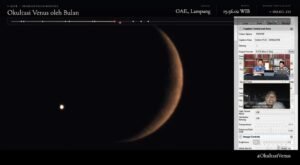
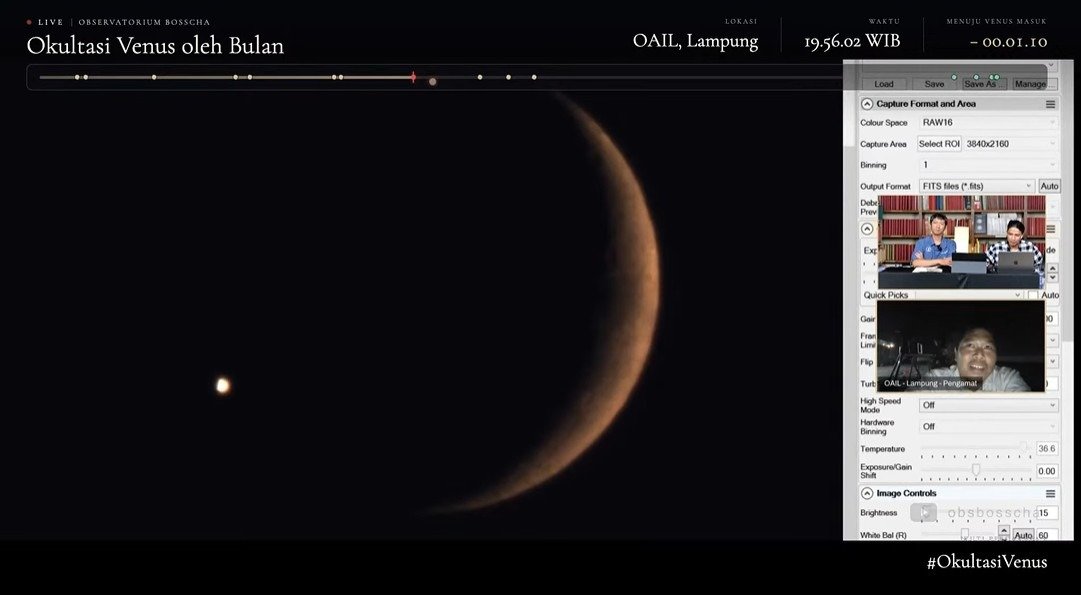
The Astronomical Observatory of the Sumatra Institute of Technology (OAIL ITERA) in Lampung was located within the occultation path. During the livestream, Venus appeared as a bright point of light near the crescent Moon before gradually approaching the Moon’s edge and disappearing behind its disk.
OAIL ITERA observations in Lampung showed Venus as a point of light beside the crescent Moon shortly before the occultation. (Documentation: Screenshot from the Bosscha Observatory Livestream)
Observations from Bosscha Observatory in Lembang, West Java, also showed Venus gradually approaching the Moon. A comparison of observations from the two locations demonstrated that the apparent position of Venus relative to the Moon can differ when viewed from different locations.
Observations from Bosscha Observatory showed Venus gradually approaching the Moon shortly before the occultation. (Documentation: Screenshot from the Bosscha Observatory Livestream)
This difference is related to the fact that the Moon is much closer to Earth than Venus. Consequently, a change in an observer’s position on Earth’s surface can produce a different viewing angle of the relative positions of the two celestial bodies.
“The Moon is closer to Earth than Venus, which is why the apparent positions of the two celestial bodies can differ when observed from different locations,” said Agus T. P. Jatmiko, a researcher at Bosscha Observatory, during the Venus Occultation Observation Livestream.
The differences were clearly reflected in reports from several observation sites. Yogyakarta, for example, was outside the occultation path, so the Moon and Venus only appeared close to each other as part of a conjunction. Meanwhile, observations from Semarang showed conditions approaching a grazing occultation, in which the apparent path of Venus passed very close to the edge of the Moon.
The Venus occultation observed from Cigadung, Cibeunying Kaler District, Bandung, West Java, on Monday (September 14, 2026). (Documentation: Ir. R. Sugeng Joko Sarwono, M.T., Ph.D.)
In general, an occultation occurs in stages. From locations within the occultation path, Venus appears to move increasingly closer to the Moon’s edge before disappearing behind the lunar disk for a period of time. Venus then reappears from the opposite side of the Moon. Differences in location can result in variations in the time of immersion, the duration of the occultation, and the position of Venus when it reappears.
In addition to geographical location, weather conditions are an important factor in successful observations. In Bangkok, Robin from WRWO Space reported cloudy conditions. The Moon was briefly visible for about one minute before being covered by clouds again. In Medan, the OIF UMSU team also faced rain and drizzle, making it difficult to observe the Moon and Venus clearly.
Similar conditions occurred in Padang. Bima from the West Sumatra astronomy community reported dense fog at the observation site, which was located at an elevation of approximately 1,200 meters above sea level, even though the team had prepared a smart telescope for the observation.
“The most important things in an observation are to have the instruments ready, the observers ready, and, finally, good weather,” Agus said.
Observations from Lamongan also demonstrated how atmospheric conditions and instruments can affect observation results. The Moon appeared reddish because it was low near the horizon, while Venus was outside the instrument’s field of view. Based on the occultation-path map shown during the livestream, Lamongan was outside the area experiencing a full occultation.
Through simultaneous observations from multiple locations, Bosscha Observatory demonstrated that the results of an astronomical observation are determined not only by the event taking place in the sky. The observer’s location, the positions of the celestial bodies, the timing of the observation, atmospheric conditions, and the instruments used also determine what can be observed from a particular location.
The collaboration also allowed the public to directly compare how a single astronomical event can appear differently from one location to another. In one area, Venus could disappear behind the Moon; in another, the two celestial bodies merely appeared close together; while elsewhere, the phenomenon was difficult to observe due to clouds, rain, or fog.
The Venus occultation on September 14, 2026, therefore, was not merely an intriguing celestial event to observe, but also provided an opportunity to learn about the geometry of celestial bodies and the importance of observations from multiple locations in developing a more comprehensive understanding of an astronomical event.